




A slab of ice 8 inches in length, 11 inches in breadth, and 2 inches thick was melted and resolidified in the form of a rod of 8 inches diameter. The length of such a rod in inches will be ______ inches.
A) 3
B) 3.5
C) 4
D) 4.5
Answer
 Verified
608.4k+ views
Hint: In this question it is given that a slab of ice 8 inches in length, 11 inches in breadth, and 2 inches thick was melted and resolidified in the form of a rod of 8 inches diameter. We have to find the length of the rod or we can say the height of the cylindrical rod. Since the ice slab resolidified into a rod then same amount of water is there in both of the shapes, so to understand it in better way we have to draw the diagram,
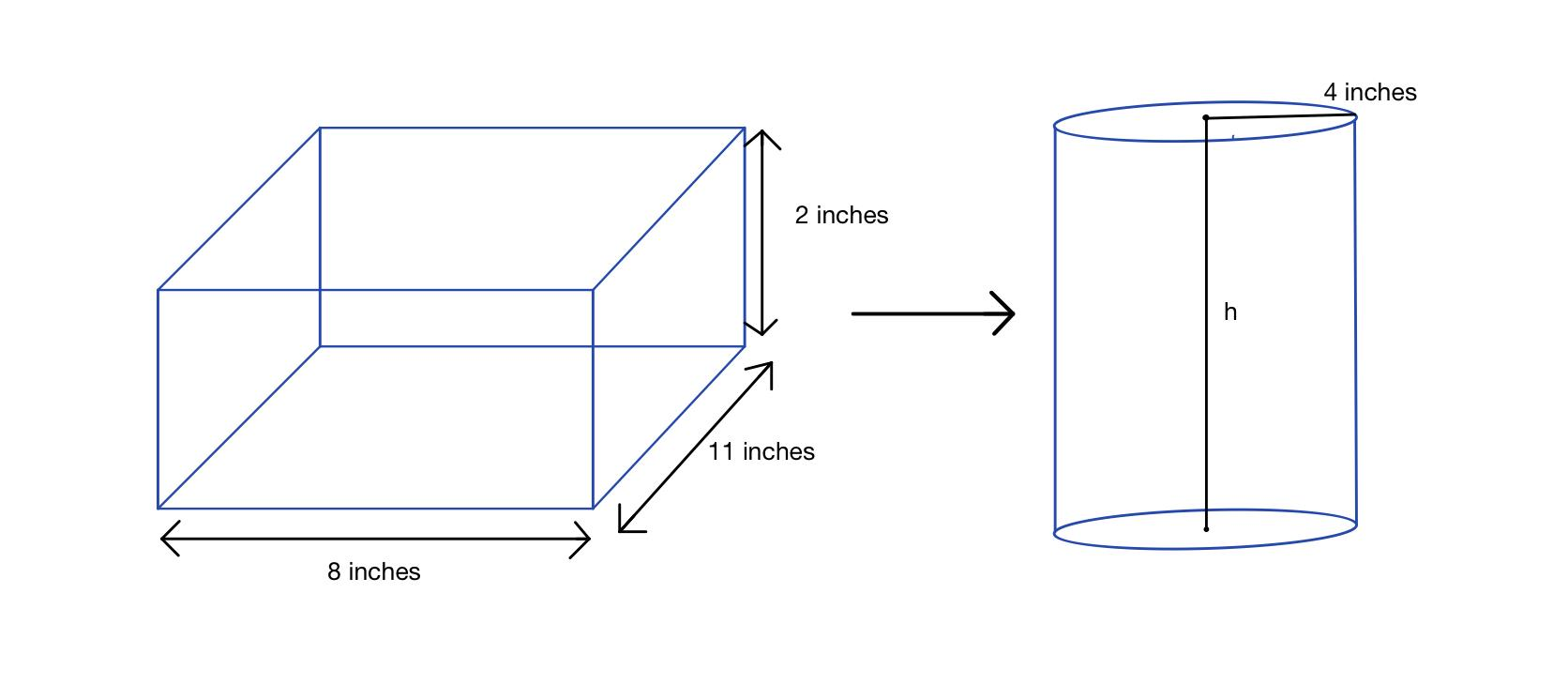
So to find the length(height) of the rod we need to first equate their volume and by solving we will get our desired solution.
i.e, the volume of a slab(cuboid) = volume of rod(cylindrical)
$$\Rightarrow \text{length}\times\text{ breadth}\times\text{ height}\ =\ \pi \left( \text{radius}\right)^{2} \times \text{height}$$..................(1)
Complete step-by-step solution:
It is given that for a ice slab, length = 8 inches, breadth =11 inches and thickness(or height of slab) =2 inches,
Then the volume of this ice slab,
$$V_{1}=\text{length}\times\text{ breadth}\times\text{ height}$$
=$$8\times 11\times 2$$ cubic inches.
=176 cubic inches.
Now for the cylindrical rod, the given diameter is 8 inches,
So, radius =$$\dfrac{\text{dimeter}}{2} =\dfrac{8}{2}$$ inches =4 inches.
And let the length(or height) of the rod be h inches.
Then the volume of this rod,
$$V_{2}=\pi \left( \text{radius}\right)^{2} \times\text{ height}$$
$$V_{2}=\pi \times 4^{2}\times h$$ cubic inches.
Now from the equation (1) we can write,
$$V_{1}=V_{2}$$
$$\Rightarrow 176=\pi \times 4^{2}\times h$$
$$\Rightarrow \pi \times 16\times h=176$$
$$\Rightarrow h=\dfrac{176}{\pi \times 16}$$
$$\Rightarrow h=\dfrac{176}{\left( \dfrac{22}{7} \right) \times 16}$$ [$$\because \pi =\dfrac{22}{7}$$]
$$\Rightarrow h=\dfrac{176\times 7}{22\times 16}$$
$$\Rightarrow h=\dfrac{1232}{352}$$
$$\Rightarrow h=3.5$$
Therefore we can say that the length of the rod is 3.5 inches.
Hence the correct option is option B.
Note: So to solve this you have to know that when you melted one shape and form another shape then the quantity of the material on both the shapes always remains the same and the quantity of material is equivalent to the volume, so in this case you have to equate their volume.
So to find the length(height) of the rod we need to first equate their volume and by solving we will get our desired solution.
i.e, the volume of a slab(cuboid) = volume of rod(cylindrical)
$$\Rightarrow \text{length}\times\text{ breadth}\times\text{ height}\ =\ \pi \left( \text{radius}\right)^{2} \times \text{height}$$..................(1)
Complete step-by-step solution:
It is given that for a ice slab, length = 8 inches, breadth =11 inches and thickness(or height of slab) =2 inches,
Then the volume of this ice slab,
$$V_{1}=\text{length}\times\text{ breadth}\times\text{ height}$$
=$$8\times 11\times 2$$ cubic inches.
=176 cubic inches.
Now for the cylindrical rod, the given diameter is 8 inches,
So, radius =$$\dfrac{\text{dimeter}}{2} =\dfrac{8}{2}$$ inches =4 inches.
And let the length(or height) of the rod be h inches.
Then the volume of this rod,
$$V_{2}=\pi \left( \text{radius}\right)^{2} \times\text{ height}$$
$$V_{2}=\pi \times 4^{2}\times h$$ cubic inches.
Now from the equation (1) we can write,
$$V_{1}=V_{2}$$
$$\Rightarrow 176=\pi \times 4^{2}\times h$$
$$\Rightarrow \pi \times 16\times h=176$$
$$\Rightarrow h=\dfrac{176}{\pi \times 16}$$
$$\Rightarrow h=\dfrac{176}{\left( \dfrac{22}{7} \right) \times 16}$$ [$$\because \pi =\dfrac{22}{7}$$]
$$\Rightarrow h=\dfrac{176\times 7}{22\times 16}$$
$$\Rightarrow h=\dfrac{1232}{352}$$
$$\Rightarrow h=3.5$$
Therefore we can say that the length of the rod is 3.5 inches.
Hence the correct option is option B.
Note: So to solve this you have to know that when you melted one shape and form another shape then the quantity of the material on both the shapes always remains the same and the quantity of material is equivalent to the volume, so in this case you have to equate their volume.
Recently Updated Pages
Master Class 10 Computer Science: Engaging Questions & Answers for Success

Master Class 10 General Knowledge: Engaging Questions & Answers for Success
Master Class 10 English: Engaging Questions & Answers for Success
Master Class 10 Social Science: Engaging Questions & Answers for Success
Master Class 10 Maths: Engaging Questions & Answers for Success
Master Class 10 Science: Engaging Questions & Answers for Success
Trending doubts
What is the median of the first 10 natural numbers class 10 maths CBSE
Which women's tennis player has 24 Grand Slam singles titles?
Who is the Brand Ambassador of Incredible India?
Why is there a time difference of about 5 hours between class 10 social science CBSE
Write a letter to the principal requesting him to grant class 10 english CBSE
A moving boat is observed from the top of a 150 m high class 10 maths CBSE