




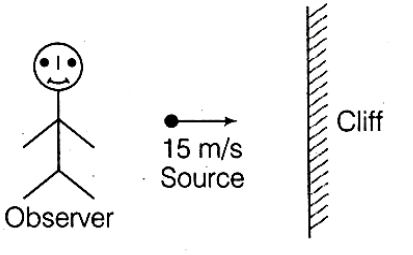
A siren providing a sound of frequency $800Hz$ which is moving away from an observer towards a cliff at a velocity of$15m{{s}^{-1}}$. Then, the frequency of sound the observer will listen in the echo reflected from the cliff is: Take velocity of sound in air =$330m{{s}^{-1}}$
$\begin{align}
& A.765Hz \\
& B.800Hz \\
& C.838Hz \\
& D.885Hz \\
\end{align}$
Answer
 Verified
616.5k+ views
Hint: Doppler Effect is the phenomena taking place in this question. The Doppler Effect is the phenomena in which variation in the frequency of a wave is taking place which is related to an observer who is in motion relative to the wave source. Here the observer is at rest. Therefore the velocity of the observer will be zero.
Complete step by step solution:
The general formula to find the apparent frequency is,
${{f}_{1}}=\dfrac{v\pm {{u}_{0}}}{v\mp {{u}_{s}}}f$
Where${{f}_{1}}$the frequency observer hears,$v$ is the velocity of sound in air,${{u}_{0}}$is the velocity of observer and ${{u}_{s}}$is the velocity with which siren is moving.
As observer is in rest,
\[{{u}_{0}}=0\]
Now substituting the values of the variables mentioned in the question,
\[\begin{align}
& {{u}_{s}}=15m{{s}^{-1}} \\
& v=330m{{s}^{-1}} \\
& f=800Hz \\
\end{align}\]
Substituting this,
\[{{f}_{1}}=\dfrac{330\pm 0}{330\mp 15}800\]
As the source is moving towards the cliff, the source is moving towards the observer in effect.
Therefore we can write that,
${{f}_{1}}=\dfrac{v}{v-{{u}_{s}}}f$
Substituting the values in this equation,
$\begin{align}
& {{f}_{1}}=\dfrac{330}{330-15}800 \\
& {{f}_{1}}=838Hz \\
\end{align}$
Hence the correct answer is C.
Note: The waves emitted by an object which is traveling towards an observer will get compressed, providing a higher frequency as the source is approaching the observer. Doppler Effect is helpful in measuring the speed at which stars and galaxies are approaching or receding from the earth. This mechanism is referred to as a redshift or blueshift. Redshift occurs when light is coming from an object that is moving away is proportional to the wavelength hence shifted to the red end of the spectrum. Blueshift is the opposite to this.
Complete step by step solution:
The general formula to find the apparent frequency is,
${{f}_{1}}=\dfrac{v\pm {{u}_{0}}}{v\mp {{u}_{s}}}f$
Where${{f}_{1}}$the frequency observer hears,$v$ is the velocity of sound in air,${{u}_{0}}$is the velocity of observer and ${{u}_{s}}$is the velocity with which siren is moving.
As observer is in rest,
\[{{u}_{0}}=0\]
Now substituting the values of the variables mentioned in the question,
\[\begin{align}
& {{u}_{s}}=15m{{s}^{-1}} \\
& v=330m{{s}^{-1}} \\
& f=800Hz \\
\end{align}\]
Substituting this,
\[{{f}_{1}}=\dfrac{330\pm 0}{330\mp 15}800\]
As the source is moving towards the cliff, the source is moving towards the observer in effect.
Therefore we can write that,
${{f}_{1}}=\dfrac{v}{v-{{u}_{s}}}f$
Substituting the values in this equation,
$\begin{align}
& {{f}_{1}}=\dfrac{330}{330-15}800 \\
& {{f}_{1}}=838Hz \\
\end{align}$
Hence the correct answer is C.
Note: The waves emitted by an object which is traveling towards an observer will get compressed, providing a higher frequency as the source is approaching the observer. Doppler Effect is helpful in measuring the speed at which stars and galaxies are approaching or receding from the earth. This mechanism is referred to as a redshift or blueshift. Redshift occurs when light is coming from an object that is moving away is proportional to the wavelength hence shifted to the red end of the spectrum. Blueshift is the opposite to this.
Recently Updated Pages
Master Class 11 Social Science: Engaging Questions & Answers for Success

Master Class 11 English: Engaging Questions & Answers for Success
Master Class 11 Maths: Engaging Questions & Answers for Success
Master Class 11 Chemistry: Engaging Questions & Answers for Success
Master Class 11 Biology: Engaging Questions & Answers for Success
Master Class 11 Physics: Engaging Questions & Answers for Success
Trending doubts
Differentiate between an exothermic and an endothermic class 11 chemistry CBSE
One Metric ton is equal to kg A 10000 B 1000 C 100 class 11 physics CBSE
Difference Between Prokaryotic Cells and Eukaryotic Cells
There are 720 permutations of the digits 1 2 3 4 5 class 11 maths CBSE
Two of the body parts which do not appear in MRI are class 11 biology CBSE
Which gas is abundant in air class 11 chemistry CBSE