




A sinusoidal voltage of peak value 283 V and frequency 50 Hz is applied to a series LCR circuit in which\[R=3\Omega \],\[L=25.48\,mH\] and. \[C=786\mu F\]
Find:
a) Impedance of the circuit.
b) The phase difference between the voltage across the source and the current.
c) The power factor.
Answer
 Verified
572.1k+ views
Hint: The impedance of the circuit is the root of the sum of the square of the resistor and the difference between the inductive and the capacitive reactance. The phase difference is the ratio of the difference between the inductive and the capacitive reactance by the resistance. The power factor is the cosine angle of the phase difference.
Formula used:
\[\begin{align}
& Z=\sqrt{{{R}^{2}}+{{({{X}_{L}}-{{X}_{C}})}^{2}}} \\
& \tan \phi =\dfrac{{{X}_{L}}-{{X}_{C}}}{R} \\
& PF=\cos \phi \\
\end{align}\]
Complete answer:
From the given information we have the data as follows.
\[\begin{align}
& V=283\,V \\
& f=50\,Hz \\
& R=3\Omega \\
& L=25.48\,mH=25.48\times {{10}^{-3}}\,H \\
& C=786\mu F=786\times {{10}^{-6}}F \\
\end{align}\]
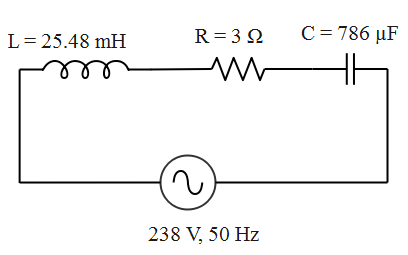
The circuit diagram representing the LCR circuit is,
a) Impedance of the circuit.
\[Z=\sqrt{{{R}^{2}}+{{({{X}_{L}}-{{X}_{C}})}^{2}}}\]
Firstly, we will compute the inductive reactance and the capacitive reactance.
The inductive reactance is given by the formula as follows.
\[\begin{align}
& {{X}_{L}}=\omega L \\
& \Rightarrow {{X}_{L}}=2\pi f\times L \\
& \Rightarrow {{X}_{L}}=2\times 3.14\times 50\times 25.48\times {{10}^{-3}} \\
& \therefore {{X}_{L}}=8\Omega \\
\end{align}\]
The capacitive reactance is given by the formula as follows.
\[\begin{align}
& {{X}_{C}}=\dfrac{1}{\omega C} \\
& \Rightarrow {{X}_{C}}=\dfrac{1}{2\pi f\times C} \\
& \Rightarrow {{X}_{C}}=\dfrac{1}{2\times 3.14\times 50\times 796\times {{10}^{-6}}} \\
& \therefore {{X}_{C}}=4\Omega \\
\end{align}\]
The impedance of the circuit is given by the formula as follows.
\[Z=\sqrt{{{R}^{2}}+{{({{X}_{L}}-{{X}_{C}})}^{2}}}\]
Substitute the values in the above formula
\[\begin{align}
& Z=\sqrt{{{3}^{2}}+{{(8-4)}^{2}}} \\
& \therefore Z=5\,\Omega \\
\end{align}\]
Therefore, the impedance value of the circuit is \[5\Omega \].
b) The phase difference between the voltage across the source and the current.
\[\tan \phi =\dfrac{{{X}_{L}}-{{X}_{C}}}{R}\]
Substitute the values in the above formula
\[\tan \phi =\dfrac{8-4}{3}\]
Continue further computation.
\[\begin{align}
& \tan \phi =\dfrac{4}{3} \\
& \Rightarrow \phi ={{\tan }^{-1}}\dfrac{4}{3} \\
\end{align}\]
Therefore, the value of the phase difference between the voltage across the source and the current is,
\[\phi =53.1{}^\circ \]
c) The power factor.
\[PF=\cos \phi \]
Substitute the values in the above formula
\[\begin{align}
& PF=\cos 53.1{}^\circ \\
& \therefore PF=0.6 \\
\end{align}\]
Therefore, the power factor is 0.6.
\[\therefore \] a) Impedance of the circuit is\[5\Omega \]. The phase difference between the voltage across the source and the current is\[53.1{}^\circ \]. The power factor is 0.6.
Note:
The power factor can also be calculated as the resistance value by the impedance value. As the circuit involves all the 3 components, that is, the resistor, inductor and the capacitor, thus, the resistance and both the reactants should be considered.
Formula used:
\[\begin{align}
& Z=\sqrt{{{R}^{2}}+{{({{X}_{L}}-{{X}_{C}})}^{2}}} \\
& \tan \phi =\dfrac{{{X}_{L}}-{{X}_{C}}}{R} \\
& PF=\cos \phi \\
\end{align}\]
Complete answer:
From the given information we have the data as follows.
\[\begin{align}
& V=283\,V \\
& f=50\,Hz \\
& R=3\Omega \\
& L=25.48\,mH=25.48\times {{10}^{-3}}\,H \\
& C=786\mu F=786\times {{10}^{-6}}F \\
\end{align}\]
The circuit diagram representing the LCR circuit is,
a) Impedance of the circuit.
\[Z=\sqrt{{{R}^{2}}+{{({{X}_{L}}-{{X}_{C}})}^{2}}}\]
Firstly, we will compute the inductive reactance and the capacitive reactance.
The inductive reactance is given by the formula as follows.
\[\begin{align}
& {{X}_{L}}=\omega L \\
& \Rightarrow {{X}_{L}}=2\pi f\times L \\
& \Rightarrow {{X}_{L}}=2\times 3.14\times 50\times 25.48\times {{10}^{-3}} \\
& \therefore {{X}_{L}}=8\Omega \\
\end{align}\]
The capacitive reactance is given by the formula as follows.
\[\begin{align}
& {{X}_{C}}=\dfrac{1}{\omega C} \\
& \Rightarrow {{X}_{C}}=\dfrac{1}{2\pi f\times C} \\
& \Rightarrow {{X}_{C}}=\dfrac{1}{2\times 3.14\times 50\times 796\times {{10}^{-6}}} \\
& \therefore {{X}_{C}}=4\Omega \\
\end{align}\]
The impedance of the circuit is given by the formula as follows.
\[Z=\sqrt{{{R}^{2}}+{{({{X}_{L}}-{{X}_{C}})}^{2}}}\]
Substitute the values in the above formula
\[\begin{align}
& Z=\sqrt{{{3}^{2}}+{{(8-4)}^{2}}} \\
& \therefore Z=5\,\Omega \\
\end{align}\]
Therefore, the impedance value of the circuit is \[5\Omega \].
b) The phase difference between the voltage across the source and the current.
\[\tan \phi =\dfrac{{{X}_{L}}-{{X}_{C}}}{R}\]
Substitute the values in the above formula
\[\tan \phi =\dfrac{8-4}{3}\]
Continue further computation.
\[\begin{align}
& \tan \phi =\dfrac{4}{3} \\
& \Rightarrow \phi ={{\tan }^{-1}}\dfrac{4}{3} \\
\end{align}\]
Therefore, the value of the phase difference between the voltage across the source and the current is,
\[\phi =53.1{}^\circ \]
c) The power factor.
\[PF=\cos \phi \]
Substitute the values in the above formula
\[\begin{align}
& PF=\cos 53.1{}^\circ \\
& \therefore PF=0.6 \\
\end{align}\]
Therefore, the power factor is 0.6.
\[\therefore \] a) Impedance of the circuit is\[5\Omega \]. The phase difference between the voltage across the source and the current is\[53.1{}^\circ \]. The power factor is 0.6.
Note:
The power factor can also be calculated as the resistance value by the impedance value. As the circuit involves all the 3 components, that is, the resistor, inductor and the capacitor, thus, the resistance and both the reactants should be considered.
Recently Updated Pages
Master Class 12 Business Studies: Engaging Questions & Answers for Success

Master Class 12 Chemistry: Engaging Questions & Answers for Success
Master Class 12 Biology: Engaging Questions & Answers for Success
Class 12 Question and Answer - Your Ultimate Solutions Guide
Master Class 11 English: Engaging Questions & Answers for Success
Master Class 11 Social Science: Engaging Questions & Answers for Success
Trending doubts
Which are the Top 10 Largest Countries of the World?
Draw a labelled sketch of the human eye class 12 physics CBSE
Differentiate between homogeneous and heterogeneous class 12 chemistry CBSE
Differentiate between Pyramid of energy and pyramid class 12 biology CBSE
Why is the cell called the structural and functional class 12 biology CBSE
Draw the diagram of the pyramid of energy Explain In class 12 biology CBSE