




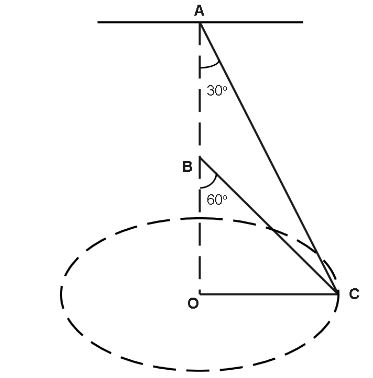
A Single wire \[ABC\] passes through a ring $C$ which revolves a constant speed in the horizontal circle of radius $r$ as shown in the figure. The speed of revolution is.
Answer
 Verified
483.3k+ views
Hint: To solve this question first one must have a concept of Newton’s law of motion. Here we first draw the diagram where we have resolved all the forces and the solved to obtain the equation and the solved for centripetal force and the equated both the equation to get our required solution.
Formula used:
${F_c} = \dfrac{{m{v^2}}}{r}$
Where, ${F_c}$ is the centripetal force, $m$ is the mass, $r$ is the radius and $v$ is the velocity.
Complete step by step answer:
Let us draw the all the forces of acting on the diagram of the given figure,
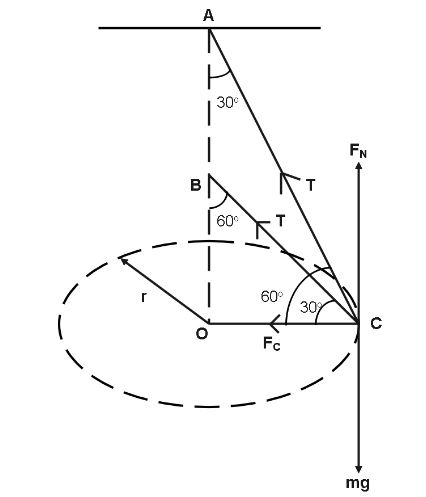
From the figure we can say that,
\[{F_N} = Mg\]
And we can write the above equation as,
$T\sin {30^ \circ } + T\sin {60^ \circ } = mg \\
\Rightarrow \dfrac{T}{2} + \dfrac{{\sqrt 3 }}{2}T = mg $
And on further simplifying we can write,
$ \Rightarrow \dfrac{T}{2} + \dfrac{{\sqrt 3 }}{2}T = mg$
$ \Rightarrow \left( {\sqrt 3 + 1} \right)\dfrac{T}{2} = mg$ -----(1)
And we know that centripetal force is given by,
${F_c} = \dfrac{{m{v^2}}}{r}$
So, we can write as,
\[T\sin {30^ \circ } + T\sin {60^ \circ } = \dfrac{{m{v^2}}}{r} \\
\Rightarrow \dfrac{{\sqrt 3 T}}{2} + \dfrac{T}{2} = \dfrac{{m{v^2}}}{r} \\ \]
On further solving,
\[\Rightarrow \dfrac{{\sqrt 3 T}}{2} + \dfrac{T}{2} = \dfrac{{m{v^2}}}{r} \\
\Rightarrow \left( {\sqrt 3 + 1} \right)\dfrac{T}{2} = \dfrac{{m{v^2}}}{r} \\ \]
And now the final step substituting the value of \[\left( {\sqrt 3 + 1} \right)\dfrac{T}{2}\] from equation 1 in the above obtained equation,
\[\left( {\sqrt 3 + 1} \right)\dfrac{T}{2} = \dfrac{{m{v^2}}}{r} \\
\Rightarrow mg = \dfrac{{m{v^2}}}{r} \\
\Rightarrow {v^2} = rg \\
\therefore v = \sqrt {rg} \\ \]
Hence, the speed of revolution is \[\sqrt {rg} \].
Note: The centripetal force acting on the body should not be confused with the centrifugal force acting on the body. Although both forces are nearly identical, the key distinction is that the centripetal force acts in the direction of the circular path's centre of curvature, whereas the centrifugal force acts in the opposite direction. As a result, students should be aware of the distinction before attempting to solve the problem.
Formula used:
${F_c} = \dfrac{{m{v^2}}}{r}$
Where, ${F_c}$ is the centripetal force, $m$ is the mass, $r$ is the radius and $v$ is the velocity.
Complete step by step answer:
Let us draw the all the forces of acting on the diagram of the given figure,
From the figure we can say that,
\[{F_N} = Mg\]
And we can write the above equation as,
$T\sin {30^ \circ } + T\sin {60^ \circ } = mg \\
\Rightarrow \dfrac{T}{2} + \dfrac{{\sqrt 3 }}{2}T = mg $
And on further simplifying we can write,
$ \Rightarrow \dfrac{T}{2} + \dfrac{{\sqrt 3 }}{2}T = mg$
$ \Rightarrow \left( {\sqrt 3 + 1} \right)\dfrac{T}{2} = mg$ -----(1)
And we know that centripetal force is given by,
${F_c} = \dfrac{{m{v^2}}}{r}$
So, we can write as,
\[T\sin {30^ \circ } + T\sin {60^ \circ } = \dfrac{{m{v^2}}}{r} \\
\Rightarrow \dfrac{{\sqrt 3 T}}{2} + \dfrac{T}{2} = \dfrac{{m{v^2}}}{r} \\ \]
On further solving,
\[\Rightarrow \dfrac{{\sqrt 3 T}}{2} + \dfrac{T}{2} = \dfrac{{m{v^2}}}{r} \\
\Rightarrow \left( {\sqrt 3 + 1} \right)\dfrac{T}{2} = \dfrac{{m{v^2}}}{r} \\ \]
And now the final step substituting the value of \[\left( {\sqrt 3 + 1} \right)\dfrac{T}{2}\] from equation 1 in the above obtained equation,
\[\left( {\sqrt 3 + 1} \right)\dfrac{T}{2} = \dfrac{{m{v^2}}}{r} \\
\Rightarrow mg = \dfrac{{m{v^2}}}{r} \\
\Rightarrow {v^2} = rg \\
\therefore v = \sqrt {rg} \\ \]
Hence, the speed of revolution is \[\sqrt {rg} \].
Note: The centripetal force acting on the body should not be confused with the centrifugal force acting on the body. Although both forces are nearly identical, the key distinction is that the centripetal force acts in the direction of the circular path's centre of curvature, whereas the centrifugal force acts in the opposite direction. As a result, students should be aware of the distinction before attempting to solve the problem.
Recently Updated Pages
Master Class 11 Computer Science: Engaging Questions & Answers for Success

Master Class 11 Business Studies: Engaging Questions & Answers for Success
Master Class 11 Economics: Engaging Questions & Answers for Success
Master Class 11 English: Engaging Questions & Answers for Success
Master Class 11 Maths: Engaging Questions & Answers for Success
Master Class 11 Biology: Engaging Questions & Answers for Success
Trending doubts
One Metric ton is equal to kg A 10000 B 1000 C 100 class 11 physics CBSE
There are 720 permutations of the digits 1 2 3 4 5 class 11 maths CBSE
Discuss the various forms of bacteria class 11 biology CBSE
Draw a diagram of a plant cell and label at least eight class 11 biology CBSE
State the laws of reflection of light
Explain zero factorial class 11 maths CBSE