




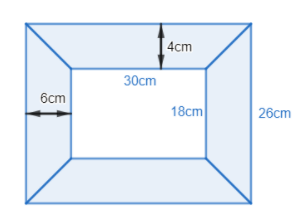
A simple picture frame is made by joining four trapezium shaped strips of wood. Find the area of each trapezium and total area of the frame.
Answer
 Verified
629.7k+ views
Hint: Use the formula that the area of the trapezium is equal to the product of the sum of the parallel sides and the distance between them multiplied by half, i.e., $\dfrac{1}{2}\times \left( \text{sum of parallel sides} \right)\times \left( \text{distance between parallel sides} \right)$ . If you see the figure, there are 2 types of trapezium and each type has 2 of its type. So, find the area of each of two types of trapezium and for finding the total area, add the areas of both the types of the trapeziums and multiply by 2 as 2 trapeziums of each type are present.
Complete step-by-step answer:
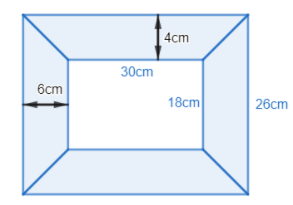
Let us start with the trapezium at the left and right side of the frame. For these trapeziums, the parallel sides have lengths 26cm and 18cm. Also, the distance between the parallel sides is 6cm. We know that the area of the trapezium is:
$\dfrac{1}{2}\times \left( \text{sum of parallel sides} \right)\times \left( \text{distance between parallel sides} \right)$
$=\dfrac{1}{2}\times \left( 26+18 \right)\times 6=44\times 3=132c{{m}^{2}}$
Now let us move to the trapezium at the top and bottom of the frame. For this trapezium the smaller parallel side is 30cm and the larger one will have 30cm extended by 6cm from each side which can be seen in the figure as the height of the left and right trapezium is 6cm. So, the other parallel side is 30+12=42cm. So, area of this trapezium is:
$\dfrac{1}{2}\times \left( \text{sum of parallel sides} \right)\times \left( \text{distance between parallel sides} \right)$
$=\dfrac{1}{2}\times \left( 30+42 \right)\times 4=144c{{m}^{2}}$
Now let us move to find the total area of the frame. For finding the total area, add the areas of both the type of the trapeziums and multiply by 2 as 2 trapeziums of each type are present.
$\text{Total area}=\left( 144+132 \right)\times 2=552c{{m}^{2}}$
Therefore, the total area of the frame is 552 sq cm and that of trapeziums are 144 sq cm, 144 sq cm, 132 sq cm and 132 sq cm.
Note: Be careful in the calculation part and learn all the formulas related to different types of quadrilaterals like kite, parallelogram etc. and be sure that you don’t confuse the area of the trapezium with the formula $\dfrac{1}{2}\times \left( \text{product of diagonals} \right)$ instead of the correct formula $\dfrac{1}{2}\times \left( \text{sum of parallel sides} \right)\times \left( \text{distance between parallel sides} \right)$ .
Complete step-by-step answer:
Let us start with the trapezium at the left and right side of the frame. For these trapeziums, the parallel sides have lengths 26cm and 18cm. Also, the distance between the parallel sides is 6cm. We know that the area of the trapezium is:
$\dfrac{1}{2}\times \left( \text{sum of parallel sides} \right)\times \left( \text{distance between parallel sides} \right)$
$=\dfrac{1}{2}\times \left( 26+18 \right)\times 6=44\times 3=132c{{m}^{2}}$
Now let us move to the trapezium at the top and bottom of the frame. For this trapezium the smaller parallel side is 30cm and the larger one will have 30cm extended by 6cm from each side which can be seen in the figure as the height of the left and right trapezium is 6cm. So, the other parallel side is 30+12=42cm. So, area of this trapezium is:
$\dfrac{1}{2}\times \left( \text{sum of parallel sides} \right)\times \left( \text{distance between parallel sides} \right)$
$=\dfrac{1}{2}\times \left( 30+42 \right)\times 4=144c{{m}^{2}}$
Now let us move to find the total area of the frame. For finding the total area, add the areas of both the type of the trapeziums and multiply by 2 as 2 trapeziums of each type are present.
$\text{Total area}=\left( 144+132 \right)\times 2=552c{{m}^{2}}$
Therefore, the total area of the frame is 552 sq cm and that of trapeziums are 144 sq cm, 144 sq cm, 132 sq cm and 132 sq cm.
Note: Be careful in the calculation part and learn all the formulas related to different types of quadrilaterals like kite, parallelogram etc. and be sure that you don’t confuse the area of the trapezium with the formula $\dfrac{1}{2}\times \left( \text{product of diagonals} \right)$ instead of the correct formula $\dfrac{1}{2}\times \left( \text{sum of parallel sides} \right)\times \left( \text{distance between parallel sides} \right)$ .
Recently Updated Pages
Master Class 12 Economics: Engaging Questions & Answers for Success

Master Class 12 English: Engaging Questions & Answers for Success
Master Class 12 Social Science: Engaging Questions & Answers for Success
Master Class 12 Maths: Engaging Questions & Answers for Success
Master Class 12 Physics: Engaging Questions & Answers for Success
Master Class 9 General Knowledge: Engaging Questions & Answers for Success
Trending doubts
Find the sum of series 1 + 2 + 3 + 4 + 5 + + 100 class 9 maths CBSE
Difference Between Plant Cell and Animal Cell
Fill the blanks with the suitable prepositions 1 The class 9 english CBSE
What is pollution? How many types of pollution? Define it
Name 10 Living and Non living things class 9 biology CBSE
What is the full form of pH?