




A simple pendulum of period T has a metal bob which is negatively charged. If it is allowed to oscillate above a positively charged metal plate its period will be
(A) Remains equal to T
(B) Less than T
(C) Greater than T
(D) Infinite
Answer
 Verified
478.5k+ views
Hint: In order to solve this question, we will use the general formula of time period of a simple pendulum and then we will see the effect of electric field produced due to metal plate and then we will compare both equations of time period of simple pendulum and figure out the new time period relation with initial time period of the pendulum.
Complete answer:
As we know that, if a simple pendulum has a length of l and is placed under the effect of gravity only then, its Time period T is written mathematically as
$ T = 2\pi \sqrt {\dfrac{l}{g}} $ where g is acceleration due to gravity.
Now, if metal bob has a negative charge and there is positively charged metal plate below it, then due to attraction nature between positive and negative charges we will observe that, metal bob of negative charge will tend to attracts downward towards positive metal plate, let ‘E’ be the electric field generate due to positive metal plate and m be the mass of negative charged bob having charge of q then, the acceleration produced on the bob in downward direction as shown in diagram is given by,
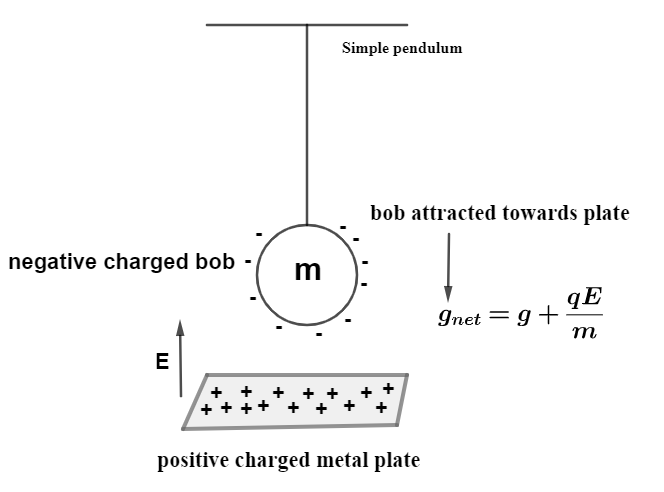
Force due to electric field on bob is $ {F_e} = qE $ accelerated force will be $ F = ma $ where a is acceleration due to electric field and both forces will be equal balancing each other so $ qE = ma $ hence, acceleration will be $ a = \dfrac{{qE}}{m} $ now, bob is affected by net acceleration in downward direction with magnitude of $ {g_{net}} = g + a $ sum of acceleration due to gravity and acceleration due to electric field and due to this net acceleration, new time period of bob will be,
$ T' = 2\pi \sqrt {\dfrac{l}{{{a_{net}}}}} $ on putting the value we get,
$ T' = 2\pi \sqrt {\dfrac{l}{{g + a}}} $
Now, since the denominator factor $ g + a > g $ and time period is inversely proportional to the acceleration which means larger the acceleration, less the time period so we see that,
$ g + a > g $ which means larger the acceleration in case of T’ as compared to that of T, lesser the time period T’ will be as compared to that of T. hence,
$ T' < T $
Hence, the correct option is (B) Less than T.
Note:
It should be remembered that, under the effect of gravity only, the acceleration on the bob of any simple pendulum is always the acceleration due to gravity while neglecting the air drag and all other resistive forces for ease of calculation and the direction of electric field is always from the positive to negative charges.
Complete answer:
As we know that, if a simple pendulum has a length of l and is placed under the effect of gravity only then, its Time period T is written mathematically as
$ T = 2\pi \sqrt {\dfrac{l}{g}} $ where g is acceleration due to gravity.
Now, if metal bob has a negative charge and there is positively charged metal plate below it, then due to attraction nature between positive and negative charges we will observe that, metal bob of negative charge will tend to attracts downward towards positive metal plate, let ‘E’ be the electric field generate due to positive metal plate and m be the mass of negative charged bob having charge of q then, the acceleration produced on the bob in downward direction as shown in diagram is given by,
Force due to electric field on bob is $ {F_e} = qE $ accelerated force will be $ F = ma $ where a is acceleration due to electric field and both forces will be equal balancing each other so $ qE = ma $ hence, acceleration will be $ a = \dfrac{{qE}}{m} $ now, bob is affected by net acceleration in downward direction with magnitude of $ {g_{net}} = g + a $ sum of acceleration due to gravity and acceleration due to electric field and due to this net acceleration, new time period of bob will be,
$ T' = 2\pi \sqrt {\dfrac{l}{{{a_{net}}}}} $ on putting the value we get,
$ T' = 2\pi \sqrt {\dfrac{l}{{g + a}}} $
Now, since the denominator factor $ g + a > g $ and time period is inversely proportional to the acceleration which means larger the acceleration, less the time period so we see that,
$ g + a > g $ which means larger the acceleration in case of T’ as compared to that of T, lesser the time period T’ will be as compared to that of T. hence,
$ T' < T $
Hence, the correct option is (B) Less than T.
Note:
It should be remembered that, under the effect of gravity only, the acceleration on the bob of any simple pendulum is always the acceleration due to gravity while neglecting the air drag and all other resistive forces for ease of calculation and the direction of electric field is always from the positive to negative charges.
Recently Updated Pages
Master Class 11 Computer Science: Engaging Questions & Answers for Success

Master Class 11 Business Studies: Engaging Questions & Answers for Success
Master Class 11 Economics: Engaging Questions & Answers for Success
Master Class 11 English: Engaging Questions & Answers for Success
Master Class 11 Maths: Engaging Questions & Answers for Success
Master Class 11 Biology: Engaging Questions & Answers for Success
Trending doubts
One Metric ton is equal to kg A 10000 B 1000 C 100 class 11 physics CBSE
There are 720 permutations of the digits 1 2 3 4 5 class 11 maths CBSE
Discuss the various forms of bacteria class 11 biology CBSE
Draw a diagram of a plant cell and label at least eight class 11 biology CBSE
State the laws of reflection of light
10 examples of friction in our daily life