




A simple pendulum of length 0.2 m has bob of mass 5 gm, it is pulled aside through an angle ${{60}^{0}}$from the vertical. A spherical body of mass 2.5 gm is placed at the lowest position of the bob. When the bob is released it strikes the spherical body and comes to rest. What is the velocity of the spherical body? (in m/s)
(g=9.8 $m/{{s}^{2}}$)
(A) 1.4
(B) 2.8
(C) 3.5
(D) 4.9
Answer
 Verified
606k+ views
Hint: The length of the pendulum is 0.2 m and the mass of the bob is 5 g. When the pendulum is displaced from its mean position and then it moves to and fro in a simple harmonic motion. Now, the angle made with the vertical is ${{60}^{0}}$and the bob is taken to one of its extreme positions. Also, a body is placed at its mean position and the bob strikes the body. We can make use of law of conservation of energy and law of conservation of momentum.
Complete step by step answer:
Length of pendulum,$l=0.2m$
Mass of the bob,$m=5g$
Mass of the body $m'=2.5g$
Angle made with the vertical,$\theta ={{60}^{0}}$
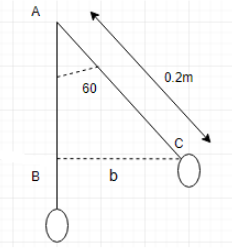
We know potential energy of the bob of a pendulum is given by $mgh$. First of all, find the height of the pendulum at its extreme position.
From triangle $ABC$,
$\Rightarrow \cos 60=\dfrac{b}{0.2}$
$\Rightarrow \dfrac{1}{2}=\dfrac{b}{0.2}$
$\Rightarrow b=0.1$
So, the height of the pendulum is $0.2-0.1=0.1m$
So, when the bob moves and strikes the body its entire potential energy gets converted into kinetic energy of the Body.
$\Rightarrow mgh=\dfrac{m{{v}^{2}}}{2}$
$\Rightarrow 5\times 9.8\times 0.1=\dfrac{5{{v}^{2}}}{2}$
$\Rightarrow {{v}^{2}} = 1.96$
$\Rightarrow v=1.4m/s$
So, the velocity of the bob comes out to be 1.4 m/s. Now we can make use of the law of conservation of momentum.
$\Rightarrow 5\times 1.4=2.5v$
$\therefore v=2.8m/s$
So, the correct option is B.
Note:This is the easiest way to solve this problem. Momentum conservation is a universal law which holds until there are no external force acts on the system. Also, there is no loss of energy taking place in the system. All the units must be in standard SI convention.Had an external force been acting on the system, we would not be able to solve this problem using conservation of linear momentum law. Momentum is a vector quantity because it is the product of mass and velocity and velocity is a vector quantity.
Complete step by step answer:
Length of pendulum,$l=0.2m$
Mass of the bob,$m=5g$
Mass of the body $m'=2.5g$
Angle made with the vertical,$\theta ={{60}^{0}}$
We know potential energy of the bob of a pendulum is given by $mgh$. First of all, find the height of the pendulum at its extreme position.
From triangle $ABC$,
$\Rightarrow \cos 60=\dfrac{b}{0.2}$
$\Rightarrow \dfrac{1}{2}=\dfrac{b}{0.2}$
$\Rightarrow b=0.1$
So, the height of the pendulum is $0.2-0.1=0.1m$
So, when the bob moves and strikes the body its entire potential energy gets converted into kinetic energy of the Body.
$\Rightarrow mgh=\dfrac{m{{v}^{2}}}{2}$
$\Rightarrow 5\times 9.8\times 0.1=\dfrac{5{{v}^{2}}}{2}$
$\Rightarrow {{v}^{2}} = 1.96$
$\Rightarrow v=1.4m/s$
So, the velocity of the bob comes out to be 1.4 m/s. Now we can make use of the law of conservation of momentum.
$\Rightarrow 5\times 1.4=2.5v$
$\therefore v=2.8m/s$
So, the correct option is B.
Note:This is the easiest way to solve this problem. Momentum conservation is a universal law which holds until there are no external force acts on the system. Also, there is no loss of energy taking place in the system. All the units must be in standard SI convention.Had an external force been acting on the system, we would not be able to solve this problem using conservation of linear momentum law. Momentum is a vector quantity because it is the product of mass and velocity and velocity is a vector quantity.
Recently Updated Pages
Basicity of sulphurous acid and sulphuric acid are

Master Class 12 Economics: Engaging Questions & Answers for Success
Master Class 12 Biology: Engaging Questions & Answers for Success
Master Class 11 English: Engaging Questions & Answers for Success
Master Class 11 Physics: Engaging Questions & Answers for Success
Master Class 11 Computer Science: Engaging Questions & Answers for Success
Trending doubts
Draw a diagram of a plant cell and label at least eight class 11 biology CBSE
Proton was discovered by A Thomson B Rutherford C Chadwick class 11 chemistry CBSE
What is the purity of pure gold in carat class 11 chemistry CBSE
Can anyone list 10 advantages and disadvantages of friction
Lysosomes are known as suicidal bags of cell why class 11 biology CBSE
Derive the equation of motion by the calculus method class 11 physics CBSE