




A simple pendulum is of length $50cm$. Find time period and frequency of oscillation.$\left( g=9.8m/{{s}^{2}} \right)$.
A. \[1.38~sec\] , $0.7246Hz$
B. \[2.419sec\],$0.545Hz$
C. \[5.619~sec\],$0.6045Hz$
D. \[1.419~sec\],$0.7045Hz$
Answer
 Verified
591k+ views
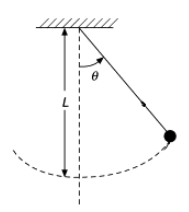
Hint: A simple pendulum is a hypothetical apparatus which consists of a point mass m suspended from a weightless, frictionless thread of constant length l and fixed at a pivotal point P. The motion of the body about the string is periodic when displaced to an initial angle of deviation from the original equilibrium position is small, representing a simple harmonic motion.
Complete step by step answer:
The information given to us:
Length of the simple pendulum,$l=50cm=0.5m$
And acceleration due to gravity, $g=9.8m/{{s}^{2}}$
The time period of a simple pendulum is given by,
$T=2\pi \sqrt{\dfrac{l}{g}}$
Where l is Length of the simple pendulum
And g is the acceleration due to gravity.
Putting the values in the formula, we get
$T=2\pi \sqrt{\dfrac{0.5}{9.8}}$
$\Rightarrow T=2\pi \sqrt{\dfrac{10}{196}}$
\[\Rightarrow T=\dfrac{2\pi }{14}\sqrt{10}\]
\[\Rightarrow T=\dfrac{\pi }{7}\sqrt{10}\]
\[\therefore T=1.419\]
Therefore, Time period of the simple pendulum, \[T=1.419\sec \]
As we know, frequency is the inverse of Time Period, thus we can find out frequency of the pendulum by
$\nu =\dfrac{1}{T}$
Putting the values, we get
$\nu =\dfrac{1}{1.419}$
\[\therefore \nu =0.745Hz\]
Therefore, frequency of the simple pendulum, \[\nu =0.745Hz\]
Hence, the correct option is option (D)\[1.419~sec\], $0.7045Hz$.
Note:
One is advised to convert quantities into their standard units as and when required just like how we have converted few into meters so as to avoid getting an incorrect answer. It is also advised to keep in mind that a simple pendulum is in equilibrium until and unless displaced to an angle, when it swings to and from extreme positions and represents a simple harmonic motion.
Complete step by step answer:
The information given to us:
Length of the simple pendulum,$l=50cm=0.5m$
And acceleration due to gravity, $g=9.8m/{{s}^{2}}$
The time period of a simple pendulum is given by,
$T=2\pi \sqrt{\dfrac{l}{g}}$
Where l is Length of the simple pendulum
And g is the acceleration due to gravity.
Putting the values in the formula, we get
$T=2\pi \sqrt{\dfrac{0.5}{9.8}}$
$\Rightarrow T=2\pi \sqrt{\dfrac{10}{196}}$
\[\Rightarrow T=\dfrac{2\pi }{14}\sqrt{10}\]
\[\Rightarrow T=\dfrac{\pi }{7}\sqrt{10}\]
\[\therefore T=1.419\]
Therefore, Time period of the simple pendulum, \[T=1.419\sec \]
As we know, frequency is the inverse of Time Period, thus we can find out frequency of the pendulum by
$\nu =\dfrac{1}{T}$
Putting the values, we get
$\nu =\dfrac{1}{1.419}$
\[\therefore \nu =0.745Hz\]
Therefore, frequency of the simple pendulum, \[\nu =0.745Hz\]
Hence, the correct option is option (D)\[1.419~sec\], $0.7045Hz$.
Note:
One is advised to convert quantities into their standard units as and when required just like how we have converted few into meters so as to avoid getting an incorrect answer. It is also advised to keep in mind that a simple pendulum is in equilibrium until and unless displaced to an angle, when it swings to and from extreme positions and represents a simple harmonic motion.
Recently Updated Pages
Master Class 11 Social Science: Engaging Questions & Answers for Success

Master Class 11 Physics: Engaging Questions & Answers for Success
Master Class 11 Maths: Engaging Questions & Answers for Success
Master Class 11 Economics: Engaging Questions & Answers for Success
Master Class 11 Computer Science: Engaging Questions & Answers for Success
Master Class 11 Chemistry: Engaging Questions & Answers for Success
Trending doubts
One Metric ton is equal to kg A 10000 B 1000 C 100 class 11 physics CBSE
There are 720 permutations of the digits 1 2 3 4 5 class 11 maths CBSE
1 Quintal is equal to a 110 kg b 10 kg c 100kg d 1000 class 11 physics CBSE
State and prove Bernoullis theorem class 11 physics CBSE
Difference Between Prokaryotic Cells and Eukaryotic Cells
Which among the following are examples of coming together class 11 social science CBSE