




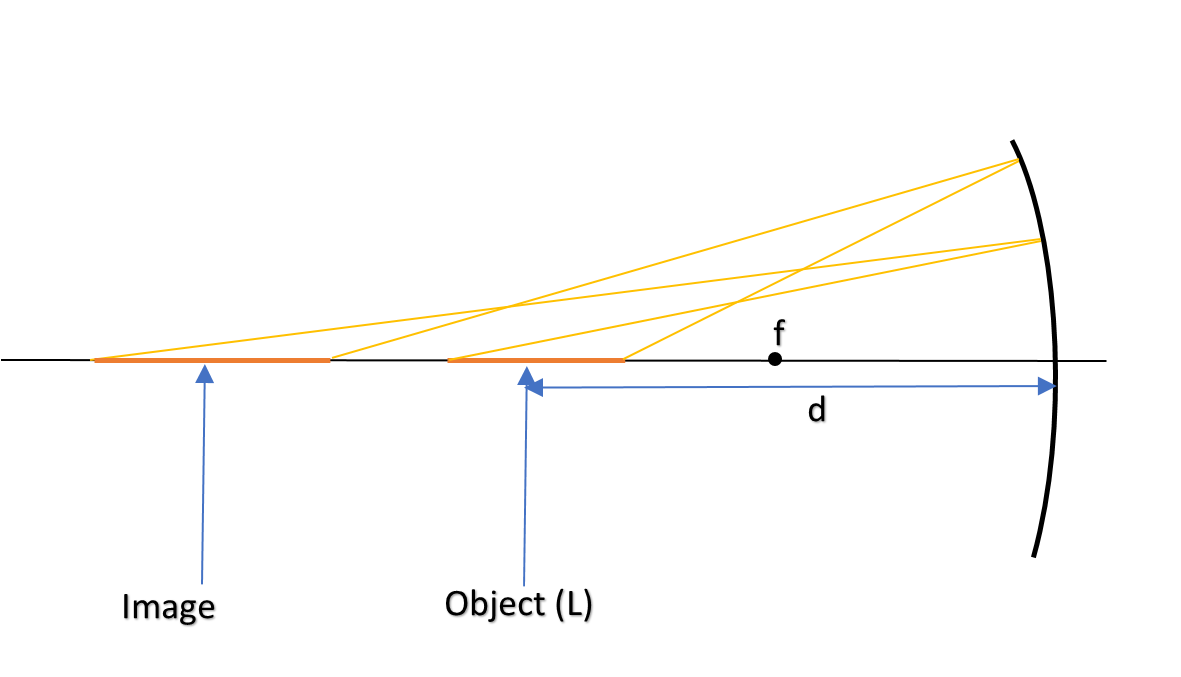
A short linear object, of length l, lies along the axis of a concave mirror, of focal length f, at a distance ‘d’ from the pole of the mirror. The size of the image is then (nearly):
$\text{A.}\quad \dfrac{fl}{d-f}$
$\text{B.}\quad \dfrac{d-f}{fl}$
$\text{C.}\quad \dfrac{(d-f)^2}{f^2}l$
$\text{D.}\quad \dfrac{f^2l}{(d-f)^2}$
Answer
 Verified
597.9k+ views
Hint: As the object is short, we can assume the distance of one end of the object approximately equal to the distance of the other end of the object. Hence we can use differentiation in solving this type of problems.
Formula used:
$\dfrac1f=\dfrac1u+\dfrac1v$
Complete step-by-step answer:
First of all, we shall find the image distance.
Putting the values of f and u with proper sign conventions, we get;
$\dfrac1{-f}=\dfrac1{-d}+\dfrac1v$
$\implies v = \dfrac{df}{f-d}$
Differentiating the mirror formula, we get
$d\left[\dfrac1f=\dfrac1u+\dfrac1v\right]$
$\implies 0 = \dfrac{-1}{u^2}du - \dfrac{1}{v^2}dv$
Now, as per our assumption, $du = l$ and dv = size of image.
Putting the values in the equation:
$\implies 0 = \dfrac{-1}{u^2}du - \dfrac{1}{v^2}dv$
$\implies 0 = \dfrac{-1}{d^2}du - \dfrac{1}{\left( \dfrac{df}{f-d} \right)^2}dv$
$\implies dv = \left(\dfrac{f}{f-d}\right)^2 \times du$
As $du = l$, thus;
$\implies dv = \left(\dfrac{f}{f-d}\right)^2 \times l$
Or $dv = \dfrac{f^2l}{(f-d)^2}$
So, the correct answer is “Option D”.
Additional Information: Magnification of a device is the ability to produce an enlarged image of the object placed in front of it. Hence, mathematically it is the ratio of size of image to the size of the object. A concave mirror can be used to produce both enlarged and diminished images of any object. Also it could be used to produce both real and virtual images of the object.
Note: Here, a negative sign shows that the object is placed to the left of the mirror. Students should practice image formation by different mirrors in several cases. Concave mirror is very useful in many cases. It could be used as a reflector or as a heater. It can form real as well as virtual images of an object. It can also produce enlarged as well as diminished image of an object. Students are highly advised to learn how to use sign conventions in optics problems. Avoiding which could result in the wrong answer every time.
Formula used:
$\dfrac1f=\dfrac1u+\dfrac1v$
Complete step-by-step answer:
First of all, we shall find the image distance.
Putting the values of f and u with proper sign conventions, we get;
$\dfrac1{-f}=\dfrac1{-d}+\dfrac1v$
$\implies v = \dfrac{df}{f-d}$
Differentiating the mirror formula, we get
$d\left[\dfrac1f=\dfrac1u+\dfrac1v\right]$
$\implies 0 = \dfrac{-1}{u^2}du - \dfrac{1}{v^2}dv$
Now, as per our assumption, $du = l$ and dv = size of image.
Putting the values in the equation:
$\implies 0 = \dfrac{-1}{u^2}du - \dfrac{1}{v^2}dv$
$\implies 0 = \dfrac{-1}{d^2}du - \dfrac{1}{\left( \dfrac{df}{f-d} \right)^2}dv$
$\implies dv = \left(\dfrac{f}{f-d}\right)^2 \times du$
As $du = l$, thus;
$\implies dv = \left(\dfrac{f}{f-d}\right)^2 \times l$
Or $dv = \dfrac{f^2l}{(f-d)^2}$
So, the correct answer is “Option D”.
Additional Information: Magnification of a device is the ability to produce an enlarged image of the object placed in front of it. Hence, mathematically it is the ratio of size of image to the size of the object. A concave mirror can be used to produce both enlarged and diminished images of any object. Also it could be used to produce both real and virtual images of the object.
Note: Here, a negative sign shows that the object is placed to the left of the mirror. Students should practice image formation by different mirrors in several cases. Concave mirror is very useful in many cases. It could be used as a reflector or as a heater. It can form real as well as virtual images of an object. It can also produce enlarged as well as diminished image of an object. Students are highly advised to learn how to use sign conventions in optics problems. Avoiding which could result in the wrong answer every time.
Recently Updated Pages
Three beakers labelled as A B and C each containing 25 mL of water were taken A small amount of NaOH anhydrous CuSO4 and NaCl were added to the beakers A B and C respectively It was observed that there was an increase in the temperature of the solutions contained in beakers A and B whereas in case of beaker C the temperature of the solution falls Which one of the following statements isarecorrect i In beakers A and B exothermic process has occurred ii In beakers A and B endothermic process has occurred iii In beaker C exothermic process has occurred iv In beaker C endothermic process has occurred

Master Class 11 Social Science: Engaging Questions & Answers for Success
Master Class 11 Physics: Engaging Questions & Answers for Success
Master Class 11 Maths: Engaging Questions & Answers for Success
Master Class 11 Economics: Engaging Questions & Answers for Success
Master Class 11 Computer Science: Engaging Questions & Answers for Success
Three beakers labelled as A B and C each containing 25 mL of water were taken A small amount of NaOH anhydrous CuSO4 and NaCl were added to the beakers A B and C respectively It was observed that there was an increase in the temperature of the solutions contained in beakers A and B whereas in case of beaker C the temperature of the solution falls Which one of the following statements isarecorrect i In beakers A and B exothermic process has occurred ii In beakers A and B endothermic process has occurred iii In beaker C exothermic process has occurred iv In beaker C endothermic process has occurred
Master Class 11 Social Science: Engaging Questions & Answers for Success
Master Class 11 Physics: Engaging Questions & Answers for Success
Trending doubts
One Metric ton is equal to kg A 10000 B 1000 C 100 class 11 physics CBSE
There are 720 permutations of the digits 1 2 3 4 5 class 11 maths CBSE
State and prove Bernoullis theorem class 11 physics CBSE
Difference Between Prokaryotic Cells and Eukaryotic Cells
1 Quintal is equal to a 110 kg b 10 kg c 100kg d 1000 class 11 physics CBSE
Discuss the various forms of bacteria class 11 biology CBSE