



A shop has only red, green and blue carpets. $ 60\% $ of the carpets have red colour, $ 30\% $ have green colour and $ 50\% $ have blue colour. If no carpet has all three colours, what percentage of the carpets have only one colour?
$
(A)\,35\% \\
(B)\,40\% \\
(C)\,50\% \\
(D)60\% \\
$
Answer
 Verified
619.8k+ views
Hint: First of all we draw three Venn diagrams. One for carpet red, one for carpet green and one for carpet blue. Then we name different regions of the Venn diagram with letters a, b, c, d,…… and so on as many required and then framing equations as per given conditions to solve values of a, b, c, d,….. Or either relation between them to get the required option.
Complete step-by-step answer:
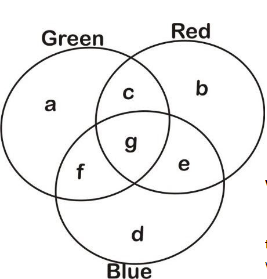
We will solve the given problems with the help of set theory. Here we consider red carpets as set A, blue carpets as set B and carpets green as set C.
As, it is given that there are $ 60\% $ of red carpets.
$
n\,(A) = 60\% \,\,or\,\dfrac{{60}}{{100}} \\
n\,(A) = \dfrac{6}{{10}} \\
$
And $ 30\% $ of carpets are green.
$
\Rightarrow n\,(B) = 30\% = \dfrac{{30}}{{100}} \\
n\,(B) = \dfrac{3}{{10}} \\
$
Also, $ 50\% $ of carpets are blue in colour.
$
\Rightarrow n\,(C) = 50\% \,\,or\,\,\dfrac{{50}}{{100}} \\
\Rightarrow n\,(C) = \dfrac{5}{{10}} \\
$
For set theory whenever there is a problem related to three sets, we always draw a Venn diagram and name different portions with letters a, b, c, d, e and so on as required as shown in figure.
Since, is given in the statement that no carpet has all three colours.
So, from Venn diagram we see that value of (g = 0)
Also, for n (A) we have b + c + e + g
$
\Rightarrow b\, + c\, + \,e + g = \dfrac{6}{{10}} \\
\Rightarrow b + c + e = \dfrac{6}{{10}}\,\,\,\,\,\,\,\,\,\,\,\,\left( {\because g = 0} \right) \\
$
Also, for n (B) we have a + f + c + g
$
\Rightarrow a + f + c + \,g = \dfrac{3}{{10}} \\
\Rightarrow a + \,f\, + \,c = \dfrac{3}{{10}}\,\,\,\,\,\,\,\,\,\,\,\,\,\,\,\,\,\,\,\,\,(\because g = 0) \\
$
Also, for n (C) we have d + f + e + g
$
\Rightarrow d + f + g + e = \dfrac{5}{{10}} \\
\Rightarrow d + f + g = \dfrac{5}{{10}}\,\,\,\,\,\,\,\,\,\,\,\,\,\,\,\,\,\,(\because g = 0) \\
$
Adding, above formed three equations we have
$
b + c + e + a + f + c + d + f + e = \dfrac{6}{{10}} + \dfrac{3}{{10}} + \dfrac{5}{{10}} \\
\Rightarrow a + b + d + 2c + 2f + 2e = \dfrac{{14}}{{10}}.................(i) \\
$
Also, we know that total percentage will always be $ 100\% $ .
Therefore, a + b + c + d + e + f + g = 1
Using g = $ 0 $ above equation becomes
a + b + c + d + e + f = 1…………………….. (i)
Subtracting (ii) from (i) we have
a + b + d + 2c + 2f + 2e – a – b – c – d – e – f = $ \dfrac{{14}}{{10}} - 1 $
$ c + f + e = \dfrac{4}{{10}} $ …………… (iii)
Now, subtracting (iii) from (i) we have
$
a + b + c + d + e + f - c - f - e = 1 - \dfrac{4}{{10}} \\
\Rightarrow a + b + d = \dfrac{6}{{10}} \\
$
Or in percentage we write as
$
a + b + d = \dfrac{6}{{10}} \times 100 \\
\Rightarrow a + b + d = 60\% \\
$
And from the Venn diagram it is very much clear that region a, b and c stands for only red, only green and only blue.
Therefore from above simplification we can say that the percentage of carpets which have only one colour is $ 60\% $ .
Hence, from given four options we see that option (D) is the correct option.
So, the correct answer is “Option D”.
Note: This type of problems can also be solved by using set theory formulas. If we apply a formula method to solve these problems then we have to remember or use a number of formulas which make it difficult as compared to the Venn diagram method. But solving it by using a Venn diagram is more convenient as it doesn't require much formulas and one can understand the solution of the problem very easily.
Complete step-by-step answer:
We will solve the given problems with the help of set theory. Here we consider red carpets as set A, blue carpets as set B and carpets green as set C.
As, it is given that there are $ 60\% $ of red carpets.
$
n\,(A) = 60\% \,\,or\,\dfrac{{60}}{{100}} \\
n\,(A) = \dfrac{6}{{10}} \\
$
And $ 30\% $ of carpets are green.
$
\Rightarrow n\,(B) = 30\% = \dfrac{{30}}{{100}} \\
n\,(B) = \dfrac{3}{{10}} \\
$
Also, $ 50\% $ of carpets are blue in colour.
$
\Rightarrow n\,(C) = 50\% \,\,or\,\,\dfrac{{50}}{{100}} \\
\Rightarrow n\,(C) = \dfrac{5}{{10}} \\
$
For set theory whenever there is a problem related to three sets, we always draw a Venn diagram and name different portions with letters a, b, c, d, e and so on as required as shown in figure.
Since, is given in the statement that no carpet has all three colours.
So, from Venn diagram we see that value of (g = 0)
Also, for n (A) we have b + c + e + g
$
\Rightarrow b\, + c\, + \,e + g = \dfrac{6}{{10}} \\
\Rightarrow b + c + e = \dfrac{6}{{10}}\,\,\,\,\,\,\,\,\,\,\,\,\left( {\because g = 0} \right) \\
$
Also, for n (B) we have a + f + c + g
$
\Rightarrow a + f + c + \,g = \dfrac{3}{{10}} \\
\Rightarrow a + \,f\, + \,c = \dfrac{3}{{10}}\,\,\,\,\,\,\,\,\,\,\,\,\,\,\,\,\,\,\,\,\,(\because g = 0) \\
$
Also, for n (C) we have d + f + e + g
$
\Rightarrow d + f + g + e = \dfrac{5}{{10}} \\
\Rightarrow d + f + g = \dfrac{5}{{10}}\,\,\,\,\,\,\,\,\,\,\,\,\,\,\,\,\,\,(\because g = 0) \\
$
Adding, above formed three equations we have
$
b + c + e + a + f + c + d + f + e = \dfrac{6}{{10}} + \dfrac{3}{{10}} + \dfrac{5}{{10}} \\
\Rightarrow a + b + d + 2c + 2f + 2e = \dfrac{{14}}{{10}}.................(i) \\
$
Also, we know that total percentage will always be $ 100\% $ .
Therefore, a + b + c + d + e + f + g = 1
Using g = $ 0 $ above equation becomes
a + b + c + d + e + f = 1…………………….. (i)
Subtracting (ii) from (i) we have
a + b + d + 2c + 2f + 2e – a – b – c – d – e – f = $ \dfrac{{14}}{{10}} - 1 $
$ c + f + e = \dfrac{4}{{10}} $ …………… (iii)
Now, subtracting (iii) from (i) we have
$
a + b + c + d + e + f - c - f - e = 1 - \dfrac{4}{{10}} \\
\Rightarrow a + b + d = \dfrac{6}{{10}} \\
$
Or in percentage we write as
$
a + b + d = \dfrac{6}{{10}} \times 100 \\
\Rightarrow a + b + d = 60\% \\
$
And from the Venn diagram it is very much clear that region a, b and c stands for only red, only green and only blue.
Therefore from above simplification we can say that the percentage of carpets which have only one colour is $ 60\% $ .
Hence, from given four options we see that option (D) is the correct option.
So, the correct answer is “Option D”.
Note: This type of problems can also be solved by using set theory formulas. If we apply a formula method to solve these problems then we have to remember or use a number of formulas which make it difficult as compared to the Venn diagram method. But solving it by using a Venn diagram is more convenient as it doesn't require much formulas and one can understand the solution of the problem very easily.
Recently Updated Pages
Master Class 11 English: Engaging Questions & Answers for Success

Master Class 11 Social Science: Engaging Questions & Answers for Success
Master Class 11 Maths: Engaging Questions & Answers for Success
Master Class 11 Biology: Engaging Questions & Answers for Success
Master Class 11 Physics: Engaging Questions & Answers for Success
Master Class 11 Chemistry: Engaging Questions & Answers for Success
Trending doubts