




A ship is travelling due east at 10km/h. A ship heading 30$^\circ $ east of north is always due north from the first ship. The speed of the second ship in km/h is:
$
{\text{A}}{\text{. }}20\sqrt 2 \\
{\text{B}}{\text{. 20}}\sqrt {\dfrac{3}{2}} \\
{\text{C}}{\text{. 20}} \\
{\text{D}}{\text{. }}\dfrac{{20}}{{\sqrt 2 }} \\
$
Answer
 Verified
680.4k+ views
Hint: A vector can be resolved into its components. This problem can be solved by resolving components of the velocities of the two ships. Equating components wherever possible may give us the required answer.
Step by step solution:
We have ship 1 travelling in the east direction with a speed of 10km/h.
${{\text{v}}_1} = 10km/h$
The ship 2 is travelling at an angle of 30$^\circ $ east of north direction with speed ${{\text{v}}_2}$. We need to find the velocity of the second ship with the available information. We can diagrammatically represent the situation as follows:
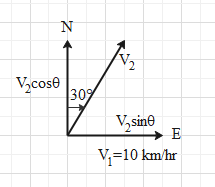
Here we have resolved the velocity ${{\text{v}}_2}$ into its components ${{\text{v}}_2}\sin \theta $ and ${{\text{v}}_2}\cos \theta $ where $\theta = 30^\circ $.
We see that component ${{\text{v}}_2}\sin \theta $ coincides with ${{\text{v}}_1}$ which means that they must be equal to each other. So, we can write
$
{{\text{v}}_2}\sin \theta = {{\text{v}}_1} \\
\Rightarrow {{\text{v}}_2} = \dfrac{{{{\text{v}}_1}}}{{\sin \theta }} \\
$
Putting the known values, we get
${{\text{v}}_2} = \dfrac{{10}}{{\sin 30^\circ }} = 10 \times 2 = 20km/h$
This is the required value and the correct answer is option C.
Additional information:
The magnitude of a vector can be calculated from its components using the Pythagoras theorem. If a vector V has components ${{\text{v}}_x}$ and ${{\text{v}}_y}$ then magnitude of vector V is given by the following expression:
${\text{V}} = \sqrt {{\text{v}}_x^2 + {\text{v}}_y^2} $
We can also resolve components of a vector in 3 dimensions. In case of 3-dimensional representation, the components of V would be ${{\text{v}}_x}$, ${{\text{v}}_y}$ and ${{\text{v}}_z}$. The magnitude of V in this case is given by modified Pythagorean Theorem as the following expression:
${\text{V}} = \sqrt {{\text{v}}_x^2 + {\text{v}}_y^2 + {\text{v}}_z^2} $
Note: The components of a vector are constructed using trigonometric identities which satisfy the Pythagorean Theorem for the magnitude of the vector. The components signify the directions in which a part of the main vector can be distributed and we designate those directions to be along the coordinate axes.
Step by step solution:
We have ship 1 travelling in the east direction with a speed of 10km/h.
${{\text{v}}_1} = 10km/h$
The ship 2 is travelling at an angle of 30$^\circ $ east of north direction with speed ${{\text{v}}_2}$. We need to find the velocity of the second ship with the available information. We can diagrammatically represent the situation as follows:
Here we have resolved the velocity ${{\text{v}}_2}$ into its components ${{\text{v}}_2}\sin \theta $ and ${{\text{v}}_2}\cos \theta $ where $\theta = 30^\circ $.
We see that component ${{\text{v}}_2}\sin \theta $ coincides with ${{\text{v}}_1}$ which means that they must be equal to each other. So, we can write
$
{{\text{v}}_2}\sin \theta = {{\text{v}}_1} \\
\Rightarrow {{\text{v}}_2} = \dfrac{{{{\text{v}}_1}}}{{\sin \theta }} \\
$
Putting the known values, we get
${{\text{v}}_2} = \dfrac{{10}}{{\sin 30^\circ }} = 10 \times 2 = 20km/h$
This is the required value and the correct answer is option C.
Additional information:
The magnitude of a vector can be calculated from its components using the Pythagoras theorem. If a vector V has components ${{\text{v}}_x}$ and ${{\text{v}}_y}$ then magnitude of vector V is given by the following expression:
${\text{V}} = \sqrt {{\text{v}}_x^2 + {\text{v}}_y^2} $
We can also resolve components of a vector in 3 dimensions. In case of 3-dimensional representation, the components of V would be ${{\text{v}}_x}$, ${{\text{v}}_y}$ and ${{\text{v}}_z}$. The magnitude of V in this case is given by modified Pythagorean Theorem as the following expression:
${\text{V}} = \sqrt {{\text{v}}_x^2 + {\text{v}}_y^2 + {\text{v}}_z^2} $
Note: The components of a vector are constructed using trigonometric identities which satisfy the Pythagorean Theorem for the magnitude of the vector. The components signify the directions in which a part of the main vector can be distributed and we designate those directions to be along the coordinate axes.
Recently Updated Pages
Which will be the least stable resonating structure class 11 chemistry CBSE

How many 5 digit telephone numbers can be construc-class-11-maths-CBSE
How do you find the angle of the resultant vector class 11 physics CBSE
Draw labelled diagram of the following i Gram seed class 11 biology CBSE
1 Quintal is equal to a 110 kg b 10 kg c 100kg d 1000 class 11 physics CBSE
What is the need and importance of classification class 11 biology CBSE
Trending doubts
Find the value of the expression given below sin 30circ class 11 maths CBSE
One Metric ton is equal to kg A 10000 B 1000 C 100 class 11 physics CBSE
10 examples of friction in our daily life
Draw a diagram of a plant cell and label at least eight class 11 biology CBSE
Difference between physical and chemical change class 11 chemistry CBSE
Proton was discovered by A Thomson B Rutherford C Chadwick class 11 chemistry CBSE