




A series LCR circuit containing a resistance of \[120\Omega \] has angular frequency \[4\times {{10}^{5}}rad{{s}^{-1}}\]. At resonance the voltage across resistance and inductance are 60V and 40V respectively. The angular frequency at which the current in the circuit lags the voltage by \[\dfrac{\pi }{4}\] is –
\[\begin{align}
& \text{A) 2}\times {{10}^{5}}rad{{s}^{-1}} \\
& \text{B) 6}\times {{10}^{5}}rad{{s}^{-1}} \\
& \text{C) 8}\times {{10}^{5}}rad{{s}^{-1}} \\
& \text{D) 10}\times {{10}^{5}}rad{{s}^{-1}} \\
\end{align}\]
Answer
 Verified
609.6k+ views
Hint: We need to find the relation between the resistance involved in the series LCR circuit and the resonance condition. The resonance conditions for voltage across the resistor and inductor can be used to solve this problem easily.
Complete answer:
We are given a series LCR circuit which includes a resistor, a capacitor and an inductor.
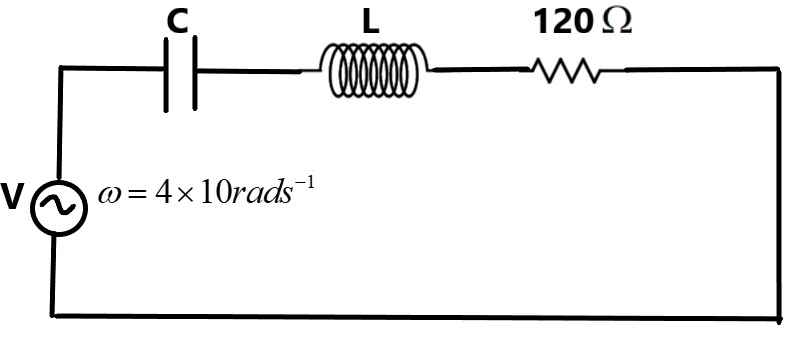
It is said that at the resonance condition a voltage drop of 60 V is measured across the resistor and 40V across the inductor. We know that in a LCR, during the resonance the complete voltage drop is across the resistor. The voltage drops across the inductor and the capacitor cancels off. So –
\[\begin{align}
& {{V}_{R}}=60V \\
& {{V}_{L}}=40V \\
& {{V}_{C}}=-40V \\
\end{align}\]
From this and the resistance value, we can find the current in the circuit as –
\[\begin{align}
& I=\dfrac{{{V}_{R}}}{R} \\
& \Rightarrow I=\dfrac{60}{120} \\
& \therefore I=0.5A \\
\end{align}\]
Now, we can find the capacitive reactance and the inductive reactance using this current as –
\[\begin{align}
& {{X}_{L}}=\omega L \\
& \text{but,} \\
& {{X}_{L}}=\dfrac{{{V}_{L}}}{I} \\
& \Rightarrow {{X}_{L}}=\dfrac{{{V}_{L}}}{I}=\omega L \\
\end{align}\]
\[\Rightarrow {{X}_{L}}=\dfrac{40}{0.5}\]
\[\therefore {{X}_{L}}=80\Omega \]
\[\begin{align}
& {{X}_{C}}=\dfrac{1}{C\omega }=\dfrac{{{V}_{C}}}{I} \\
& \therefore {{X}_{C}}=80\Omega \\
\end{align}\]
From these we can find the inductance and the capacitance as –
\[\begin{align}
& {{X}_{L}}=\omega L \\
& \Rightarrow L=\dfrac{80}{4\times {{10}^{5}}} \\
& \therefore L=0.2mH \\
\end{align}\]
\[\begin{align}
& {{X}_{C}}=\dfrac{1}{C\omega } \\
& \Rightarrow C=\dfrac{1}{80\times 4\times {{10}^{5}}} \\
& \therefore C=0.03125\mu F \\
\end{align}\]
We know that in case of a series LCR circuit, the current lagging by \[{{45}^{0}}\] can be used to find the angular velocity by using the values of the resistance, inductance and capacitance as –
\[\begin{align}
& \tan \phi =\dfrac{{{X}_{L}}-{{X}_{C}}}{R} \\
& \text{given, }\phi \text{=4}{{\text{5}}^{0}} \\
& \Rightarrow \tan {{45}^{0}}=\dfrac{\omega L-\dfrac{1}{\omega C}}{R} \\
& \Rightarrow R=\omega L-\dfrac{1}{\omega C} \\
& \Rightarrow 120=\omega (2\times {{10}^{-4}})-\dfrac{1}{\omega (3.125\times {{10}^{-8}})} \\
& \Rightarrow (2\times {{10}^{-4}}){{\omega }^{2}}-(32\times {{10}^{6}})-120\omega =0 \\
& \Rightarrow {{\omega }^{2}}-(6\times {{10}^{5}})\omega -(1.6\times {{10}^{11}})=0 \\
& \omega =\dfrac{-b\pm \sqrt{{{b}^{2}}-4ac}}{2a} \\
& \Rightarrow \omega =\dfrac{-(6\times {{10}^{5}})\pm \sqrt{{{(-6\times {{10}^{5}})}^{2}}-4(-1.6\times {{10}^{11}})}}{2} \\
& \Rightarrow \omega =(3\times {{10}^{5}})\pm \dfrac{1}{2}\sqrt{3.6\times {{10}^{11}}+6.4\times {{10}^{11}}} \\
& \Rightarrow \omega =(3\times {{10}^{5}})\pm \dfrac{1}{2}{{10}^{6}} \\
\end{align}\]
\[\begin{align}
& \Rightarrow \omega =(3\times {{10}^{5}})\pm (5\times {{10}^{5}}) \\
& \therefore \omega =(8\times {{10}^{5}})rad{{s}^{-1}} \\
\end{align}\]
So, the angular frequency observed in the circuit when the current is lagging in the circuit is double the angular frequency at the resonance condition.
The correct answer is option C.
Note:
The series LCR circuit has energy loss due to the resistor in the circuit. We can’t maintain a constant energy in the circuit by applying the voltage once unlike the LC circuits which are characterised with the LC oscillations like the simple pendulum.
Complete answer:
We are given a series LCR circuit which includes a resistor, a capacitor and an inductor.
It is said that at the resonance condition a voltage drop of 60 V is measured across the resistor and 40V across the inductor. We know that in a LCR, during the resonance the complete voltage drop is across the resistor. The voltage drops across the inductor and the capacitor cancels off. So –
\[\begin{align}
& {{V}_{R}}=60V \\
& {{V}_{L}}=40V \\
& {{V}_{C}}=-40V \\
\end{align}\]
From this and the resistance value, we can find the current in the circuit as –
\[\begin{align}
& I=\dfrac{{{V}_{R}}}{R} \\
& \Rightarrow I=\dfrac{60}{120} \\
& \therefore I=0.5A \\
\end{align}\]
Now, we can find the capacitive reactance and the inductive reactance using this current as –
\[\begin{align}
& {{X}_{L}}=\omega L \\
& \text{but,} \\
& {{X}_{L}}=\dfrac{{{V}_{L}}}{I} \\
& \Rightarrow {{X}_{L}}=\dfrac{{{V}_{L}}}{I}=\omega L \\
\end{align}\]
\[\Rightarrow {{X}_{L}}=\dfrac{40}{0.5}\]
\[\therefore {{X}_{L}}=80\Omega \]
\[\begin{align}
& {{X}_{C}}=\dfrac{1}{C\omega }=\dfrac{{{V}_{C}}}{I} \\
& \therefore {{X}_{C}}=80\Omega \\
\end{align}\]
From these we can find the inductance and the capacitance as –
\[\begin{align}
& {{X}_{L}}=\omega L \\
& \Rightarrow L=\dfrac{80}{4\times {{10}^{5}}} \\
& \therefore L=0.2mH \\
\end{align}\]
\[\begin{align}
& {{X}_{C}}=\dfrac{1}{C\omega } \\
& \Rightarrow C=\dfrac{1}{80\times 4\times {{10}^{5}}} \\
& \therefore C=0.03125\mu F \\
\end{align}\]
We know that in case of a series LCR circuit, the current lagging by \[{{45}^{0}}\] can be used to find the angular velocity by using the values of the resistance, inductance and capacitance as –
\[\begin{align}
& \tan \phi =\dfrac{{{X}_{L}}-{{X}_{C}}}{R} \\
& \text{given, }\phi \text{=4}{{\text{5}}^{0}} \\
& \Rightarrow \tan {{45}^{0}}=\dfrac{\omega L-\dfrac{1}{\omega C}}{R} \\
& \Rightarrow R=\omega L-\dfrac{1}{\omega C} \\
& \Rightarrow 120=\omega (2\times {{10}^{-4}})-\dfrac{1}{\omega (3.125\times {{10}^{-8}})} \\
& \Rightarrow (2\times {{10}^{-4}}){{\omega }^{2}}-(32\times {{10}^{6}})-120\omega =0 \\
& \Rightarrow {{\omega }^{2}}-(6\times {{10}^{5}})\omega -(1.6\times {{10}^{11}})=0 \\
& \omega =\dfrac{-b\pm \sqrt{{{b}^{2}}-4ac}}{2a} \\
& \Rightarrow \omega =\dfrac{-(6\times {{10}^{5}})\pm \sqrt{{{(-6\times {{10}^{5}})}^{2}}-4(-1.6\times {{10}^{11}})}}{2} \\
& \Rightarrow \omega =(3\times {{10}^{5}})\pm \dfrac{1}{2}\sqrt{3.6\times {{10}^{11}}+6.4\times {{10}^{11}}} \\
& \Rightarrow \omega =(3\times {{10}^{5}})\pm \dfrac{1}{2}{{10}^{6}} \\
\end{align}\]
\[\begin{align}
& \Rightarrow \omega =(3\times {{10}^{5}})\pm (5\times {{10}^{5}}) \\
& \therefore \omega =(8\times {{10}^{5}})rad{{s}^{-1}} \\
\end{align}\]
So, the angular frequency observed in the circuit when the current is lagging in the circuit is double the angular frequency at the resonance condition.
The correct answer is option C.
Note:
The series LCR circuit has energy loss due to the resistor in the circuit. We can’t maintain a constant energy in the circuit by applying the voltage once unlike the LC circuits which are characterised with the LC oscillations like the simple pendulum.
Recently Updated Pages
Master Class 12 Business Studies: Engaging Questions & Answers for Success

Master Class 12 Chemistry: Engaging Questions & Answers for Success
Master Class 12 Biology: Engaging Questions & Answers for Success
Class 12 Question and Answer - Your Ultimate Solutions Guide
Master Class 11 English: Engaging Questions & Answers for Success
Master Class 11 Social Science: Engaging Questions & Answers for Success
Trending doubts
Differentiate between Pyramid of energy and pyramid class 12 biology CBSE
Antibodies present in colostrum which protect the new class 12 biology CBSE
How many pollen sacs theca are present in each lobe class 12 biology CBSE
Bolting ie internode elongation just prior to flowering class 12 biology CBSE
Australian marsupials and placental mammals are suitable class 12 biology CBSE
Draw the diagram of the pyramid of energy Explain In class 12 biology CBSE