




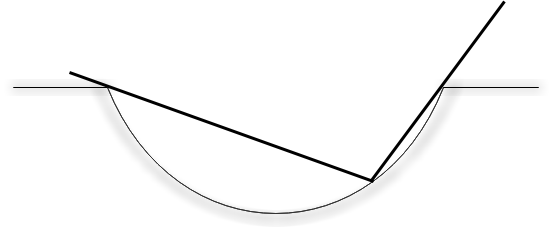
A semi-cylindrical groove of radius $r=20 \mathrm{cm}$ is made on a horizontal floor. An ant wants to cross the groove. A boy decides to help the ant making a bridge consisting of straight wire segments. But all the wires available are of length $1=38 \mathrm{cm}$, so the boy rigidly connects two wires at right angles and places the bridge in the groove as shown in the figure. If the ant can crawl up a wire segment at speed $v=0.5 \mathrm{cm} / \mathrm{s}$ and down a wire segment at speed $2 \mathrm{v}$, in what minimum time can the ant cross the groove with the help of this bridge?
Answer
 Verified
581.1k+ views
Hint: We should know that velocity is defined as the rate change of displacement per unit time. Speed in a specific direction is also known as velocity. Velocity is equal to displacement divided by time. Speed, being a scalar quantity, is the rate at which an object covers distance. The average speed is the distance which is a scalar quantity per time ratio. On the other hand, velocity is a vector quantity; it is direction-aware. An object which moves in the negative direction has a negative velocity. If the object is slowing down then its acceleration vector is directed in the opposite direction as its motion in this case. Based on this we have to solve this question.
Complete step by step answer
From the diagram, we can determine that,
$x=20 \mathrm{cm}$
$l=38 \mathrm{cm}$
$V=0.5 \mathrm{cm}$
Minimum time,
$\Rightarrow t=\dfrac{l}{2 v}+\dfrac{\sqrt{4 r^{2}-l^{2}}}{v}$
$\Rightarrow t=\dfrac{38\times 10}{2\times 0.5}+\dfrac{\sqrt{4{{(20)}^{2}}-{{(38)}^{2}}}}{0.5}$
$\Rightarrow t=38+\dfrac{\sqrt{4\times 400-1440}}{0.5}$
$\Rightarrow t=38+\dfrac{\sqrt{1600-1440}}{0.5}$
$\Rightarrow t=38+\dfrac{\sqrt{160}}{0.5}$
$\Rightarrow t=38+\dfrac{12.64}{0.5}$
$\Rightarrow t=38+25.29=63.29$ sec
Therefore, the correct answer is 63.29 sec.
Note:
We should know that if an object's speed or velocity is increasing at a constant rate then we say it has uniform acceleration. The rate of acceleration is constant. If a car speeds up then slows down then speeds up it doesn't have uniform acceleration. The instantaneous acceleration, or simply acceleration, is defined as the limit of the average acceleration when the interval of time considered approaches 0. It is also defined in a similar manner as the derivative of velocity with respect to time. If an object begins acceleration from rest or a standstill, its initial time is 0. If we get a negative value for acceleration, it means the object is slowing down. The acceleration of an object is its change in velocity over an increment of time. This can mean a change in the object's speed or direction. Average acceleration is the change of velocity over a period of time. Constant or uniform acceleration is when the velocity changes the same amount in every equal time period.
Complete step by step answer
From the diagram, we can determine that,
$x=20 \mathrm{cm}$
$l=38 \mathrm{cm}$
$V=0.5 \mathrm{cm}$
Minimum time,
$\Rightarrow t=\dfrac{l}{2 v}+\dfrac{\sqrt{4 r^{2}-l^{2}}}{v}$
$\Rightarrow t=\dfrac{38\times 10}{2\times 0.5}+\dfrac{\sqrt{4{{(20)}^{2}}-{{(38)}^{2}}}}{0.5}$
$\Rightarrow t=38+\dfrac{\sqrt{4\times 400-1440}}{0.5}$
$\Rightarrow t=38+\dfrac{\sqrt{1600-1440}}{0.5}$
$\Rightarrow t=38+\dfrac{\sqrt{160}}{0.5}$
$\Rightarrow t=38+\dfrac{12.64}{0.5}$
$\Rightarrow t=38+25.29=63.29$ sec
Therefore, the correct answer is 63.29 sec.
Note:
We should know that if an object's speed or velocity is increasing at a constant rate then we say it has uniform acceleration. The rate of acceleration is constant. If a car speeds up then slows down then speeds up it doesn't have uniform acceleration. The instantaneous acceleration, or simply acceleration, is defined as the limit of the average acceleration when the interval of time considered approaches 0. It is also defined in a similar manner as the derivative of velocity with respect to time. If an object begins acceleration from rest or a standstill, its initial time is 0. If we get a negative value for acceleration, it means the object is slowing down. The acceleration of an object is its change in velocity over an increment of time. This can mean a change in the object's speed or direction. Average acceleration is the change of velocity over a period of time. Constant or uniform acceleration is when the velocity changes the same amount in every equal time period.
Recently Updated Pages
Master Class 11 Computer Science: Engaging Questions & Answers for Success

Master Class 11 Business Studies: Engaging Questions & Answers for Success
Master Class 11 Economics: Engaging Questions & Answers for Success
Master Class 11 English: Engaging Questions & Answers for Success
Master Class 11 Maths: Engaging Questions & Answers for Success
Master Class 11 Biology: Engaging Questions & Answers for Success
Trending doubts
One Metric ton is equal to kg A 10000 B 1000 C 100 class 11 physics CBSE
There are 720 permutations of the digits 1 2 3 4 5 class 11 maths CBSE
Discuss the various forms of bacteria class 11 biology CBSE
Draw a diagram of a plant cell and label at least eight class 11 biology CBSE
State the laws of reflection of light
Explain zero factorial class 11 maths CBSE