




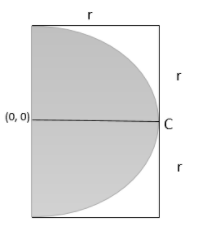
A semicircular disc of radius ‘r’ is removed from a rectangular plate of sides r and 2r. Calculate C.M of remaining portion with respect to origin .
Answer
 Verified
590.1k+ views
Hint: If we talk about the centre of mass of a body, then this point is dealing with the mass of the whole body. The centre of mass of a body is a point that behaves like the entire mass of the body exists at that point. If we choose a symmetrical body that has a symmetrical mass distribution, then the centre of mass of that body lies exactly at the centre of the body. Like a uniformly shaped pencil of length 10 cm has a centre of mass at 5cm from any end. If a body is heavy at one end, the centre of mass shifts towards the heavy portion. To find the centre of mass in a particular axis we use a formula for two mass systems.
Complete answer:
Position of centre of mass \[=\dfrac{{{m}_{1}}{{x}_{1}}+{{m}_{2}}{{x}_{2}}}{{{m}_{1}}+{{m}_{2}}}\]
Here we have \[{{m}_{1}}{{m}_{2}}\to \]masses of the two particles
And \[{{x}_{1}}{{x}_{2}}\to \] distance at x – axis respectively.
Here we can calculate the remaining area by subtracting the area of semicircle from the area of rectangular plates.
Remaining areas = Area of rectangular plate - Area of semicircles
Now let we define \[\sigma =\] mass per unit area
\[=\dfrac{M}{2{{r}^{2}}}\]
Here M = mass of rectangular slab
Mass of semicircular position \[=\sigma \times \dfrac{\pi {{r}^{2}}}{2}=\dfrac{M\pi }{4}\]
Now let calculate centre of mass of remaining portion = \[=\dfrac{{{m}_{1}}{{r}_{1}}-{{m}_{2}}{{r}_{2}}}{{{m}_{1}}-{{m}_{2}}}\]
Here \[{{m}_{1}}=\]mass of rectangular portion
\[{{m}_{2}}=\] mass of semicircular portion
\[{{r}_{1}}{{r}_{2}}=\] position of centre of mass of rectangular and semicircular portion with respect to O
We have values of \[{{r}_{1}}\] and \[{{r}_{2}}\].
Hence
Centre of mass of remaining portion
\[=\dfrac{\dfrac{Mr}{2}-\left( \dfrac{M\pi }{4} \right)\times \left( \dfrac{4r}{3\pi } \right)}{M-\dfrac{M\pi }{4}}=\dfrac{2r}{3\left( 4-\pi \right)}\]
\[{{x}_{com}}=\dfrac{2r}{3\left( 4-\pi \right)}\]
Note:
Centre of mass of a body as we discussed in the HINT portion can be estimated by the shape and distribution of mass of the body. Sometimes we will find the centre of mass can be outside the body. This is the case for structures like rings and hollow bodies. On flat surfaces, we find a centre of mass on the body.
Complete answer:
Position of centre of mass \[=\dfrac{{{m}_{1}}{{x}_{1}}+{{m}_{2}}{{x}_{2}}}{{{m}_{1}}+{{m}_{2}}}\]
Here we have \[{{m}_{1}}{{m}_{2}}\to \]masses of the two particles
And \[{{x}_{1}}{{x}_{2}}\to \] distance at x – axis respectively.
Here we can calculate the remaining area by subtracting the area of semicircle from the area of rectangular plates.
Remaining areas = Area of rectangular plate - Area of semicircles
Now let we define \[\sigma =\] mass per unit area
\[=\dfrac{M}{2{{r}^{2}}}\]
Here M = mass of rectangular slab
Mass of semicircular position \[=\sigma \times \dfrac{\pi {{r}^{2}}}{2}=\dfrac{M\pi }{4}\]
Now let calculate centre of mass of remaining portion = \[=\dfrac{{{m}_{1}}{{r}_{1}}-{{m}_{2}}{{r}_{2}}}{{{m}_{1}}-{{m}_{2}}}\]
Here \[{{m}_{1}}=\]mass of rectangular portion
\[{{m}_{2}}=\] mass of semicircular portion
\[{{r}_{1}}{{r}_{2}}=\] position of centre of mass of rectangular and semicircular portion with respect to O
We have values of \[{{r}_{1}}\] and \[{{r}_{2}}\].
Hence
Centre of mass of remaining portion
\[=\dfrac{\dfrac{Mr}{2}-\left( \dfrac{M\pi }{4} \right)\times \left( \dfrac{4r}{3\pi } \right)}{M-\dfrac{M\pi }{4}}=\dfrac{2r}{3\left( 4-\pi \right)}\]
\[{{x}_{com}}=\dfrac{2r}{3\left( 4-\pi \right)}\]
Note:
Centre of mass of a body as we discussed in the HINT portion can be estimated by the shape and distribution of mass of the body. Sometimes we will find the centre of mass can be outside the body. This is the case for structures like rings and hollow bodies. On flat surfaces, we find a centre of mass on the body.
Recently Updated Pages
Three beakers labelled as A B and C each containing 25 mL of water were taken A small amount of NaOH anhydrous CuSO4 and NaCl were added to the beakers A B and C respectively It was observed that there was an increase in the temperature of the solutions contained in beakers A and B whereas in case of beaker C the temperature of the solution falls Which one of the following statements isarecorrect i In beakers A and B exothermic process has occurred ii In beakers A and B endothermic process has occurred iii In beaker C exothermic process has occurred iv In beaker C endothermic process has occurred

Master Class 11 Social Science: Engaging Questions & Answers for Success
Master Class 11 Physics: Engaging Questions & Answers for Success
Master Class 11 Maths: Engaging Questions & Answers for Success
Master Class 11 Economics: Engaging Questions & Answers for Success
Master Class 11 Computer Science: Engaging Questions & Answers for Success
Three beakers labelled as A B and C each containing 25 mL of water were taken A small amount of NaOH anhydrous CuSO4 and NaCl were added to the beakers A B and C respectively It was observed that there was an increase in the temperature of the solutions contained in beakers A and B whereas in case of beaker C the temperature of the solution falls Which one of the following statements isarecorrect i In beakers A and B exothermic process has occurred ii In beakers A and B endothermic process has occurred iii In beaker C exothermic process has occurred iv In beaker C endothermic process has occurred
Master Class 11 Social Science: Engaging Questions & Answers for Success
Master Class 11 Physics: Engaging Questions & Answers for Success
Trending doubts
One Metric ton is equal to kg A 10000 B 1000 C 100 class 11 physics CBSE
There are 720 permutations of the digits 1 2 3 4 5 class 11 maths CBSE
State and prove Bernoullis theorem class 11 physics CBSE
Draw a diagram of a plant cell and label at least eight class 11 biology CBSE
Difference Between Prokaryotic Cells and Eukaryotic Cells
Discuss the various forms of bacteria class 11 biology CBSE