




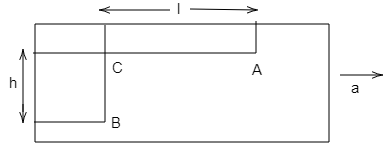
A sealed tank containing a liquid of density $\rho $ moves with horizontal acceleration $a$ as shown in the figure. The difference in pressure between two points $A$ and $B$ will be
$(A)h\rho g$
$(B)l\rho g$
$(C)h\rho g - l\rho a$
$(D)h\rho g + l\rho a$
Answer
 Verified
560.1k+ views
Hint: This question is based on the concept of hydrostatic pressure. Hydrostatic pressure is the pressure exerted by or existing within a liquid at rest with respect to adjacent bodies. The SI unit of hydrostatic pressure is Pascal.
Complete answer:
In this question, we need to calculate the pressure difference between the two points $A$and $B$.
Now, since there is no height difference between $A$ and $C$, so no hydrostatic pressure difference between them. But, since the liquid is accelerating so there will be a pressure difference which will be created between them.
${P_C} - {P_A} = \rho al.........(1)$
Now, if we look at the two points $B$ and $C$, we can clearly see that the acceleration of both of them is the same as they are lying in the same vertical plane. But there is a height difference between these two points and thus, a hydrostatic pressure difference will be present between them.
${P_B} - {P_C} = \rho gh.........(2)$
On adding equation (1) and (2), we get,
${P_C} - {P_A} + {P_B} - {P_C} = \rho al + \rho gh$
${P_B} - {P_A} = \rho al + \rho gh$
Now, this equation can be rewritten as,
${P_B} - {P_A} = h\rho g + l\rho a$
So, the pressure difference between the points $A$ and $B$ is ${P_B} - {P_A} = h\rho g + l\rho a$.
Hence, the correct answer is $(D)h\rho g + l\rho a$.
Note: It is important to note that in such questions, there are two types of pressure difference. The first pressure difference is due to the hydrostatic pressure as the two points are at a different height. The other pressure difference is due to the fact that the liquid is accelerating horizontally.
Complete answer:
In this question, we need to calculate the pressure difference between the two points $A$and $B$.
Now, since there is no height difference between $A$ and $C$, so no hydrostatic pressure difference between them. But, since the liquid is accelerating so there will be a pressure difference which will be created between them.
${P_C} - {P_A} = \rho al.........(1)$
Now, if we look at the two points $B$ and $C$, we can clearly see that the acceleration of both of them is the same as they are lying in the same vertical plane. But there is a height difference between these two points and thus, a hydrostatic pressure difference will be present between them.
${P_B} - {P_C} = \rho gh.........(2)$
On adding equation (1) and (2), we get,
${P_C} - {P_A} + {P_B} - {P_C} = \rho al + \rho gh$
${P_B} - {P_A} = \rho al + \rho gh$
Now, this equation can be rewritten as,
${P_B} - {P_A} = h\rho g + l\rho a$
So, the pressure difference between the points $A$ and $B$ is ${P_B} - {P_A} = h\rho g + l\rho a$.
Hence, the correct answer is $(D)h\rho g + l\rho a$.
Note: It is important to note that in such questions, there are two types of pressure difference. The first pressure difference is due to the hydrostatic pressure as the two points are at a different height. The other pressure difference is due to the fact that the liquid is accelerating horizontally.
Recently Updated Pages
If x a + bt + ct2 where x is in meters and t is in class 11 physics CBSE

A car covers the first half distance between two places class 11 physics CBSE
The resultant of two vectors overrightarrow P and overrightarrow class 11 physics CBSE
Find the value of cos 135 class 11 maths CBSE
A mass M is held in place by an applied force F and class 11 physics CBSE
A solution of glucose in water is labelled as 10 dfracwv class 11 chemistry CBSE
Trending doubts
Find the value of the expression given below sin 30circ class 11 maths CBSE
One Metric ton is equal to kg A 10000 B 1000 C 100 class 11 physics CBSE
Draw a diagram of nephron and explain its structur class 11 biology CBSE
10 examples of friction in our daily life
Proton was discovered by A Thomson B Rutherford C Chadwick class 11 chemistry CBSE
Bond order ofO2 O2+ O2 and O22 is in order A O2 langle class 11 chemistry CBSE