




A satellite of mass $m$ is orbiting around the earth at a height $h$ above the surface of the earth .Mass of the earth is $M$ and its radius is $R$.The angular momentum of the satellite is independent of :
A. \[{\text{m}}\]
B. \[{\text{M}}\]
C. \[{\text{h}}\]
D. \[{\text{None of these}}\]
Answer
 Verified
549.3k+ views
Hint: To solve the given question we use the concepts of gravitation and angular momentum.We first find orbital velocity of satellite at height h and then using his we find angular momentum.Angular momentum will be independent of those variables not present in the equation .
Formulas used:
\[\mathop L\limits^ \to = r \times \mathop p\limits^ \to \]
where ‘L’ is angular momentum, ‘r’ is radius and ‘p’ is momentum.
Complete step by step answer:
We are given a satellite in the question.It is said that the mass of the satellite is ‘m’, radius of the orbit is ‘r’ and mass of earth is considered as ‘M’. The figure below shows the given situation.
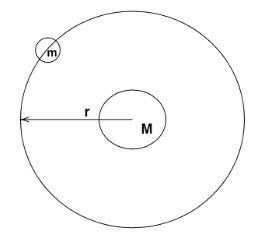
For a satellite orbiting earth, the required centripetal force is given by the gravitational attraction force of earth. We can find the orbiting velocity of the satellite by equating these two forces.The orbital velocity of a satellite orbiting from a height h from the surface of earth is given by,
\[v = \sqrt {\dfrac{{GM}}{r}} \]
where \[r = R + h\], \[G\] is gravitational constant and \[M\] is the mass of earth.
We know that the equation for angular momentum is given by,
\[\mathop L\limits^ \to = r \times \mathop p\limits^ \to \],
We know momentum is given by,
\[\mathop p\limits^ \to = m\mathop v\limits^ \to \]
where ‘m’ is mass of the body and ‘v’ is velocity of the body.
Therefore we get angular momentum as
\[ \Rightarrow \mathop L\limits^ \to = m\mathop v\limits^ \to r\]
In the given case, mass is the mass of the satellite ‘m’, radius is the radius of the orbit ‘r’ and velocity is the orbital velocity. By substituting this in the equation of angular momentum, we get
\[\mathop L\limits^ \to = mr \times \sqrt {\dfrac{{GM}}{r}} \]
By squaring on both sides,
\[ \Rightarrow {L^2} = {m^2}{r^2}\dfrac{{GM}}{r}\]
By solving this equation ,we get
\[ \Rightarrow \mathop L\limits^ \to = m\sqrt {GMr} \]
\[ \therefore \mathop L\limits^ \to = m\sqrt {GM\left( {R + h} \right)} \] as \[r = R + h\]
Therefore, the correct answer is option D.
Note: Angular momentum of a body is simply the total amount of rotational motion of that body. Angular momentum is experienced by bodies mainly in two situations; when the body is accelerating about a fixed point and when the body is rotating about a fixed point. Angular momentum when the body is accelerating about a fixed point is given as,
\[ \Rightarrow \mathop L\limits^ \to = r \times \mathop p\limits^ \to \]
Angular momentum when the body is rotating about a fixed point is given as,
\[ \Rightarrow \mathop L\limits^ \to = I \times \mathop \omega \limits^ \to \]
Formulas used:
\[\mathop L\limits^ \to = r \times \mathop p\limits^ \to \]
where ‘L’ is angular momentum, ‘r’ is radius and ‘p’ is momentum.
Complete step by step answer:
We are given a satellite in the question.It is said that the mass of the satellite is ‘m’, radius of the orbit is ‘r’ and mass of earth is considered as ‘M’. The figure below shows the given situation.
For a satellite orbiting earth, the required centripetal force is given by the gravitational attraction force of earth. We can find the orbiting velocity of the satellite by equating these two forces.The orbital velocity of a satellite orbiting from a height h from the surface of earth is given by,
\[v = \sqrt {\dfrac{{GM}}{r}} \]
where \[r = R + h\], \[G\] is gravitational constant and \[M\] is the mass of earth.
We know that the equation for angular momentum is given by,
\[\mathop L\limits^ \to = r \times \mathop p\limits^ \to \],
We know momentum is given by,
\[\mathop p\limits^ \to = m\mathop v\limits^ \to \]
where ‘m’ is mass of the body and ‘v’ is velocity of the body.
Therefore we get angular momentum as
\[ \Rightarrow \mathop L\limits^ \to = m\mathop v\limits^ \to r\]
In the given case, mass is the mass of the satellite ‘m’, radius is the radius of the orbit ‘r’ and velocity is the orbital velocity. By substituting this in the equation of angular momentum, we get
\[\mathop L\limits^ \to = mr \times \sqrt {\dfrac{{GM}}{r}} \]
By squaring on both sides,
\[ \Rightarrow {L^2} = {m^2}{r^2}\dfrac{{GM}}{r}\]
By solving this equation ,we get
\[ \Rightarrow \mathop L\limits^ \to = m\sqrt {GMr} \]
\[ \therefore \mathop L\limits^ \to = m\sqrt {GM\left( {R + h} \right)} \] as \[r = R + h\]
Therefore, the correct answer is option D.
Note: Angular momentum of a body is simply the total amount of rotational motion of that body. Angular momentum is experienced by bodies mainly in two situations; when the body is accelerating about a fixed point and when the body is rotating about a fixed point. Angular momentum when the body is accelerating about a fixed point is given as,
\[ \Rightarrow \mathop L\limits^ \to = r \times \mathop p\limits^ \to \]
Angular momentum when the body is rotating about a fixed point is given as,
\[ \Rightarrow \mathop L\limits^ \to = I \times \mathop \omega \limits^ \to \]
Recently Updated Pages
Which will be the least stable resonating structure class 11 chemistry CBSE

How many 5 digit telephone numbers can be construc-class-11-maths-CBSE
How do you find the angle of the resultant vector class 11 physics CBSE
Draw labelled diagram of the following i Gram seed class 11 biology CBSE
What is the need and importance of classification class 11 biology CBSE
The way in which the sparrows expressed their sorrow class 11 english CBSE
Trending doubts
One Metric ton is equal to kg A 10000 B 1000 C 100 class 11 physics CBSE
Find the value of the expression given below sin 30circ class 11 maths CBSE
1 Quintal is equal to a 110 kg b 10 kg c 100kg d 1000 class 11 physics CBSE
Draw a diagram of nephron and explain its structur class 11 biology CBSE
10 examples of friction in our daily life
Proton was discovered by A Thomson B Rutherford C Chadwick class 11 chemistry CBSE