




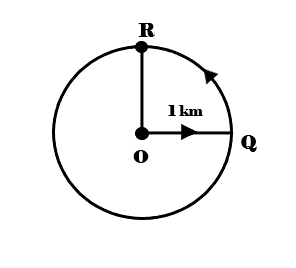
A runner starts from O and gets to O following path OQRO in 1 hr. What is net displacement and average speed?
(A) 0, 0km/hr
(B) 0, 3.57km/hr
(C) 0, 2.57km/hr
(D) 0, 1km/hr
Answer
 Verified
573.9k+ views
Hint
Displacement is considered as the length of the straight line joining the starting and ending point of a motion of a body. Average speed is the rate of change of the distance (scalar) covered during the motion. So by substituting the values, we will be able to calculate the average speed.
Formula used: In the solution we will be using the following formula,
$ \Rightarrow C = 2\pi r $ where $ C $ is the circumference of a circle, and $ r $ is the radius of the circle.
$ \Rightarrow v = \dfrac{d}{t} $ where $ v $ is the average speed, $ d $ is the distance covered and $ t $ is the time taken to cover that distance.
Complete step by step answer
Displacement of a body is the length covered in a specified direction. Hence, the straight line drawn connecting the starting point to the ending point of the motion of the body is considered as the displacement of the body undergoing such motion.
So, if the starting and the ending are the same point, the length of the straight line is zero. Hence, the displacement is zero meters.
But average speed is the distance (not displacement) per unit time taken. The total distance is the sum of all l lengths that constitute the motion. Hence for the question above, the total distance is
$ \Rightarrow d = OQ + QR + RO $
Length OQ and RO are the radius of the circle which is given as 1 km. While QR is the quarter of the circumference of the circle.
Hence,
$ \Rightarrow QR = \dfrac{1}{4}\left( {2\pi r} \right) = \dfrac{1}{2}\pi r $
On substituting the value of the radius we get
$ \Rightarrow QR = \dfrac{1}{2} \times \pi \times 1 = 1.57km $
Thus, total distance covered is
$ \Rightarrow d = 1 + 1.57 + 1 = 3.57km $
Now the time taken is 1 hr.
Hence, the average speed is given by
$ \Rightarrow v = \dfrac{d}{t} = \dfrac{{3.57}}{1} = 3.57km/hr $
$ \therefore v = 3.57km/hr $
Hence the answer is option (B).
Note
Scientifically, the concept of speed in general is utilized when the motion in question has many direction changes or the motion is a periodic or circular motion. These are situations where using the concept of average velocity (which is displacement per unit time) we will not be able to calculate the distance covered by the body with time.
Displacement is considered as the length of the straight line joining the starting and ending point of a motion of a body. Average speed is the rate of change of the distance (scalar) covered during the motion. So by substituting the values, we will be able to calculate the average speed.
Formula used: In the solution we will be using the following formula,
$ \Rightarrow C = 2\pi r $ where $ C $ is the circumference of a circle, and $ r $ is the radius of the circle.
$ \Rightarrow v = \dfrac{d}{t} $ where $ v $ is the average speed, $ d $ is the distance covered and $ t $ is the time taken to cover that distance.
Complete step by step answer
Displacement of a body is the length covered in a specified direction. Hence, the straight line drawn connecting the starting point to the ending point of the motion of the body is considered as the displacement of the body undergoing such motion.
So, if the starting and the ending are the same point, the length of the straight line is zero. Hence, the displacement is zero meters.
But average speed is the distance (not displacement) per unit time taken. The total distance is the sum of all l lengths that constitute the motion. Hence for the question above, the total distance is
$ \Rightarrow d = OQ + QR + RO $
Length OQ and RO are the radius of the circle which is given as 1 km. While QR is the quarter of the circumference of the circle.
Hence,
$ \Rightarrow QR = \dfrac{1}{4}\left( {2\pi r} \right) = \dfrac{1}{2}\pi r $
On substituting the value of the radius we get
$ \Rightarrow QR = \dfrac{1}{2} \times \pi \times 1 = 1.57km $
Thus, total distance covered is
$ \Rightarrow d = 1 + 1.57 + 1 = 3.57km $
Now the time taken is 1 hr.
Hence, the average speed is given by
$ \Rightarrow v = \dfrac{d}{t} = \dfrac{{3.57}}{1} = 3.57km/hr $
$ \therefore v = 3.57km/hr $
Hence the answer is option (B).
Note
Scientifically, the concept of speed in general is utilized when the motion in question has many direction changes or the motion is a periodic or circular motion. These are situations where using the concept of average velocity (which is displacement per unit time) we will not be able to calculate the distance covered by the body with time.
Recently Updated Pages
Master Class 11 Computer Science: Engaging Questions & Answers for Success

Master Class 11 Business Studies: Engaging Questions & Answers for Success
Master Class 11 Economics: Engaging Questions & Answers for Success
Master Class 11 English: Engaging Questions & Answers for Success
Master Class 11 Maths: Engaging Questions & Answers for Success
Master Class 11 Biology: Engaging Questions & Answers for Success
Trending doubts
One Metric ton is equal to kg A 10000 B 1000 C 100 class 11 physics CBSE
There are 720 permutations of the digits 1 2 3 4 5 class 11 maths CBSE
Discuss the various forms of bacteria class 11 biology CBSE
Draw a diagram of a plant cell and label at least eight class 11 biology CBSE
State the laws of reflection of light
Explain zero factorial class 11 maths CBSE