




A rubber ball of mass \[10gm\] and volume $15c{m^3}$ dipped in water to a depth of $10m$ . Assuming density of water uniform throughout the depth, find
(a) the acceleration of the ball, and
(b) the time taken by it to the surface if it is released from rest. Take $g = 980cm{\text{ }}{s^{ - 2}}$ .
A. $(a)5.9m{\text{ }}{s^{ - 2}}{\text{ }}(b)2.02\sec $
B. $(a)4.9m{\text{ }}{s^{ - 2}}{\text{ }}(b)2.02\sec $
C. $(a)4.9m{\text{ }}{s^{ - 2}}{\text{ }}(b)12.02\sec $
D. $(a)8.9m{\text{ }}{s^{ - 2}}{\text{ }}(b)2.02\sec $
Answer
 Verified
495.3k+ views
Hint: To solve this type of question, firstly, we will draw the free body diagram and resolve all the forces to get the acceleration. And in the second part we will substitute the values of acceleration in the equation of motion to get the required result.
Formula used:
${F_b} = \rho gh$
Where,
${F_b}$ is the buoyant force,
$\rho $ is the density of water,
$g$ is the acceleration due to gravity and
$h$ is the height/depth.
Complete answer:
According to the question it is given that,
The mass is $10gm$ ,
Volume is $15c{m^3}$ ,
Depth is $10m$ ,
$g = 980cm{\text{ }}{s^{ - 2}}$ and
Density $\rho = 1kg{\text{ }}c{m^{ - 2}}$
First part:
Now we will find the effective upward force on the ball by resolving the forces on ball,
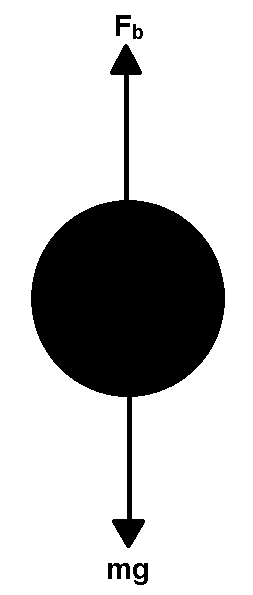
$F = {F_b} - mg = ma$
$
a = \dfrac{1}{m}({F_b} - mg) \\
\Rightarrow a = \dfrac{1}{{10}}(\rho gh - mg) \\
\Rightarrow a = \dfrac{1}{{10}}(15 \times 1 \times 980 - 10 \times 980) \\
\Rightarrow a = 940cm{\text{ }}{s^{ - 2}} \\
\Rightarrow a = 4.9m{\text{ }}{s^{ - 2}} \\
$
So, we have got the acceleration of the ball i.e., $a = 4.9m{\text{ }}{s^{ - 2}}$ .
Second part:
Now we have to calculate the time taken by the ball to reach the surface.
As we have acceleration, $a = 4.9m{\text{ }}{s^{ - 2}}$ ,
Initial speed $u = 0$
We can easily find by using equation of motion,
We know that $s = ut + \dfrac{1}{2}a{t^2}$
Now, putting all the values in the above equation,
$
s = ut + \dfrac{1}{2}a{t^2} \\
\Rightarrow 10 = 0(t) + \dfrac{1}{2} \times 4.9 \times {t^2} \\
\Rightarrow {t^2} = \dfrac{{2 \times 10}}{{4.9}} \\
\Rightarrow t = \sqrt {\dfrac{{2 \times 10}}{{4.9}}} \\
\therefore t = 2.02\sec \\
$
Hence, the required time to reach the ball at the surface is $2.02\sec $ .
Hence, the correct option is (B).
Note:
You must draw free body diagram to solve this question easily and don’t forget to use the given data of $g = 980cm{\text{ }}{s^{ - 2}}$ instead of $g = 9.8m{\text{ }}{s^{ - 2}}$ and proceed accordingly as above to get the required answer. A free body diagram consists of a diagrammatic representation of a single body or a subsystem of bodies isolated from its surroundings showing all the forces acting on it.
Formula used:
${F_b} = \rho gh$
Where,
${F_b}$ is the buoyant force,
$\rho $ is the density of water,
$g$ is the acceleration due to gravity and
$h$ is the height/depth.
Complete answer:
According to the question it is given that,
The mass is $10gm$ ,
Volume is $15c{m^3}$ ,
Depth is $10m$ ,
$g = 980cm{\text{ }}{s^{ - 2}}$ and
Density $\rho = 1kg{\text{ }}c{m^{ - 2}}$
First part:
Now we will find the effective upward force on the ball by resolving the forces on ball,
$F = {F_b} - mg = ma$
$
a = \dfrac{1}{m}({F_b} - mg) \\
\Rightarrow a = \dfrac{1}{{10}}(\rho gh - mg) \\
\Rightarrow a = \dfrac{1}{{10}}(15 \times 1 \times 980 - 10 \times 980) \\
\Rightarrow a = 940cm{\text{ }}{s^{ - 2}} \\
\Rightarrow a = 4.9m{\text{ }}{s^{ - 2}} \\
$
So, we have got the acceleration of the ball i.e., $a = 4.9m{\text{ }}{s^{ - 2}}$ .
Second part:
Now we have to calculate the time taken by the ball to reach the surface.
As we have acceleration, $a = 4.9m{\text{ }}{s^{ - 2}}$ ,
Initial speed $u = 0$
We can easily find by using equation of motion,
We know that $s = ut + \dfrac{1}{2}a{t^2}$
Now, putting all the values in the above equation,
$
s = ut + \dfrac{1}{2}a{t^2} \\
\Rightarrow 10 = 0(t) + \dfrac{1}{2} \times 4.9 \times {t^2} \\
\Rightarrow {t^2} = \dfrac{{2 \times 10}}{{4.9}} \\
\Rightarrow t = \sqrt {\dfrac{{2 \times 10}}{{4.9}}} \\
\therefore t = 2.02\sec \\
$
Hence, the required time to reach the ball at the surface is $2.02\sec $ .
Hence, the correct option is (B).
Note:
You must draw free body diagram to solve this question easily and don’t forget to use the given data of $g = 980cm{\text{ }}{s^{ - 2}}$ instead of $g = 9.8m{\text{ }}{s^{ - 2}}$ and proceed accordingly as above to get the required answer. A free body diagram consists of a diagrammatic representation of a single body or a subsystem of bodies isolated from its surroundings showing all the forces acting on it.
Recently Updated Pages
Master Class 11 Computer Science: Engaging Questions & Answers for Success

Master Class 11 Business Studies: Engaging Questions & Answers for Success
Master Class 11 Economics: Engaging Questions & Answers for Success
Master Class 11 English: Engaging Questions & Answers for Success
Master Class 11 Maths: Engaging Questions & Answers for Success
Master Class 11 Biology: Engaging Questions & Answers for Success
Trending doubts
One Metric ton is equal to kg A 10000 B 1000 C 100 class 11 physics CBSE
There are 720 permutations of the digits 1 2 3 4 5 class 11 maths CBSE
Discuss the various forms of bacteria class 11 biology CBSE
Draw a diagram of a plant cell and label at least eight class 11 biology CBSE
State the laws of reflection of light
Explain zero factorial class 11 maths CBSE