




A round uniform body of radius \[R\], mass \[M\] , and moment of inertia \[I\], rolls down (without slipping) an inclined plane making an angle with the horizontal. Then its acceleration is :
A.\[\dfrac{{g\sin \theta }}{{1 + I/M{R^2}}}\]
B.\[\dfrac{{g\sin \theta }}{{1 + M{R^2}/I}}\]
C.\[\dfrac{{g\sin \theta }}{{1 - I/M{R^2}}}\]
D.\[\dfrac{{g\sin \theta }}{{1 - M{R^2}/I}}\]
Answer
 Verified
478.5k+ views
Hint: The frictional force is the force that restricts the motion of the body. To solve this question we need to first draw the free body diagram and mark all the forces that act upon the uniform body. And then we will use the torque formula and from that, we will find the frictional force. Then we need to substitute this in the equation of motion formula to find an equation for the acceleration of the body.
Complete answer:
The free-body diagram of the rotating body is given below.
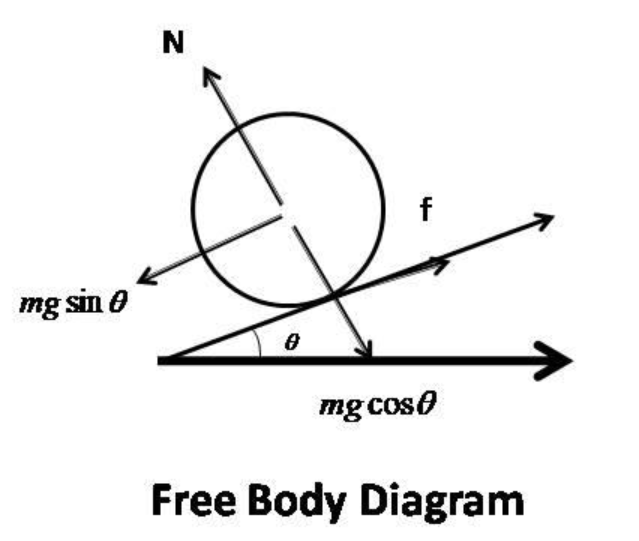
From the diagram, the equation of the motion can be written as,
\[ \Rightarrow mg\sin \theta - f = ma\] ……… (1)
Here,
\[m\] is the mass of the body
\[mg\sin \theta \] is the horizontal component
\[f\] is the frictional force.
Now the torque acting on the body is given by,
\[ \Rightarrow \tau = f \times R\] …… (2)
Equation (2) can also be written in terms of the moment of inertia as,
\[ \Rightarrow \tau = I\alpha \] ……. (3)
Here,
\[I\] is the moment of inertia
\[\alpha \] is the angular acceleration
Equating equations (2) and (3)
\[ \Rightarrow f \times R = I\alpha \]
\[ \Rightarrow f = \dfrac{{I\alpha }}{R}\] …… (4)
Also, the acceleration of the body is given as,
\[ \Rightarrow a = \alpha R\] …… (5)
Substituting equation (4) in (5) we get,
\[ \Rightarrow f = \dfrac{{I\alpha }}{R}\] ….. (6)
\[ \Rightarrow f = \dfrac{{Ia}}{{{R^2}}}\]
Substituting this in the equation of motion we get,
\[ \Rightarrow mg\sin \theta - \dfrac{{Ia}}{{{R^2}}} = ma\]
\[ \Rightarrow mg\sin \theta = ma + \dfrac{{Ia}}{{{R^2}}}\]
\[ \Rightarrow a = \dfrac{{g\sin \theta }}{{1 + I/m{R^2}}}\]
Therefore, the correct option is C.
Note:
We usually use the term torque when we study the entire rotating object. Torque is a measure of force that acts on an object and that causes the object to rotate. The object always rotates about an axis and this axis is called the pivot. The SI unit of torque is $Nm$. Torque can be categorized into two types one is static and the other is dynamic.
Complete answer:
The free-body diagram of the rotating body is given below.
From the diagram, the equation of the motion can be written as,
\[ \Rightarrow mg\sin \theta - f = ma\] ……… (1)
Here,
\[m\] is the mass of the body
\[mg\sin \theta \] is the horizontal component
\[f\] is the frictional force.
Now the torque acting on the body is given by,
\[ \Rightarrow \tau = f \times R\] …… (2)
Equation (2) can also be written in terms of the moment of inertia as,
\[ \Rightarrow \tau = I\alpha \] ……. (3)
Here,
\[I\] is the moment of inertia
\[\alpha \] is the angular acceleration
Equating equations (2) and (3)
\[ \Rightarrow f \times R = I\alpha \]
\[ \Rightarrow f = \dfrac{{I\alpha }}{R}\] …… (4)
Also, the acceleration of the body is given as,
\[ \Rightarrow a = \alpha R\] …… (5)
Substituting equation (4) in (5) we get,
\[ \Rightarrow f = \dfrac{{I\alpha }}{R}\] ….. (6)
\[ \Rightarrow f = \dfrac{{Ia}}{{{R^2}}}\]
Substituting this in the equation of motion we get,
\[ \Rightarrow mg\sin \theta - \dfrac{{Ia}}{{{R^2}}} = ma\]
\[ \Rightarrow mg\sin \theta = ma + \dfrac{{Ia}}{{{R^2}}}\]
\[ \Rightarrow a = \dfrac{{g\sin \theta }}{{1 + I/m{R^2}}}\]
Therefore, the correct option is C.
Note:
We usually use the term torque when we study the entire rotating object. Torque is a measure of force that acts on an object and that causes the object to rotate. The object always rotates about an axis and this axis is called the pivot. The SI unit of torque is $Nm$. Torque can be categorized into two types one is static and the other is dynamic.
Recently Updated Pages
Master Class 11 Computer Science: Engaging Questions & Answers for Success

Master Class 11 Business Studies: Engaging Questions & Answers for Success
Master Class 11 Economics: Engaging Questions & Answers for Success
Master Class 11 English: Engaging Questions & Answers for Success
Master Class 11 Maths: Engaging Questions & Answers for Success
Master Class 11 Biology: Engaging Questions & Answers for Success
Trending doubts
One Metric ton is equal to kg A 10000 B 1000 C 100 class 11 physics CBSE
There are 720 permutations of the digits 1 2 3 4 5 class 11 maths CBSE
Discuss the various forms of bacteria class 11 biology CBSE
Draw a diagram of a plant cell and label at least eight class 11 biology CBSE
State the laws of reflection of light
Explain zero factorial class 11 maths CBSE