




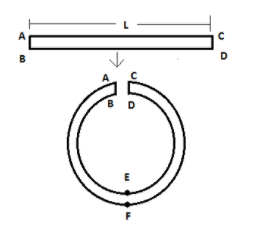
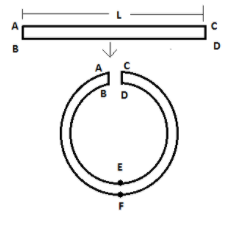
A rod of length \[L\] with square cross-section \[\left( a\times a \right)\] is bent to form a circular ring. Then the value of stress developed at points E and F respectively, (\[Y\] is Young's modulus of metal rod)
\[\begin{align}
& \text{A)Zero in both} \\
& \text{B)}\dfrac{\text{2 }\!\!\pi\!\!\text{ aY}}{\text{L}}\text{compression,}\dfrac{\text{2 }\!\!\pi\!\!\text{ aY}}{\text{L}}\text{tension} \\
& \text{C)}\dfrac{\text{ }\!\!\pi\!\!\text{ aY}}{\text{L}}\text{compression,}\dfrac{\text{ }\!\!\pi\!\!\text{ aY}}{\text{L}}\text{tension} \\
& \text{D)2}\dfrac{\text{ }\!\!\pi\!\!\text{ aY}}{\text{L}}\text{compression in both} \\
\end{align}\]
Answer
 Verified
576.3k+ views
Hint: Here the length of dimensions of the rod and values of Young’s modulus are given. Question is to find the stress developed in the points E and F when the rod is bent to form a circular ring. To find the stress we can use the bending equation, which relates, young’s modulus, radius of curvature, distance of the layer at which the bending stress is considered.
Formula used:
\[\text{circumference of circle = 2 }\!\!\pi\!\!\text{ R}\]
\[\dfrac{\sigma }{y}=\dfrac{E}{R}\]
Complete answer:
We have,
\[\dfrac{\sigma }{y}=\dfrac{E}{R}\]
Where,
\[\sigma \]is the bending stress
\[E\]is young’s modulus
\[y\] is the distance of the layer at which the bending stress is considered
R = Radius of curvature
Given, the length of wire is \[L\]. Let \[R\]be the radius of the circle. Then,
Circumference of the circle, \[2\pi R=L\]
Then,
\[R=\dfrac{L}{2\pi }\]
Given, Young’s modulus of metal rod is \[Y\]. i.e.,
\[E=Y\]
Given that, the rod has a square cross-section \[\left( a\times a \right)\]. Then,
\[y=\dfrac{a}{2}\]
Then,
\[\sigma =\dfrac{Ey}{R}=\dfrac{Y\dfrac{a}{2}}{\dfrac{L}{2\pi }}=\dfrac{2\pi Y\dfrac{a}{2}}{L}=\dfrac{\pi Ya}{L}\]
Hence, then the value of stress developed at points E and F is \[\dfrac{\pi Ya}{L}\].
Here, the point E experiences compression and point F experiences tension.
Therefore, answer is option C.
Note:
At the neutral axis of a beam, the bending stress is zero, which is coincident with the centroid of the beam's cross section. The bending stress increases as we move away from the neutral axis, and reaches the maximum value at the extreme fibers at the top and bottom of the beam.
Formula used:
\[\text{circumference of circle = 2 }\!\!\pi\!\!\text{ R}\]
\[\dfrac{\sigma }{y}=\dfrac{E}{R}\]
Complete answer:
We have,
\[\dfrac{\sigma }{y}=\dfrac{E}{R}\]
Where,
\[\sigma \]is the bending stress
\[E\]is young’s modulus
\[y\] is the distance of the layer at which the bending stress is considered
R = Radius of curvature
Given, the length of wire is \[L\]. Let \[R\]be the radius of the circle. Then,
Circumference of the circle, \[2\pi R=L\]
Then,
\[R=\dfrac{L}{2\pi }\]
Given, Young’s modulus of metal rod is \[Y\]. i.e.,
\[E=Y\]
Given that, the rod has a square cross-section \[\left( a\times a \right)\]. Then,
\[y=\dfrac{a}{2}\]
Then,
\[\sigma =\dfrac{Ey}{R}=\dfrac{Y\dfrac{a}{2}}{\dfrac{L}{2\pi }}=\dfrac{2\pi Y\dfrac{a}{2}}{L}=\dfrac{\pi Ya}{L}\]
Hence, then the value of stress developed at points E and F is \[\dfrac{\pi Ya}{L}\].
Here, the point E experiences compression and point F experiences tension.
Therefore, answer is option C.
Note:
At the neutral axis of a beam, the bending stress is zero, which is coincident with the centroid of the beam's cross section. The bending stress increases as we move away from the neutral axis, and reaches the maximum value at the extreme fibers at the top and bottom of the beam.
Recently Updated Pages
Master Class 11 English: Engaging Questions & Answers for Success

Master Class 11 Maths: Engaging Questions & Answers for Success
Master Class 11 Biology: Engaging Questions & Answers for Success
Master Class 11 Social Science: Engaging Questions & Answers for Success
Master Class 11 Physics: Engaging Questions & Answers for Success
Master Class 11 Accountancy: Engaging Questions & Answers for Success
Trending doubts
One Metric ton is equal to kg A 10000 B 1000 C 100 class 11 physics CBSE
There are 720 permutations of the digits 1 2 3 4 5 class 11 maths CBSE
Discuss the various forms of bacteria class 11 biology CBSE
Draw a diagram of a plant cell and label at least eight class 11 biology CBSE
State the laws of reflection of light
Explain zero factorial class 11 maths CBSE