



A rod of $2cm$ diameter , $30cm$ length is transformed into a wire $3m$ length of uniform thickness. The diameter of the wire is:
A.$\dfrac{2}{{10}}cm$
B.$2/\sqrt {10} cm$
C.$1/\sqrt {10} cm$
D.$\dfrac{1}{{10}}cm$
Answer
 Verified
596.7k+ views
Hint - To solve this problem, firstly we should know about geometry, shape, formula which will help us to understand the problem, create an imaginary figure in our mind by which we can solve the problem logistically. Half of the solution is within the question, firstly we should carefully read the problem and collect the given information and then use the given information to solve the problem by applying the formula required.
Complete step-by-step answer:
Here, we have a rod in the shape of a cylinder. A cylinder is a $3$ -D shape having a circular base. A cylinder can be seen as a deposit of circular disks that are stacked on one another. A cylinder can be seen as an assembly of multiple congruent disks stacked one above the other.
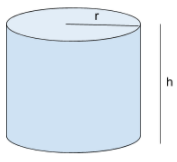
Volume of Cylinder - $h\, \times \,\pi \, \times {r^2}$
Now, let’s solve our question –
Given,
${r_1} = 1cm$ $\left[ {{r_1} = \dfrac{{{d_1}}}{2} = \dfrac{2}{2} = 1} \right]$
${h_1} = 30cm$
Converted into a wire of length
${h_2} = 300cm$ $\left[ {1m = 100cm,3m = 300cm} \right]$
$r = ?$
Volume of rod = Volume of wire $\left[ {{V_1} = {V_2}} \right]$
$ \Rightarrow \pi r_1^2{h_1} = \,\pi r_2^2{h_2}$ $\left[ {volume\,of\,Cylinder = h \times \pi \times {r^2}} \right]$
$ \Rightarrow \pi \times {\left( 1 \right)^2} \times 30 = \pi \times r_2^2 \times 300$
$ \Rightarrow r_2^2 = \dfrac{{30}}{{300}}$
$\therefore \,\,{r_2} = \dfrac{1}{{\sqrt {10} }}cm$
$\therefore \,\,diameter = 2{r_2}$
$ = \dfrac{2}{{\sqrt {10} }}cm$
Hence, the correct answer is B - $ = \,\dfrac{2}{{\sqrt {10} }}\,cm$
Note - The Volume of a cylinder is the density of the cylinder which signifies the total amount of material it can carry or how much amount of material can be immersed in it. It is given by the formula,$\pi {r^2}h$ , where the circular base is having r as a radius and h is the height of the cylinder. The volume of the cylinder can be calculated by the product of the area of base and height. Also, as in this question, a rod is changed into a wire (both having the same shape, i.e., of a cylinder). Now when we talk about Volume, it remains the same, which means, Volume of rod is equal to the volume of the wire.
Complete step-by-step answer:
Here, we have a rod in the shape of a cylinder. A cylinder is a $3$ -D shape having a circular base. A cylinder can be seen as a deposit of circular disks that are stacked on one another. A cylinder can be seen as an assembly of multiple congruent disks stacked one above the other.
Volume of Cylinder - $h\, \times \,\pi \, \times {r^2}$
Now, let’s solve our question –
Given,
${r_1} = 1cm$ $\left[ {{r_1} = \dfrac{{{d_1}}}{2} = \dfrac{2}{2} = 1} \right]$
${h_1} = 30cm$
Converted into a wire of length
${h_2} = 300cm$ $\left[ {1m = 100cm,3m = 300cm} \right]$
$r = ?$
Volume of rod = Volume of wire $\left[ {{V_1} = {V_2}} \right]$
$ \Rightarrow \pi r_1^2{h_1} = \,\pi r_2^2{h_2}$ $\left[ {volume\,of\,Cylinder = h \times \pi \times {r^2}} \right]$
$ \Rightarrow \pi \times {\left( 1 \right)^2} \times 30 = \pi \times r_2^2 \times 300$
$ \Rightarrow r_2^2 = \dfrac{{30}}{{300}}$
$\therefore \,\,{r_2} = \dfrac{1}{{\sqrt {10} }}cm$
$\therefore \,\,diameter = 2{r_2}$
$ = \dfrac{2}{{\sqrt {10} }}cm$
Hence, the correct answer is B - $ = \,\dfrac{2}{{\sqrt {10} }}\,cm$
Note - The Volume of a cylinder is the density of the cylinder which signifies the total amount of material it can carry or how much amount of material can be immersed in it. It is given by the formula,$\pi {r^2}h$ , where the circular base is having r as a radius and h is the height of the cylinder. The volume of the cylinder can be calculated by the product of the area of base and height. Also, as in this question, a rod is changed into a wire (both having the same shape, i.e., of a cylinder). Now when we talk about Volume, it remains the same, which means, Volume of rod is equal to the volume of the wire.

Recently Updated Pages
Master Class 8 Social Science: Engaging Questions & Answers for Success

Master Class 8 English: Engaging Questions & Answers for Success
Class 8 Question and Answer - Your Ultimate Solutions Guide
Master Class 8 Maths: Engaging Questions & Answers for Success
Master Class 8 Science: Engaging Questions & Answers for Success
Master Class 7 English: Engaging Questions & Answers for Success
Trending doubts
What is BLO What is the full form of BLO class 8 social science CBSE
Citizens of India can vote at the age of A 18 years class 8 social science CBSE
Full form of STD, ISD and PCO
Convert 40circ C to Fahrenheit A 104circ F B 107circ class 8 maths CBSE
Advantages and disadvantages of science
Right to vote is a AFundamental Right BFundamental class 8 social science CBSE