




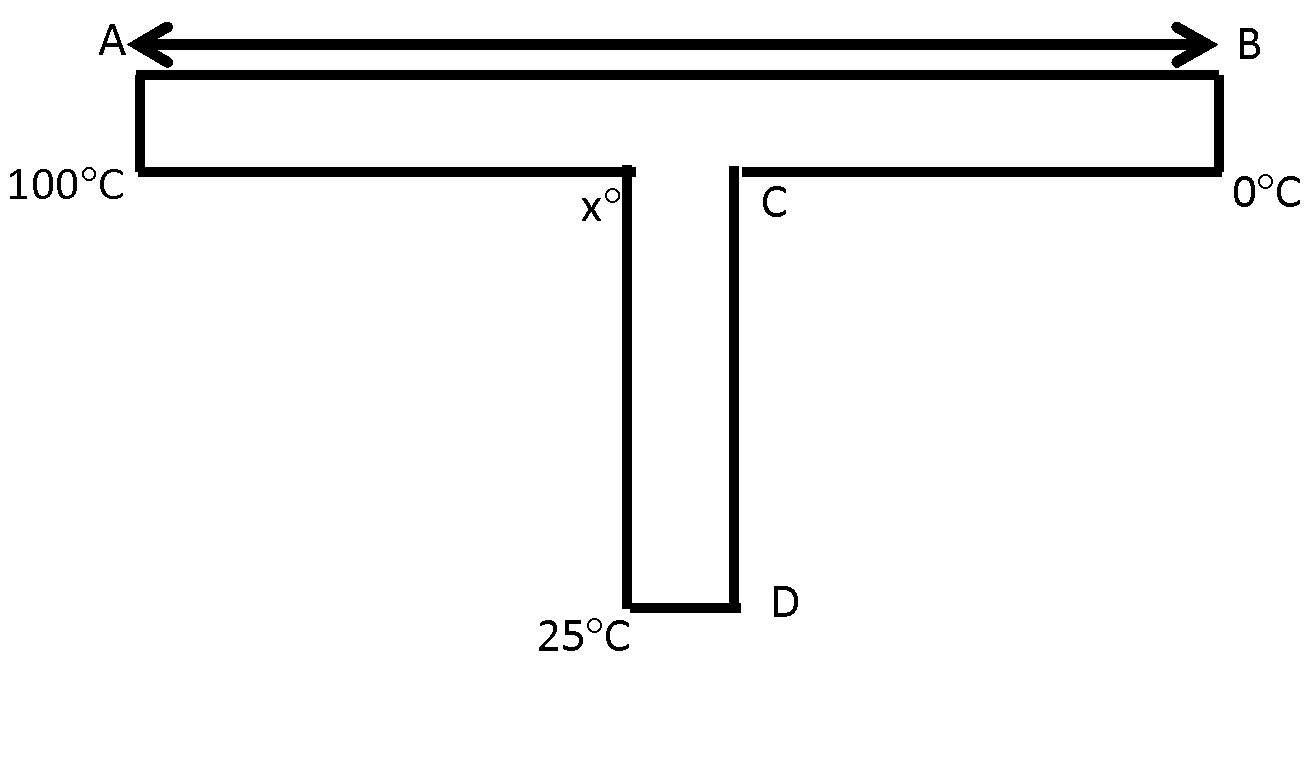
A rod CD of thermal resistance $5.0K/W$ is joined at the middle of an identical rod AB as shown in figure, the ends A, B and D are maintained at $10^\circ C$ and $25^\circ C$ respectively. Find the heat current (in W) in CD.
Answer
 Verified
618.6k+ views
Hint: The heat current always flows from higher temperature to lower temperature. Also, by junction law, the heat current through AC is the sum of heat current through CD and CB.
Formula used:
Heat current, $H = \dfrac{Q}{t} = \dfrac{{KA\left( {{T_1} - {T_2}} \right)}}{x}$
Where A is the cross sectional area ${T_1}$ is the temperature of the hot part.
${T_2}$ is temperature of cold part
$x$ is the length covered
$Q$ is heat and t is time taken for its flow
Complete step by step answer:
As both rods are identical, so the areas of both are same
And total lengths are also the same. So, area of cross section is
constant $ = A$. As A is at higher temperature than both
D and B So, current will flow from A to both arms B and D.
So, by junction law, heat current of AC $ = $ Heat current of BC $ + $ Heat current of CD
i.e.,
${H_{AC}} = {H_{CB}} + {H_{CD}}$… (i)
Let C be at $x^\circ C$ temperature.
as we know heat current, $H = \dfrac{{KA\left( {{T_1} - {T_2}} \right)}}{x}$
So, equation (i) becomes
$\dfrac{{KA\left( {100 - x} \right)}}{{l/2}} = \dfrac{{KA\left( {x - 0} \right)}}{{l/2}} + \dfrac{{KA\left( {x - 25} \right)}}{l}$
$
\Rightarrow 2\left( {100 - x} \right) = 2\left( x \right) + x - 25 \\
\Rightarrow 200 - 2x = 2x + x - 25 \\
\Rightarrow 200 - 2x = 3x - 25 \\
\Rightarrow 5x = 225 \\
\Rightarrow x = \dfrac{{225}}{5} \\
\Rightarrow x = 45^\circ C \\
$
So, the temperature at C is $45^\circ C$.
So, the heat current for part CD is
$
{H_{CD}} = \dfrac{Q}{t} = \dfrac{{KA\left( {45 - 25} \right)}}{l} \\
= \dfrac{{20}}{{l/KA}} = \dfrac{{20}}{5} = 4W \\
$
As thermal resistance $ = \dfrac{l}{{KA}} = 5K{W^{ - 1}}$
So, heat current is $4W$.
Note:
Remember for heat currents ${H_{AC}}$ and ${H_{CB}}$, the value of x is $l/2$ not l this is because the rod CD is in the middle of AB.Also remember the concept of thermal resistance and calorimetry while solving the question.
Formula used:
Heat current, $H = \dfrac{Q}{t} = \dfrac{{KA\left( {{T_1} - {T_2}} \right)}}{x}$
Where A is the cross sectional area ${T_1}$ is the temperature of the hot part.
${T_2}$ is temperature of cold part
$x$ is the length covered
$Q$ is heat and t is time taken for its flow
Complete step by step answer:
As both rods are identical, so the areas of both are same
And total lengths are also the same. So, area of cross section is
constant $ = A$. As A is at higher temperature than both
D and B So, current will flow from A to both arms B and D.
So, by junction law, heat current of AC $ = $ Heat current of BC $ + $ Heat current of CD
i.e.,
${H_{AC}} = {H_{CB}} + {H_{CD}}$… (i)
Let C be at $x^\circ C$ temperature.
as we know heat current, $H = \dfrac{{KA\left( {{T_1} - {T_2}} \right)}}{x}$
So, equation (i) becomes
$\dfrac{{KA\left( {100 - x} \right)}}{{l/2}} = \dfrac{{KA\left( {x - 0} \right)}}{{l/2}} + \dfrac{{KA\left( {x - 25} \right)}}{l}$
$
\Rightarrow 2\left( {100 - x} \right) = 2\left( x \right) + x - 25 \\
\Rightarrow 200 - 2x = 2x + x - 25 \\
\Rightarrow 200 - 2x = 3x - 25 \\
\Rightarrow 5x = 225 \\
\Rightarrow x = \dfrac{{225}}{5} \\
\Rightarrow x = 45^\circ C \\
$
So, the temperature at C is $45^\circ C$.
So, the heat current for part CD is
$
{H_{CD}} = \dfrac{Q}{t} = \dfrac{{KA\left( {45 - 25} \right)}}{l} \\
= \dfrac{{20}}{{l/KA}} = \dfrac{{20}}{5} = 4W \\
$
As thermal resistance $ = \dfrac{l}{{KA}} = 5K{W^{ - 1}}$
So, heat current is $4W$.
Note:
Remember for heat currents ${H_{AC}}$ and ${H_{CB}}$, the value of x is $l/2$ not l this is because the rod CD is in the middle of AB.Also remember the concept of thermal resistance and calorimetry while solving the question.
Recently Updated Pages
Master Class 12 Economics: Engaging Questions & Answers for Success

Master Class 12 English: Engaging Questions & Answers for Success
Master Class 12 Social Science: Engaging Questions & Answers for Success
Master Class 12 Maths: Engaging Questions & Answers for Success
Master Class 12 Physics: Engaging Questions & Answers for Success
Master Class 9 General Knowledge: Engaging Questions & Answers for Success
Trending doubts
One Metric ton is equal to kg A 10000 B 1000 C 100 class 11 physics CBSE
Difference Between Prokaryotic Cells and Eukaryotic Cells
Two of the body parts which do not appear in MRI are class 11 biology CBSE
Find the value of the expression given below sin 30circ class 11 maths CBSE
1 ton equals to A 100 kg B 1000 kg C 10 kg D 10000 class 11 physics CBSE
Draw a diagram of nephron and explain its structur class 11 biology CBSE