




A rocket with a lift-off mass $3.5 \times 10^{4}$ kg is blasted upwards with an initial acceleration of $10 \mathrm{m} / \mathrm{s}^{2}$. Then the initial thrust of the blast is-
(A) $3.5 \times 10^{5} \mathrm{N}$
(B) $7.0\times {{10}^{5}}\text{N}$
(C) $14.0 \times 10^{5} \mathrm{N}$
(D) $175 \times 10^{1} \mathrm{N}$
Answer
 Verified
611.7k+ views
Hint
We know that thrust is defined as a mechanical force that is generated most often through the reaction between the accelerating masses of the gases that are taken into consideration. Based on this concept we have to solve this question.
Complete step by step answer
From the figure given, we can see that the force due to gravity mg acts on the rocket in the downward direction while the thrust F acts in the upward direction.
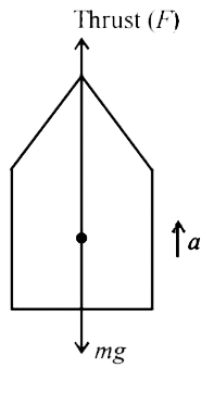
$F-m g=m a$.
By solving the above equation, we get,
$\therefore F=m(g+a)$.
Given,
Mass of rocket while lift-off (m) = $3.5 \times 10^{4}$kg
The initial acceleration of rocket while lift-off is $10 \mathrm{m} / \mathrm{s}^{2}$
Therefore, the thrust can be calculated with the equation given which evaluates to:
$=3.5+{{10}^{4}}(10+10)$
$=7\times {{10}^{5}}\text{N}$
Therefore, the correct answer is Option (B).
Note
We should know that thrust is mostly generated because of the reaction of the acceleration between the gases, but it should not be confused with acceleration. Trust is a vector quantity since it gives us an idea about the accelerating direction of the gas as well. The magnitude of the thrust depends on the amount of the gas that is accelerated and on the difference in the velocity of the gas that is passed through the engine.
We know that thrust is defined as a mechanical force that is generated most often through the reaction between the accelerating masses of the gases that are taken into consideration. Based on this concept we have to solve this question.
Complete step by step answer
From the figure given, we can see that the force due to gravity mg acts on the rocket in the downward direction while the thrust F acts in the upward direction.
$F-m g=m a$.
By solving the above equation, we get,
$\therefore F=m(g+a)$.
Given,
Mass of rocket while lift-off (m) = $3.5 \times 10^{4}$kg
The initial acceleration of rocket while lift-off is $10 \mathrm{m} / \mathrm{s}^{2}$
Therefore, the thrust can be calculated with the equation given which evaluates to:
$=3.5+{{10}^{4}}(10+10)$
$=7\times {{10}^{5}}\text{N}$
Therefore, the correct answer is Option (B).
Note
We should know that thrust is mostly generated because of the reaction of the acceleration between the gases, but it should not be confused with acceleration. Trust is a vector quantity since it gives us an idea about the accelerating direction of the gas as well. The magnitude of the thrust depends on the amount of the gas that is accelerated and on the difference in the velocity of the gas that is passed through the engine.
Recently Updated Pages
Master Class 12 Economics: Engaging Questions & Answers for Success

Master Class 12 English: Engaging Questions & Answers for Success
Master Class 12 Social Science: Engaging Questions & Answers for Success
Master Class 12 Maths: Engaging Questions & Answers for Success
Master Class 12 Physics: Engaging Questions & Answers for Success
Master Class 9 General Knowledge: Engaging Questions & Answers for Success
Trending doubts
One Metric ton is equal to kg A 10000 B 1000 C 100 class 11 physics CBSE
Difference Between Prokaryotic Cells and Eukaryotic Cells
Two of the body parts which do not appear in MRI are class 11 biology CBSE
1 ton equals to A 100 kg B 1000 kg C 10 kg D 10000 class 11 physics CBSE
Draw a diagram of nephron and explain its structur class 11 biology CBSE
10 examples of friction in our daily life