




A rocket is launched normal to the surface of the Earth, away from the sun, along the line joining the Sun and the Earth. The Sun is $3\times {{10}^{5}}$ times heavier than the Earth and is at a distance $2.5\times {{10}^{4}}$ times larger than the radius of the Earth. The escape velocity from Earth’s gravitational field is ${{v}_{e}}=11.2\,\,km{{s}^{-1}}$. The minimum initial velocity $({{v}_{s}})$ required for the rocket to be able to leave the Sun-Earth system is closest to (Ignore the rotation and revolution of the Earth and the presence of any other planet)
(A) ${{v}_{s}}=62\,\,km{{s}^{-1}}$
(B) ${{v}_{s}}=42\,\,km{{s}^{-1}}$
(C) ${{v}_{s}}=72\,\,km{{s}^{-1}}$
(D) ${{v}_{s}}=22\,\,km{{s}^{-1}}$
Answer
 Verified
594.3k+ views
Hint: To find the minimum initial velocity, we use conservation of energy theorem. From law of conservation of energy, we have
Loss in kinetic energy = Gain in potential energy
Complete step by step solution:
Let ${{M}_{e}}$ be the mass of Earth and $R$ be the radius of Earth.
Given: Mass of Sun ${{M}_{s}}=3\times {{10}^{5}}{{M}_{e}}$, Distance between Earth and Sun $d=2.5\times {{10}^{4}}R$, Escape velocity ${{v}_{e}}=11.2\,\,km{{s}^{-1}}$
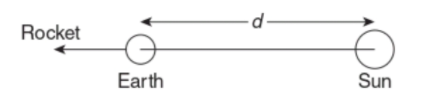
According to law of conservation of energy, we get
$\dfrac{1}{2}m{{v}_{s}}^{2}=\dfrac{G{{M}_{e}}m}{R}+\dfrac{G{{M}_{s}}m}{R+d}$ $...(\text{i})$
Where $m$ is the mass of the rocket.
But here $d>>R$, so we can write $R+d\approx d$
By putting the given values in equation $(\text{i})$, we get
$\Rightarrow \dfrac{1}{2}m{{v}_{s}}^{2}=\dfrac{G{{M}_{e}}m}{R}+\dfrac{G(3.5\times {{10}^{5}}{{M}_{e}})m}{2.5\times {{10}^{4}}R}$
$\Rightarrow \dfrac{1}{2}m{{v}_{s}}^{2}=\dfrac{G{{M}_{e}}m}{R}\left( 1+\dfrac{3\times {{10}^{5}}}{2.5\times {{10}^{4}}} \right)$
$\Rightarrow \dfrac{1}{2}m{{v}_{s}}^{2}=\dfrac{G{{M}_{e}}m}{R}\left( 1+12 \right)$
$\Rightarrow \dfrac{1}{2}m{{v}_{s}}^{2}=\dfrac{13G{{M}_{e}}m}{R}$
$\Rightarrow {{v}_{s}}^{2}=2\times \dfrac{13G{{M}_{e}}}{R}$
$\Rightarrow {{v}_{s}}=\sqrt{2\times \dfrac{13G{{M}_{e}}}{R}}$ $...(\text{ii})$
It is given that escape velocity ${{v}_{e}}=11.2\,\,km{{s}^{-1}}$.
Escape velocity on earth is defined as the minimum velocity with which the body has to be projected vertically upwards from the surface of earth so that it crosses the gravitational field of earth and never returns.
Escape velocity of Earth is given by,
${{v}_{e}}=\sqrt{\dfrac{2G{{M}_{e}}}{R}}$ $...\text{(iii)}$
Where $G=$ universal gravitational constant. Its value is $6.67\times {{10}^{-11\,\,}}{{m}^{3}}k{{g}^{-1}}{{s}^{-2}}$
Put the value of equation $(\text{iii})$ in equation $(\text{ii})$, we get
${{v}_{s}}=\sqrt{13}\,{{v}_{e}}$
$\Rightarrow {{v}_{s}}=\sqrt{13}\times 11.2$
$\Rightarrow {{v}_{s}}=40.38\,\,km{{s}^{-1}}$
$\Rightarrow {{v}_{s}}\approx 42\,\,km{{s}^{-1}}$
Note:Escape velocity is the minimum velocity with which the body must be thrown so that it just escapes the gravitational field of the nearby object. Here in our case a nearby object is Earth and sun.
Loss in kinetic energy = Gain in potential energy
Complete step by step solution:
Let ${{M}_{e}}$ be the mass of Earth and $R$ be the radius of Earth.
Given: Mass of Sun ${{M}_{s}}=3\times {{10}^{5}}{{M}_{e}}$, Distance between Earth and Sun $d=2.5\times {{10}^{4}}R$, Escape velocity ${{v}_{e}}=11.2\,\,km{{s}^{-1}}$
According to law of conservation of energy, we get
$\dfrac{1}{2}m{{v}_{s}}^{2}=\dfrac{G{{M}_{e}}m}{R}+\dfrac{G{{M}_{s}}m}{R+d}$ $...(\text{i})$
Where $m$ is the mass of the rocket.
But here $d>>R$, so we can write $R+d\approx d$
By putting the given values in equation $(\text{i})$, we get
$\Rightarrow \dfrac{1}{2}m{{v}_{s}}^{2}=\dfrac{G{{M}_{e}}m}{R}+\dfrac{G(3.5\times {{10}^{5}}{{M}_{e}})m}{2.5\times {{10}^{4}}R}$
$\Rightarrow \dfrac{1}{2}m{{v}_{s}}^{2}=\dfrac{G{{M}_{e}}m}{R}\left( 1+\dfrac{3\times {{10}^{5}}}{2.5\times {{10}^{4}}} \right)$
$\Rightarrow \dfrac{1}{2}m{{v}_{s}}^{2}=\dfrac{G{{M}_{e}}m}{R}\left( 1+12 \right)$
$\Rightarrow \dfrac{1}{2}m{{v}_{s}}^{2}=\dfrac{13G{{M}_{e}}m}{R}$
$\Rightarrow {{v}_{s}}^{2}=2\times \dfrac{13G{{M}_{e}}}{R}$
$\Rightarrow {{v}_{s}}=\sqrt{2\times \dfrac{13G{{M}_{e}}}{R}}$ $...(\text{ii})$
It is given that escape velocity ${{v}_{e}}=11.2\,\,km{{s}^{-1}}$.
Escape velocity on earth is defined as the minimum velocity with which the body has to be projected vertically upwards from the surface of earth so that it crosses the gravitational field of earth and never returns.
Escape velocity of Earth is given by,
${{v}_{e}}=\sqrt{\dfrac{2G{{M}_{e}}}{R}}$ $...\text{(iii)}$
Where $G=$ universal gravitational constant. Its value is $6.67\times {{10}^{-11\,\,}}{{m}^{3}}k{{g}^{-1}}{{s}^{-2}}$
Put the value of equation $(\text{iii})$ in equation $(\text{ii})$, we get
${{v}_{s}}=\sqrt{13}\,{{v}_{e}}$
$\Rightarrow {{v}_{s}}=\sqrt{13}\times 11.2$
$\Rightarrow {{v}_{s}}=40.38\,\,km{{s}^{-1}}$
$\Rightarrow {{v}_{s}}\approx 42\,\,km{{s}^{-1}}$
Note:Escape velocity is the minimum velocity with which the body must be thrown so that it just escapes the gravitational field of the nearby object. Here in our case a nearby object is Earth and sun.
Recently Updated Pages
Master Class 11 Social Science: Engaging Questions & Answers for Success

Master Class 11 Physics: Engaging Questions & Answers for Success
Master Class 11 Maths: Engaging Questions & Answers for Success
Master Class 11 Economics: Engaging Questions & Answers for Success
Master Class 11 Computer Science: Engaging Questions & Answers for Success
Master Class 11 Chemistry: Engaging Questions & Answers for Success
Trending doubts
One Metric ton is equal to kg A 10000 B 1000 C 100 class 11 physics CBSE
There are 720 permutations of the digits 1 2 3 4 5 class 11 maths CBSE
1 Quintal is equal to a 110 kg b 10 kg c 100kg d 1000 class 11 physics CBSE
State and prove Bernoullis theorem class 11 physics CBSE
Difference Between Prokaryotic Cells and Eukaryotic Cells
Discuss the various forms of bacteria class 11 biology CBSE