




A rock is launched upward at ${45^o}$. A bee moves along the trajectory of the rock at a constant speed equal to the initial speed of the rock. What is the magnitude of acceleration (in m${s^{ - 2}}$) of the bee at the top point of the trajectory? For the rock, neglect the air resistance.
(A) 20
(B) 30
(C) 40
(D) 50
Answer
 Verified
561.3k+ views
Hint : In a projectile motion a body moves simultaneously in the direction of horizontal and vertical. Here in question it is projected with${45^o}$. We first find out the acceleration due to gravity of rock which is $\dfrac{{{{\left( {v{{\cos }^o}} \right)}^2}}}{r}$ =g, where v is the final velocity, r is the radius of curvature and g is the gravity=10$m{s^{ - 2}}$ . From there we will get $\dfrac{{{v^2}}}{r}$ for stone and it will be the same for bees too.
Complete Step by step solution:
Step 1:
Projectile motion is a form of motion experienced by an object or particle (a projectile) that is projected near the Earth's surface and moves along a curved path under the action of gravity only (in particular, the effects of air resistance are assumed to be negligible).
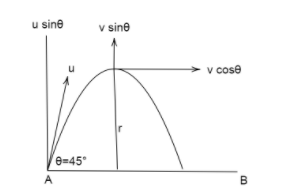
When a particle is projected obliquely near the earth’s surface, it moves simultaneously in the direction of horizontal and vertical. The motion of such a particle is called Projectile Motion. In the below diagram, where a particle is projected at an angle$\theta $ =${45^o}$ with an initial velocity u.
We have a diagram below for the better understanding of the question. Stone moves along tangentially hence along the cos$\theta $ component.
Step 2:
We are given a bee moves along the trajectory of the rock at a constant speed equal to the initial speed of the rock
And we have to find the magnitude of acceleration (in m${s^{ - 2}}$) of the bee at the top point of the trajectory.
So, the acceleration due to gravity of rock at the top point is $\dfrac{{{{\left( {v{{\cos }^o}} \right)}^2}}}{r}$=g, where v is the final velocity, r is the radius of curvature and g is the gravity=10$m{s^{ - 2}}$
From here we can write it as $\dfrac{{{v^2}}}{r}$=$\dfrac{g}{{\cos \theta }}$ ……. (1)
We are given$\theta $=${45^o}$ and cos${45^o}$=$\dfrac{1}{{\sqrt 2 }}$ ($\therefore {\cos ^2}{45^o} = \dfrac{1}{2}$ )
Putting in equation (1) the value of ${\cos ^2}{45^o}$ and g we will get $\dfrac{{{v^2}}}{r}$=20m${s^{ - 2}}$
The bee and rock will have same radius of curvature r hence the magnitude of acceleration (in m${s^{ - 2}}$) of the bee at the top point of the trajectory is 20$m{s^{ - 2}}$
Option A is correct.
Note:
In projectile motion the maximum horizontal range can be obtained when an object is thrown at an angle of ${45^o}$ and here the range will be maximum for the stone. For maximum horizontal range ${R_m} = \dfrac{{{v^2}}}{g}$ , g is the gravity constant and v is velocity.
Complete Step by step solution:
Step 1:
Projectile motion is a form of motion experienced by an object or particle (a projectile) that is projected near the Earth's surface and moves along a curved path under the action of gravity only (in particular, the effects of air resistance are assumed to be negligible).
When a particle is projected obliquely near the earth’s surface, it moves simultaneously in the direction of horizontal and vertical. The motion of such a particle is called Projectile Motion. In the below diagram, where a particle is projected at an angle$\theta $ =${45^o}$ with an initial velocity u.
We have a diagram below for the better understanding of the question. Stone moves along tangentially hence along the cos$\theta $ component.
Step 2:
We are given a bee moves along the trajectory of the rock at a constant speed equal to the initial speed of the rock
And we have to find the magnitude of acceleration (in m${s^{ - 2}}$) of the bee at the top point of the trajectory.
So, the acceleration due to gravity of rock at the top point is $\dfrac{{{{\left( {v{{\cos }^o}} \right)}^2}}}{r}$=g, where v is the final velocity, r is the radius of curvature and g is the gravity=10$m{s^{ - 2}}$
From here we can write it as $\dfrac{{{v^2}}}{r}$=$\dfrac{g}{{\cos \theta }}$ ……. (1)
We are given$\theta $=${45^o}$ and cos${45^o}$=$\dfrac{1}{{\sqrt 2 }}$ ($\therefore {\cos ^2}{45^o} = \dfrac{1}{2}$ )
Putting in equation (1) the value of ${\cos ^2}{45^o}$ and g we will get $\dfrac{{{v^2}}}{r}$=20m${s^{ - 2}}$
The bee and rock will have same radius of curvature r hence the magnitude of acceleration (in m${s^{ - 2}}$) of the bee at the top point of the trajectory is 20$m{s^{ - 2}}$
Option A is correct.
Note:
In projectile motion the maximum horizontal range can be obtained when an object is thrown at an angle of ${45^o}$ and here the range will be maximum for the stone. For maximum horizontal range ${R_m} = \dfrac{{{v^2}}}{g}$ , g is the gravity constant and v is velocity.
Recently Updated Pages
Master Class 11 Social Science: Engaging Questions & Answers for Success

Master Class 11 Physics: Engaging Questions & Answers for Success
Master Class 11 Maths: Engaging Questions & Answers for Success
Master Class 11 Economics: Engaging Questions & Answers for Success
Master Class 11 Computer Science: Engaging Questions & Answers for Success
Master Class 11 Chemistry: Engaging Questions & Answers for Success
Trending doubts
One Metric ton is equal to kg A 10000 B 1000 C 100 class 11 physics CBSE
There are 720 permutations of the digits 1 2 3 4 5 class 11 maths CBSE
1 Quintal is equal to a 110 kg b 10 kg c 100kg d 1000 class 11 physics CBSE
State and prove Bernoullis theorem class 11 physics CBSE
Difference Between Prokaryotic Cells and Eukaryotic Cells
Which among the following are examples of coming together class 11 social science CBSE