




A road is 8m wide. Two poles measuring 10m and 16m are fixed on two sides across the road. Find distance between their upper ends $(AC)$.

Answer
 Verified
629.4k+ views
Hint : In above question we need to find the length of AC.
For that we will assume this figure. As a combination of two figures. Below one is a rectangle with sides ABDE and above one is the right triangle AEC.
We have all the dimensions of the rectangle, we will find dimensions of triangles.
Formulas/Properties used
1. Pythagorean Theorem -
According to this theorem ${(Hypotenuse)^2} = $ sum of square of legs
${(AB)^2} = {(AC)^2} + {(BC)^2}$
2. Property of rectangle – Opposite sides of rectangle are equal and parallel to each other. And its vertices make an angle of $90^\circ $.
Complete step by step solution :
Let’s divide the given figure in two parts.
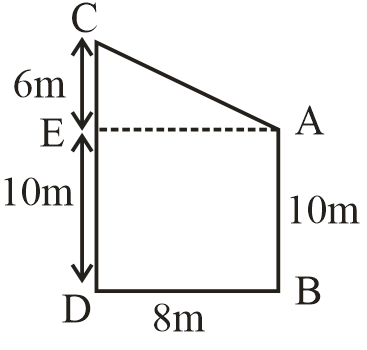
Two parts of given figure one is $\Delta ACE$ and other one is rectangle ABDE
Here in $\Delta ACE$
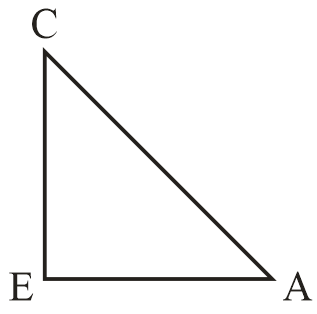
$EA = 8m$
$CE = CD = ED$
$ = (16 - 10)m$
$CE = 6m$
In rectangle ABDE
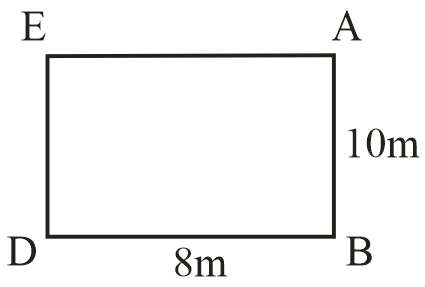
If $AB = 10m$ given
$ED = 10m$ (opposite sides of rectangle are equal)
$DB = 8m$ (given)
$EA = 8m$ (opposite sides of rectangle)
$\Delta ACE$ is a right angled triangle, so by using Pythagora's theorem.
${(Hypotenuse)^2} = {(Base)^2} + {(Perpendicular)^2}$
${(AC)^2} = {(CE)^2} + {(AE)^2}$
${(AC)^2} = {(6)^2} + {(8)^2}$
${(AC)^2} = 36 + 64$
${(AC)^2} = 100$
$AC = \sqrt {100} $
$AC = 10m$
Therefore distance between upper ends of given figure is $AC = 10m$
Note: While using Pythagoras theorem do not make the mistake of adding the values of both the legs first and then squaring the result. It is incorrect .
For that we will assume this figure. As a combination of two figures. Below one is a rectangle with sides ABDE and above one is the right triangle AEC.
We have all the dimensions of the rectangle, we will find dimensions of triangles.
Formulas/Properties used
1. Pythagorean Theorem -
According to this theorem ${(Hypotenuse)^2} = $ sum of square of legs
${(AB)^2} = {(AC)^2} + {(BC)^2}$
2. Property of rectangle – Opposite sides of rectangle are equal and parallel to each other. And its vertices make an angle of $90^\circ $.
Complete step by step solution :
Let’s divide the given figure in two parts.
Two parts of given figure one is $\Delta ACE$ and other one is rectangle ABDE
Here in $\Delta ACE$
$EA = 8m$
$CE = CD = ED$
$ = (16 - 10)m$
$CE = 6m$
In rectangle ABDE
If $AB = 10m$ given
$ED = 10m$ (opposite sides of rectangle are equal)
$DB = 8m$ (given)
$EA = 8m$ (opposite sides of rectangle)
$\Delta ACE$ is a right angled triangle, so by using Pythagora's theorem.
${(Hypotenuse)^2} = {(Base)^2} + {(Perpendicular)^2}$
${(AC)^2} = {(CE)^2} + {(AE)^2}$
${(AC)^2} = {(6)^2} + {(8)^2}$
${(AC)^2} = 36 + 64$
${(AC)^2} = 100$
$AC = \sqrt {100} $
$AC = 10m$
Therefore distance between upper ends of given figure is $AC = 10m$
Note: While using Pythagoras theorem do not make the mistake of adding the values of both the legs first and then squaring the result. It is incorrect .
Recently Updated Pages
Master Class 11 English: Engaging Questions & Answers for Success

Master Class 11 Social Science: Engaging Questions & Answers for Success
Master Class 11 Maths: Engaging Questions & Answers for Success
Master Class 11 Biology: Engaging Questions & Answers for Success
Master Class 11 Physics: Engaging Questions & Answers for Success
Master Class 11 Chemistry: Engaging Questions & Answers for Success
Trending doubts
Explain the Treaty of Vienna of 1815 class 10 social science CBSE
What is the Total Duration of Football Match?
The shortest day of the year in India
In which year voting age was reduced from 21 to 18?
10 examples of evaporation in daily life with explanations
What planets have no moons Which one has only one moon class 10 physics CBSE