




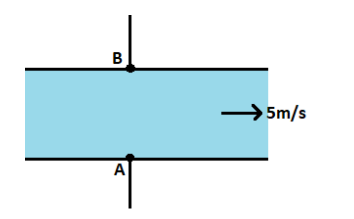
A river is flowing from west to east with a speed 5 m/s. A swimmer can swim in still water at a speed of 10 m/s. If he wants to start from point A on the south bank and reach opposite point B on the north bank, in what direction should he swim?
A. ${{30}^{o}}$ east of north
B. ${{60}^{o}}$ east of north
C. ${{30}^{o}}$ west of north
D. ${{60}^{o}}$ west of north
Answer
 Verified
628.2k+ views
Hint: We have a river and the velocity of the flow of the river is given. A swimmer needs to cross the river from point A to point B. since the river is flowing the swimmer should jump to the river in the opposite direction of the flow of the river. We can find the angle of the direction by drawing the figure.
Complete step-by-step answer:
In the question we have a river and velocity of the flow of the river is given
${{v}_{r}}=5m/s$
There is a swimmer who wants to cross the river from point A on the south bank to point B on the north bank.
It is said that the swimmer can swim in still water with a velocity,
${{v}_{s}}=10m/s$
For the swimmer to reach point B, he needs to jump from point A making an angle $\text{ }\!\!\theta\!\!\text{ }$ with the vertical.
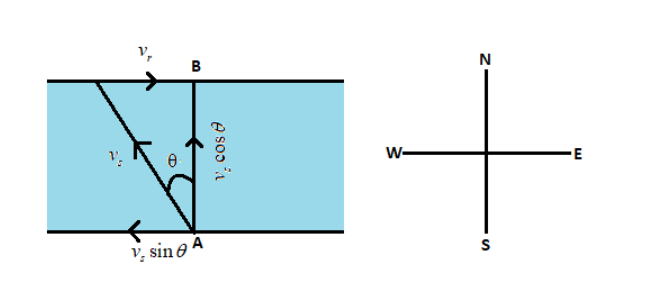
When the swimmer jumps by making an angle $\text{ }\!\!\theta\!\!\text{ }$, the direction should be opposite to the direction of the flow of the river. I.e. the direction of the will be west north.
When he jumps in the west north direction by making the angle $\text{ }\!\!\theta\!\!\text{ }$, the swimmer will have his velocity 10m/s and the river will have its velocity 5m/s. Therefore due to the velocity of the river in the east direction the swimmer will reach the point B.
Now we need to find out the angle $\text{ }\!\!\theta\!\!\text{ }$
Consider the figure.
We know that the swimmer will jump with a velocity 10m/s.
It will have two components in x and y directions.
${{v}_{s}}\cos \theta =10\cos \theta $, in the y direction and,
${{v}_{s}}\sin \theta =10\sin \theta $ In the negative x direction
We know that the river is flowing in the positive x direction with a velocity 5m/s
For the man jumping from point A to reach point B, the velocity of the river should be equal to the x component of the velocity of the swimmer.
i.e. when the velocity of the river equals the horizontal velocity of the swimmer, the swimmer will swim with a velocity of $10\cos \theta $ in the y direction, thus reaching point B.
Therefore,
$\begin{align}
& 10\sin \theta =5m/s \\
& \sin \theta =\dfrac{5}{10} \\
& \sin \theta =\dfrac{1}{2} \\
& \theta ={{\sin }^{-1}}\left( \dfrac{1}{2} \right) \\
& \theta ={{30}^{o}} \\
\end{align}$
Therefore the swimmer should jump from point A at an angle of ${{30}^{o}}$ in the west north direction to reach point B.
Hence the correct answer is option C.
Note: If the swimmer jumps straight from point A to the river, he will not reach point B.
This is because the swimmer has a velocity of 10m/s in the north direction and river has a velocity of 5m/s in the east direction. Therefore the direction of the swimmer will be the resultant of these two velocities. Hence he will not reach the point B.
Therefore we can’t jump directly from point A.
Complete step-by-step answer:
In the question we have a river and velocity of the flow of the river is given
${{v}_{r}}=5m/s$
There is a swimmer who wants to cross the river from point A on the south bank to point B on the north bank.
It is said that the swimmer can swim in still water with a velocity,
${{v}_{s}}=10m/s$
For the swimmer to reach point B, he needs to jump from point A making an angle $\text{ }\!\!\theta\!\!\text{ }$ with the vertical.
When the swimmer jumps by making an angle $\text{ }\!\!\theta\!\!\text{ }$, the direction should be opposite to the direction of the flow of the river. I.e. the direction of the will be west north.
When he jumps in the west north direction by making the angle $\text{ }\!\!\theta\!\!\text{ }$, the swimmer will have his velocity 10m/s and the river will have its velocity 5m/s. Therefore due to the velocity of the river in the east direction the swimmer will reach the point B.
Now we need to find out the angle $\text{ }\!\!\theta\!\!\text{ }$
Consider the figure.
We know that the swimmer will jump with a velocity 10m/s.
It will have two components in x and y directions.
${{v}_{s}}\cos \theta =10\cos \theta $, in the y direction and,
${{v}_{s}}\sin \theta =10\sin \theta $ In the negative x direction
We know that the river is flowing in the positive x direction with a velocity 5m/s
For the man jumping from point A to reach point B, the velocity of the river should be equal to the x component of the velocity of the swimmer.
i.e. when the velocity of the river equals the horizontal velocity of the swimmer, the swimmer will swim with a velocity of $10\cos \theta $ in the y direction, thus reaching point B.
Therefore,
$\begin{align}
& 10\sin \theta =5m/s \\
& \sin \theta =\dfrac{5}{10} \\
& \sin \theta =\dfrac{1}{2} \\
& \theta ={{\sin }^{-1}}\left( \dfrac{1}{2} \right) \\
& \theta ={{30}^{o}} \\
\end{align}$
Therefore the swimmer should jump from point A at an angle of ${{30}^{o}}$ in the west north direction to reach point B.
Hence the correct answer is option C.
Note: If the swimmer jumps straight from point A to the river, he will not reach point B.
This is because the swimmer has a velocity of 10m/s in the north direction and river has a velocity of 5m/s in the east direction. Therefore the direction of the swimmer will be the resultant of these two velocities. Hence he will not reach the point B.
Therefore we can’t jump directly from point A.
Recently Updated Pages
Master Class 11 English: Engaging Questions & Answers for Success

Master Class 11 Social Science: Engaging Questions & Answers for Success
Master Class 11 Maths: Engaging Questions & Answers for Success
Master Class 11 Biology: Engaging Questions & Answers for Success
Master Class 11 Physics: Engaging Questions & Answers for Success
Master Class 11 Chemistry: Engaging Questions & Answers for Success
Trending doubts
One Metric ton is equal to kg A 10000 B 1000 C 100 class 11 physics CBSE
Difference Between Prokaryotic Cells and Eukaryotic Cells
Find the value of the expression given below sin 30circ class 11 maths CBSE
Difference between physical and chemical change class 11 chemistry CBSE
Two of the body parts which do not appear in MRI are class 11 biology CBSE
Draw a diagram of a plant cell and label at least eight class 11 biology CBSE