




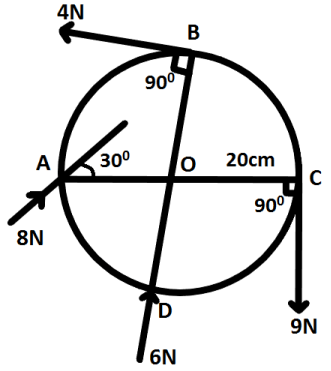
A ring of radius $ 20cm $ and mass $ 100g $ is acted upon by our forces as shown in figure. The angular velocity required by it in $ 2s $ starting from the rest is:
(A) $ 90rad/s $
(B) $ 900rad/s $
(C) $ 180rad/s $
(D) $ 950rad/s $
Answer
 Verified
540.6k+ views
Hint :To solve this question, we will first find the total torque applied on the ring. Then by using the relationship between torque and angular acceleration, we will find the angular acceleration of the ring. And finally, using this acceleration and time given, we will find the angular velocity of the ring.
$ \tau = Fr\sin \theta $ , where, $ \tau $ is the torque, $ F $ is the force, $ r $ is the radius of the ring, $ \theta $ is the angle through which the force is applied
$ \tau = I\alpha $ , where, $ \tau $ is the torque, $ I $ is the moment of inertia of the ring about its centre and $ \alpha $ is the angular acceleration.
$ I = m{r^2} $ , where, $ I $ is the moment of inertia of the ring about its centre, $ m $ is the mass of the ring and $ r $ is the radius of the ring
$ \omega = \alpha t $ , where, $ \alpha $ is the angular acceleration, $ \omega $ is the angular velocity and $ t $ is the time.
Complete Step By Step Answer:
First we will find the total torque for which we need to find the torque due to individual forces applied on the body. We will take compressive force as negative and tensile force as positive.
$ {\tau _A} = {F_A}r\sin {\theta _A} = - 8 \times 0.2 \times \sin 30 = - 8 \times 0.2 \times \dfrac{1}{2} = - 0.8Nm $
$ {\tau _B} = {F_B}r\sin {\theta _B} = 4 \times 0.2 \times \sin 90 = 4 \times 0.2 \times 1 = 0.8Nm $ $ $
$ {\tau _C} = {F_C}r\sin {\theta _C} = 9 \times 0.2 \times \sin 90 = 9 \times 0.2 \times 1 = 1.8Nm $
Now, the line of force applied at point D passes through the centre of the ring. Therefore,
$ {\tau _D} = {F_D} \times 0 = - 6 \times 0 = 0Nm $
Thus, we can say that the total torque is given by:
$ \tau = {\tau _A} + {\tau _B} + {\tau _C} + {\tau _D} = - 0.8 + 0.8 + 1.8 - 0 = 1.8Nm $
Now, we will find the angular acceleration.
We know that $ \tau = I\alpha $ and $ I = m{r^2} $
$
\Rightarrow \tau = m{r^2}\alpha \\
\Rightarrow \alpha = \dfrac{\tau }{{m{r^2}}} \\
$
We have $ \tau = 1.8Nm $ , $ m = 100g = 0.1kg $ and $ r = 20cm = 0.2m $ .
$ \Rightarrow \alpha = \dfrac{{1.8}}{{0.1 \times {{0.2}^2}}} = 450rad/{s^2} $
We know that angular velocity can be given by the formula $ \omega = \alpha t $ and we are asked to find the angular velocity for the time period of $ 2s $ .
$ \Rightarrow \omega = \alpha t = 450 \times 2 = 900rad/s $
Hence, option B is the right answer.
Note :
Here, we have used the formula for the moment of inertia of the ring about its centre which is $ I = m{r^2} $ . However, if the solid disc is given instead of the ring this formula becomes $ I = \dfrac{1}{2}m{r^2} $ . The procedure for the disc remains the same except this change in its moment of inertia.
$ \tau = Fr\sin \theta $ , where, $ \tau $ is the torque, $ F $ is the force, $ r $ is the radius of the ring, $ \theta $ is the angle through which the force is applied
$ \tau = I\alpha $ , where, $ \tau $ is the torque, $ I $ is the moment of inertia of the ring about its centre and $ \alpha $ is the angular acceleration.
$ I = m{r^2} $ , where, $ I $ is the moment of inertia of the ring about its centre, $ m $ is the mass of the ring and $ r $ is the radius of the ring
$ \omega = \alpha t $ , where, $ \alpha $ is the angular acceleration, $ \omega $ is the angular velocity and $ t $ is the time.
Complete Step By Step Answer:
First we will find the total torque for which we need to find the torque due to individual forces applied on the body. We will take compressive force as negative and tensile force as positive.
$ {\tau _A} = {F_A}r\sin {\theta _A} = - 8 \times 0.2 \times \sin 30 = - 8 \times 0.2 \times \dfrac{1}{2} = - 0.8Nm $
$ {\tau _B} = {F_B}r\sin {\theta _B} = 4 \times 0.2 \times \sin 90 = 4 \times 0.2 \times 1 = 0.8Nm $ $ $
$ {\tau _C} = {F_C}r\sin {\theta _C} = 9 \times 0.2 \times \sin 90 = 9 \times 0.2 \times 1 = 1.8Nm $
Now, the line of force applied at point D passes through the centre of the ring. Therefore,
$ {\tau _D} = {F_D} \times 0 = - 6 \times 0 = 0Nm $
Thus, we can say that the total torque is given by:
$ \tau = {\tau _A} + {\tau _B} + {\tau _C} + {\tau _D} = - 0.8 + 0.8 + 1.8 - 0 = 1.8Nm $
Now, we will find the angular acceleration.
We know that $ \tau = I\alpha $ and $ I = m{r^2} $
$
\Rightarrow \tau = m{r^2}\alpha \\
\Rightarrow \alpha = \dfrac{\tau }{{m{r^2}}} \\
$
We have $ \tau = 1.8Nm $ , $ m = 100g = 0.1kg $ and $ r = 20cm = 0.2m $ .
$ \Rightarrow \alpha = \dfrac{{1.8}}{{0.1 \times {{0.2}^2}}} = 450rad/{s^2} $
We know that angular velocity can be given by the formula $ \omega = \alpha t $ and we are asked to find the angular velocity for the time period of $ 2s $ .
$ \Rightarrow \omega = \alpha t = 450 \times 2 = 900rad/s $
Hence, option B is the right answer.
Note :
Here, we have used the formula for the moment of inertia of the ring about its centre which is $ I = m{r^2} $ . However, if the solid disc is given instead of the ring this formula becomes $ I = \dfrac{1}{2}m{r^2} $ . The procedure for the disc remains the same except this change in its moment of inertia.
Recently Updated Pages
Master Class 11 Computer Science: Engaging Questions & Answers for Success

Master Class 11 Business Studies: Engaging Questions & Answers for Success
Master Class 11 Economics: Engaging Questions & Answers for Success
Master Class 11 English: Engaging Questions & Answers for Success
Master Class 11 Maths: Engaging Questions & Answers for Success
Master Class 11 Biology: Engaging Questions & Answers for Success
Trending doubts
One Metric ton is equal to kg A 10000 B 1000 C 100 class 11 physics CBSE
There are 720 permutations of the digits 1 2 3 4 5 class 11 maths CBSE
Discuss the various forms of bacteria class 11 biology CBSE
Draw a diagram of a plant cell and label at least eight class 11 biology CBSE
State the laws of reflection of light
Explain zero factorial class 11 maths CBSE