




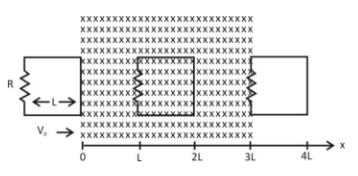
A rigid wire loop of square shape having side length L and resistance R is moving along the x-axis with a constant velocity ${v_0}$ in the plane of the paper. At$t = 0$, the right edge of the loop enters a region of length $3L$ where there is a uniform magnetic field ${B_0}$ into the plane of the paper, as shown in the figure. From sufficiently large ${v_0}$, the loop eventually crosses the region. Let x be the location of the right edge of the loop. Let v(x), I(x) and F(x) represent the velocity of the loop, current in the loop, and force on the loop, respectively, as a function of x. counter-clockwise current is taken as positive.
Which of the following schematic plot(s) is (are) correct? (Ignore gravity)
Answer
 Verified
608.7k+ views
Hint:Recall the concept of motional emf is used and the force through it.Whenever a conducting rod is moving in a magnetic field, either showing translator motion (or) rotatory motions as a result a P.D is established at the ends of the rod. An electric field appears along with the length of the rod directed from the high potential end to the low potential one. This EMF is called Motional EMF.
Formula used:
(i) $i = \dfrac{{VBL}}{R}$
(ii) $F = iLB$
(iii) $F = ma = mv\dfrac{{dv}}{{dx}}$
Complete step by step answer:
Before entering the loop that is before $t = 0$ there is no change in magnetic field and area of loop. So, till $x = 0$no current will flow in the loop. Now, when the loop enters the magnetic field region, its flux changes and hence current is induced in it in counter clockwise direction as given by Fleming’s right hand rule and this current is given by
$i = \dfrac{{VBL}}{R}$… (i). From $x = 0$ to $x = L$
And the force is given by
$F = iLB$
Putting equation (i) in it, we get
$F = \dfrac{{VBL}}{R} \times LB - \dfrac{{V{B^2}{L^2}}}{R}$
This force acts leftward direction while it enters.
When the loop is completely inside the field, there will be no change in flux inside the loop and hence no current will flow through the loop i.e.
From $x = L$to $x = 2L$,
$ \Rightarrow i = 0$
Now, again from \[x = 2L\] to \[x = 3L\], the loop starts moving again and the area changes and current starts flowing again and the force is given by
$ F' = - mv\dfrac{{dv}}{{dx}} = \dfrac{{V{B^2}{L^2}}}{R}$
$ \Rightarrow dv = - \dfrac{{{B^2}{L^2}}}{{mR}}dx$
Now integrating dv from ${v_0}$ to final velocity v and dx from $0$ to x.
So, we have
$\int\limits_{{v_0}}^v {dv} = \int\limits_0^x {\dfrac{{ - {B^2}{L^2}}}{{mR}}} dx$
\[ \Rightarrow \left[ v \right]_{{v_0}}^v = \dfrac{{ - {B^2}{L^2}}}{{mR}}\left[ x \right]_0^x\]
$
\Rightarrow v - {v_0} = \dfrac{{ - {B^2}{L^2}}}{{mR}}x \\
\Rightarrow {v_0} = \dfrac{{ - {B^2}{L^2}}}{{mR}}x \\
\Rightarrow v\left( x \right) = {v_0} - \dfrac{{{B^2}{L^2}}}{{mR}}x \\
$
Which is the velocity let $\dfrac{{{B^2}{L^2}}}{{mR}} = K$, a constant. So above equation becomes
$v\left( x \right) = {v_0} - Kx$
Similarly, current is given by
\[
I\left( x \right) = L = \dfrac{{VBL}}{R} \\
\Rightarrow I\left( x \right) = \left[ {{v_0} - \dfrac{{{B^2}{L^2}}}{{mR}}x} \right]\dfrac{{BL}}{R} \\
\Rightarrow I\left( x \right) = \dfrac{{{v_0}BL}}{R} - \dfrac{{{B^3}{L^3}}}{{m{R^2}}}x \\
\Rightarrow I\left( x \right) = \dfrac{{{V_0}BL}}{R} - \dfrac{{BLKx}}{R} \\
\]
Now, for \[x = 0,{\text{ }}I\left( x \right) = \dfrac{{{v_0}BL}}{R}\]
Which is maximum.
And $v\left( x \right) = {v_0} - 0$
$v\left( x \right) = {v_0} = $maximum
So, from $x = 0$to L, I is maximum and V is also maximum i.e.
$\therefore v = {v_0}$
Then b/w $x = L$to $2L$, current becomes zero and v also becomes constant .Then after $x = 2L$, velocity decreases but the current increases.
So, both option B and C are correct.
Note:Remember that as both I and V are functions of x and when the loop is inside the field completely i.e. from $x = L$to $x = 2L$, there will no change in flux hence, no current will flow but it continues to move with constant velocity as for $F = 0,{\text{ a}} = 0$but $v = $constant.
Formula used:
(i) $i = \dfrac{{VBL}}{R}$
(ii) $F = iLB$
(iii) $F = ma = mv\dfrac{{dv}}{{dx}}$
Complete step by step answer:
Before entering the loop that is before $t = 0$ there is no change in magnetic field and area of loop. So, till $x = 0$no current will flow in the loop. Now, when the loop enters the magnetic field region, its flux changes and hence current is induced in it in counter clockwise direction as given by Fleming’s right hand rule and this current is given by
$i = \dfrac{{VBL}}{R}$… (i). From $x = 0$ to $x = L$
And the force is given by
$F = iLB$
Putting equation (i) in it, we get
$F = \dfrac{{VBL}}{R} \times LB - \dfrac{{V{B^2}{L^2}}}{R}$
This force acts leftward direction while it enters.
When the loop is completely inside the field, there will be no change in flux inside the loop and hence no current will flow through the loop i.e.
From $x = L$to $x = 2L$,
$ \Rightarrow i = 0$
Now, again from \[x = 2L\] to \[x = 3L\], the loop starts moving again and the area changes and current starts flowing again and the force is given by
$ F' = - mv\dfrac{{dv}}{{dx}} = \dfrac{{V{B^2}{L^2}}}{R}$
$ \Rightarrow dv = - \dfrac{{{B^2}{L^2}}}{{mR}}dx$
Now integrating dv from ${v_0}$ to final velocity v and dx from $0$ to x.
So, we have
$\int\limits_{{v_0}}^v {dv} = \int\limits_0^x {\dfrac{{ - {B^2}{L^2}}}{{mR}}} dx$
\[ \Rightarrow \left[ v \right]_{{v_0}}^v = \dfrac{{ - {B^2}{L^2}}}{{mR}}\left[ x \right]_0^x\]
$
\Rightarrow v - {v_0} = \dfrac{{ - {B^2}{L^2}}}{{mR}}x \\
\Rightarrow {v_0} = \dfrac{{ - {B^2}{L^2}}}{{mR}}x \\
\Rightarrow v\left( x \right) = {v_0} - \dfrac{{{B^2}{L^2}}}{{mR}}x \\
$
Which is the velocity let $\dfrac{{{B^2}{L^2}}}{{mR}} = K$, a constant. So above equation becomes
$v\left( x \right) = {v_0} - Kx$
Similarly, current is given by
\[
I\left( x \right) = L = \dfrac{{VBL}}{R} \\
\Rightarrow I\left( x \right) = \left[ {{v_0} - \dfrac{{{B^2}{L^2}}}{{mR}}x} \right]\dfrac{{BL}}{R} \\
\Rightarrow I\left( x \right) = \dfrac{{{v_0}BL}}{R} - \dfrac{{{B^3}{L^3}}}{{m{R^2}}}x \\
\Rightarrow I\left( x \right) = \dfrac{{{V_0}BL}}{R} - \dfrac{{BLKx}}{R} \\
\]
Now, for \[x = 0,{\text{ }}I\left( x \right) = \dfrac{{{v_0}BL}}{R}\]
Which is maximum.
And $v\left( x \right) = {v_0} - 0$
$v\left( x \right) = {v_0} = $maximum
So, from $x = 0$to L, I is maximum and V is also maximum i.e.
$\therefore v = {v_0}$
Then b/w $x = L$to $2L$, current becomes zero and v also becomes constant .Then after $x = 2L$, velocity decreases but the current increases.
So, both option B and C are correct.
Note:Remember that as both I and V are functions of x and when the loop is inside the field completely i.e. from $x = L$to $x = 2L$, there will no change in flux hence, no current will flow but it continues to move with constant velocity as for $F = 0,{\text{ a}} = 0$but $v = $constant.
Recently Updated Pages
Master Class 12 Business Studies: Engaging Questions & Answers for Success

Master Class 12 Chemistry: Engaging Questions & Answers for Success
Master Class 12 Biology: Engaging Questions & Answers for Success
Class 12 Question and Answer - Your Ultimate Solutions Guide
Master Class 11 English: Engaging Questions & Answers for Success
Master Class 11 Social Science: Engaging Questions & Answers for Success
Trending doubts
Which are the Top 10 Largest Countries of the World?
Draw a labelled sketch of the human eye class 12 physics CBSE
Differentiate between homogeneous and heterogeneous class 12 chemistry CBSE
Differentiate between Pyramid of energy and pyramid class 12 biology CBSE
Why is the cell called the structural and functional class 12 biology CBSE
Draw the diagram of the pyramid of energy Explain In class 12 biology CBSE