




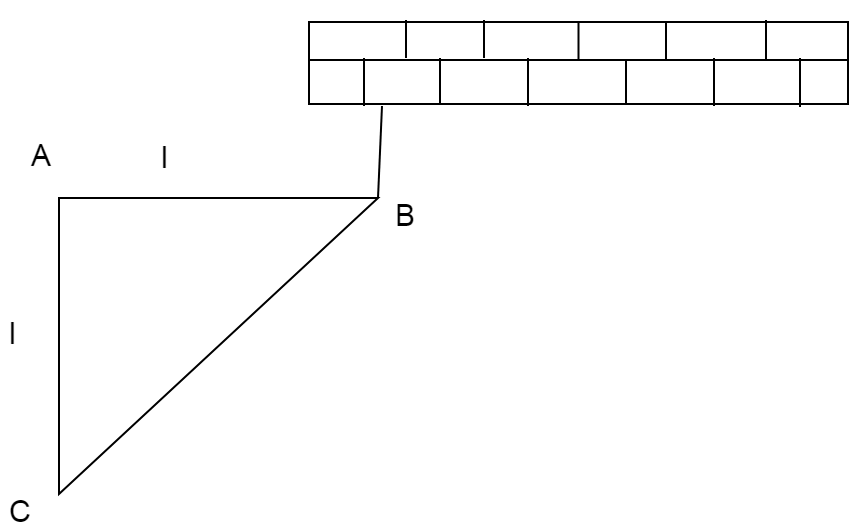
A right triangular plate ABC of mass $m$is free to rotate in the vertical plane about a fixed horizontal axis through A. It is supported by a string such that the side AB is horizontal. The reaction at the support A is:
(A) $\dfrac{{mg}}{3}$
(B) $\dfrac{{2mg}}{3}$
(C) $\dfrac{{mg}}{2}$
(D) $mg$
Answer
 Verified
576k+ views
Hint: In order to solve this question, we need to use the concept of centroid as it is the point at which the entire mass of the system is balanced. Now we need to find the force experienced at point A. Now, Taking moment of force around point B, we can obtain the required solution.
Complete Step-By-Step solution:
We know that the length AB given to us is $l$.
We know that, in the case of a right angled triangle, the centroid lies at a distance of $\dfrac{2}{3}$od the base, in this case it is $l$.
Now, let us consider that at any point in the given system the torque is conserved. Suppose we consider the torque to be conserved at point B.
Now, the tension due to the string acts at point B as well.
Now, we know that torque is the product of force and its perpendicular distance. Thus, at point B torque is $0$as the perpendicular distance is$0$.
We know that point A acts as a support, therefore, an upward normal force must exist acting at the distance$l$.
Let us consider this force as$N$.
Now, this normal force is opposed by the weight of the body which acts from the centroid.
Thus, the total torque at A is given by:
$N \times l - mg \times \dfrac{{2l}}{3}$
Where, $m$is the mass of the plate
Now, since the total torque is conserved, we can write:
$N \times l - mg \times \dfrac{{2l}}{3} = 0$
On solving the equation and cancelling the equal terms, we get:
$N = \dfrac{{2mg}}{3}$
This is our required solution.
Hence, option (B) is correct.
Note:
Centroid of a triangle implies the point where three medians intersect. This can be computed using the coordinates of three points that makes the triangle. The centre of mass of a triangle lies at its centroid. This is thus the point where the entire weight of the triangle can be balanced.
Complete Step-By-Step solution:
We know that the length AB given to us is $l$.
We know that, in the case of a right angled triangle, the centroid lies at a distance of $\dfrac{2}{3}$od the base, in this case it is $l$.
Now, let us consider that at any point in the given system the torque is conserved. Suppose we consider the torque to be conserved at point B.
Now, the tension due to the string acts at point B as well.
Now, we know that torque is the product of force and its perpendicular distance. Thus, at point B torque is $0$as the perpendicular distance is$0$.
We know that point A acts as a support, therefore, an upward normal force must exist acting at the distance$l$.
Let us consider this force as$N$.
Now, this normal force is opposed by the weight of the body which acts from the centroid.
Thus, the total torque at A is given by:
$N \times l - mg \times \dfrac{{2l}}{3}$
Where, $m$is the mass of the plate
Now, since the total torque is conserved, we can write:
$N \times l - mg \times \dfrac{{2l}}{3} = 0$
On solving the equation and cancelling the equal terms, we get:
$N = \dfrac{{2mg}}{3}$
This is our required solution.
Hence, option (B) is correct.
Note:
Centroid of a triangle implies the point where three medians intersect. This can be computed using the coordinates of three points that makes the triangle. The centre of mass of a triangle lies at its centroid. This is thus the point where the entire weight of the triangle can be balanced.
Recently Updated Pages
Master Class 11 Social Science: Engaging Questions & Answers for Success

Master Class 11 English: Engaging Questions & Answers for Success
Master Class 11 Maths: Engaging Questions & Answers for Success
Master Class 11 Chemistry: Engaging Questions & Answers for Success
Master Class 11 Biology: Engaging Questions & Answers for Success
Master Class 11 Physics: Engaging Questions & Answers for Success
Trending doubts
One Metric ton is equal to kg A 10000 B 1000 C 100 class 11 physics CBSE
Difference Between Prokaryotic Cells and Eukaryotic Cells
How many of the following diseases can be studied with class 11 biology CBSE
Two of the body parts which do not appear in MRI are class 11 biology CBSE
Which of the following enzymes is used for carboxylation class 11 biology CBSE
Explain zero factorial class 11 maths CBSE