




A right circular cone of volume A, a right circular cylinder of volume M, and a sphere of volume C all have the same radius, and the common height of the cone and the cylinder is equal to the diameter of the sphere. Then,
(a) \[A - M + C = 0\]
(b) \[A + M = C\]
(c) \[2A = M + C\]
(d) \[{A^2} - {M^2} + {C^2} = 0\]
Answer
 Verified
573k+ views
Hint: Here, we need to find the correct equation from the given options. First, we will find the volumes of the given cone, cylinder, and sphere using the formulae of their respective volumes. Then, we will substitute the volumes in the given options to find the correct option.
Formula used:
We will use the following formulas:
1.The volume of a cone is given by the formula \[\dfrac{1}{3}\pi {r^2}h\], where \[r\] is the radius of the base of the cone, and \[h\] is the height of the cone.
2.The volume of a cylinder is given by the formula \[\pi {r^2}h\], where \[r\] is the radius of the base of the cylinder, and \[h\] is the height of the cylinder.
3.The volume of a sphere is given by the formula \[\dfrac{4}{3}\pi {r^3}\], where \[r\] is the radius of the sphere.
Complete step-by-step answer:
Let the common height of the cylinder and the cone be \[h\] units.
Let the common radius of the sphere, cylinder and the cone be \[r\] units.
Now, we will draw the diagrams of cylinder, cone and sphere showing the radius and height.
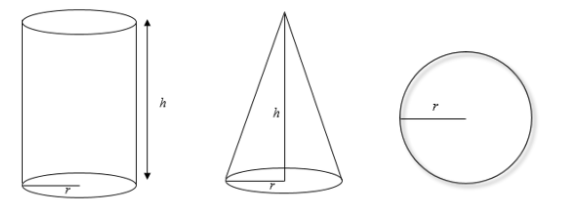
We know that the radius is half of the diameter, that is \[r = \dfrac{d}{2}\].
Therefore, multiplying both sides of the equation by 2, we get
\[d = 2r\]
It is given that the height of the cylinder and the cone is equal to the diameter of the sphere.
Thus, we get
\[ \Rightarrow h = d\]
Substituting \[d = 2r\] in the equation, we get
\[ \Rightarrow h = 2r\]
Now, we will calculate the volumes of the cone, the cylinder, and the sphere.
The volume of a cone is given by the formula \[\dfrac{1}{3}\pi {r^2}h\], where \[r\] is the radius of the base of the cone, and \[h\] is the height of the cone.
Therefore, using the formula for volume of cone, we get
Volume of the given right circular cone \[ = \dfrac{1}{3}\pi {r^2}h\]
Substituting \[h = 2r\] in the equation, we get
\[ \Rightarrow \] Volume of the given right circular cone \[ = \dfrac{1}{3}\pi {r^2}\left( {2r} \right)\]
Simplifying the expression, we get
\[ \Rightarrow \] Volume of the given right circular cone \[ = \dfrac{2}{3}\pi {r^3}\]
It is given that the right circular cone has the volume A.
Therefore, we get the equation
\[A = \dfrac{2}{3}\pi {r^3}\]
The volume of a cylinder is given by the formula \[\pi {r^2}h\], where \[r\] is the radius of the base of the cylinder, and \[h\] is the height of the cylinder.
Therefore, using the formula for volume of cylinder, we get
Volume of the given right circular cylinder \[ = \pi {r^2}h\]
Substituting \[h = 2r\] in the equation, we get
\[ \Rightarrow \]Volume of the given right circular cylinder \[ = \pi {r^2}\left( {2r} \right)\]
Simplifying the expression, we get
\[ \Rightarrow \] Volume of the given right circular cylinder \[ = 2\pi {r^3}\]
It is given that the right circular cylinder has the volume M.
Therefore, we get the equation
\[M = 2\pi {r^3}\]
The volume of a sphere is given by the formula \[\dfrac{4}{3}\pi {r^3}\], where \[r\] is the radius of the sphere.
Therefore, using the formula for volume of sphere, we get
Volume of the given sphere \[ = \dfrac{4}{3}\pi {r^3}\]
It is given that the right circular cylinder has the volume C.
Therefore, we get the equation
\[C = \dfrac{4}{3}\pi {r^3}\]
Now, we will check the given options using the values of the volumes.
The first equation is \[A - M + C = 0\].
Substituting \[A = \dfrac{2}{3}\pi {r^3}\], \[M = 2\pi {r^3}\], and \[C = \dfrac{4}{3}\pi {r^3}\] in the equation, we get
\[ \Rightarrow \dfrac{2}{3}\pi {r^3} - 2\pi {r^3} + \dfrac{4}{3}\pi {r^3} = 0\]
The L.C.M. of the terms is 3.
Taking the L.C.M., we get
\[ \Rightarrow \dfrac{{2 - 6 + 4}}{3}\pi {r^3} = 0\]
Simplifying the expression, we get
\[\begin{array}{l} \Rightarrow \dfrac{0}{3}\pi {r^3} = 0\\ \Rightarrow 0 \times \pi {r^3} = 0\\ \Rightarrow 0 = 0\end{array}\]
We can observe that L.H.S. is equal to R.H.S.
Thus, option (a) is correct.
Note: We will also check the other options so to find why they are not the correct answer.
The second equation is \[A + M = C\].
Substituting \[A = \dfrac{2}{3}\pi {r^3}\], \[M = 2\pi {r^3}\], and \[C = \dfrac{4}{3}\pi {r^3}\] in the equation, we get
\[ \Rightarrow \dfrac{2}{3}\pi {r^3} + 2\pi {r^3} = \dfrac{4}{3}\pi {r^3}\]
Simplifying the expression, we get
\[\begin{array}{l} \Rightarrow \dfrac{{2 + 6}}{3}\pi {r^3} = \dfrac{4}{3}\pi {r^3}\\ \Rightarrow \dfrac{8}{3}\pi {r^3} = \dfrac{4}{3}\pi {r^3}\end{array}\]
This is not possible unless the radius is equal to 0. Hence, option (b) is incorrect.
The third equation is \[2A = M + C\].
Substituting \[A = \dfrac{2}{3}\pi {r^3}\], \[M = 2\pi {r^3}\], and \[C = \dfrac{4}{3}\pi {r^3}\] in the equation, we get
\[ \Rightarrow 2 \times \dfrac{2}{3}\pi {r^3} = 2\pi {r^3} + \dfrac{4}{3}\pi {r^3}\]
Simplifying the expression, we get
\[\begin{array}{l} \Rightarrow \dfrac{4}{3}\pi {r^3} = \dfrac{{6 + 4}}{3}\pi {r^3}\\ \Rightarrow \dfrac{4}{3}\pi {r^3} = \dfrac{{10}}{3}\pi {r^3}\end{array}\]
This is not possible unless the radius is equal to 0. Hence, option (c) is incorrect.
The fourth equation is \[{A^2} - {M^2} + {C^2} = 0\].
Substituting \[A = \dfrac{2}{3}\pi {r^3}\], \[M = 2\pi {r^3}\], and \[C = \dfrac{4}{3}\pi {r^3}\] in the equation, we get
\[ \Rightarrow {\left( {\dfrac{2}{3}\pi {r^3}} \right)^2} - {\left( {2\pi {r^3}} \right)^2} + {\left( {\dfrac{4}{3}\pi {r^3}} \right)^2} = 0\]
Simplifying the expression, we get
\[\begin{array}{l} \Rightarrow \dfrac{4}{9}{\pi ^2}{r^6} - 4{\pi ^2}{r^6} + \dfrac{{16}}{9}{\pi ^2}{r^6} = 0\\ \Rightarrow \dfrac{{4 - 36 + 16}}{9}{\pi ^2}{r^6} = 0\\ \Rightarrow \dfrac{{ - 16}}{3}\pi {r^3} = 0\end{array}\]
This is not possible unless the radius is equal to 0. Hence, option (d) is incorrect.
Formula used:
We will use the following formulas:
1.The volume of a cone is given by the formula \[\dfrac{1}{3}\pi {r^2}h\], where \[r\] is the radius of the base of the cone, and \[h\] is the height of the cone.
2.The volume of a cylinder is given by the formula \[\pi {r^2}h\], where \[r\] is the radius of the base of the cylinder, and \[h\] is the height of the cylinder.
3.The volume of a sphere is given by the formula \[\dfrac{4}{3}\pi {r^3}\], where \[r\] is the radius of the sphere.
Complete step-by-step answer:
Let the common height of the cylinder and the cone be \[h\] units.
Let the common radius of the sphere, cylinder and the cone be \[r\] units.
Now, we will draw the diagrams of cylinder, cone and sphere showing the radius and height.
We know that the radius is half of the diameter, that is \[r = \dfrac{d}{2}\].
Therefore, multiplying both sides of the equation by 2, we get
\[d = 2r\]
It is given that the height of the cylinder and the cone is equal to the diameter of the sphere.
Thus, we get
\[ \Rightarrow h = d\]
Substituting \[d = 2r\] in the equation, we get
\[ \Rightarrow h = 2r\]
Now, we will calculate the volumes of the cone, the cylinder, and the sphere.
The volume of a cone is given by the formula \[\dfrac{1}{3}\pi {r^2}h\], where \[r\] is the radius of the base of the cone, and \[h\] is the height of the cone.
Therefore, using the formula for volume of cone, we get
Volume of the given right circular cone \[ = \dfrac{1}{3}\pi {r^2}h\]
Substituting \[h = 2r\] in the equation, we get
\[ \Rightarrow \] Volume of the given right circular cone \[ = \dfrac{1}{3}\pi {r^2}\left( {2r} \right)\]
Simplifying the expression, we get
\[ \Rightarrow \] Volume of the given right circular cone \[ = \dfrac{2}{3}\pi {r^3}\]
It is given that the right circular cone has the volume A.
Therefore, we get the equation
\[A = \dfrac{2}{3}\pi {r^3}\]
The volume of a cylinder is given by the formula \[\pi {r^2}h\], where \[r\] is the radius of the base of the cylinder, and \[h\] is the height of the cylinder.
Therefore, using the formula for volume of cylinder, we get
Volume of the given right circular cylinder \[ = \pi {r^2}h\]
Substituting \[h = 2r\] in the equation, we get
\[ \Rightarrow \]Volume of the given right circular cylinder \[ = \pi {r^2}\left( {2r} \right)\]
Simplifying the expression, we get
\[ \Rightarrow \] Volume of the given right circular cylinder \[ = 2\pi {r^3}\]
It is given that the right circular cylinder has the volume M.
Therefore, we get the equation
\[M = 2\pi {r^3}\]
The volume of a sphere is given by the formula \[\dfrac{4}{3}\pi {r^3}\], where \[r\] is the radius of the sphere.
Therefore, using the formula for volume of sphere, we get
Volume of the given sphere \[ = \dfrac{4}{3}\pi {r^3}\]
It is given that the right circular cylinder has the volume C.
Therefore, we get the equation
\[C = \dfrac{4}{3}\pi {r^3}\]
Now, we will check the given options using the values of the volumes.
The first equation is \[A - M + C = 0\].
Substituting \[A = \dfrac{2}{3}\pi {r^3}\], \[M = 2\pi {r^3}\], and \[C = \dfrac{4}{3}\pi {r^3}\] in the equation, we get
\[ \Rightarrow \dfrac{2}{3}\pi {r^3} - 2\pi {r^3} + \dfrac{4}{3}\pi {r^3} = 0\]
The L.C.M. of the terms is 3.
Taking the L.C.M., we get
\[ \Rightarrow \dfrac{{2 - 6 + 4}}{3}\pi {r^3} = 0\]
Simplifying the expression, we get
\[\begin{array}{l} \Rightarrow \dfrac{0}{3}\pi {r^3} = 0\\ \Rightarrow 0 \times \pi {r^3} = 0\\ \Rightarrow 0 = 0\end{array}\]
We can observe that L.H.S. is equal to R.H.S.
Thus, option (a) is correct.
Note: We will also check the other options so to find why they are not the correct answer.
The second equation is \[A + M = C\].
Substituting \[A = \dfrac{2}{3}\pi {r^3}\], \[M = 2\pi {r^3}\], and \[C = \dfrac{4}{3}\pi {r^3}\] in the equation, we get
\[ \Rightarrow \dfrac{2}{3}\pi {r^3} + 2\pi {r^3} = \dfrac{4}{3}\pi {r^3}\]
Simplifying the expression, we get
\[\begin{array}{l} \Rightarrow \dfrac{{2 + 6}}{3}\pi {r^3} = \dfrac{4}{3}\pi {r^3}\\ \Rightarrow \dfrac{8}{3}\pi {r^3} = \dfrac{4}{3}\pi {r^3}\end{array}\]
This is not possible unless the radius is equal to 0. Hence, option (b) is incorrect.
The third equation is \[2A = M + C\].
Substituting \[A = \dfrac{2}{3}\pi {r^3}\], \[M = 2\pi {r^3}\], and \[C = \dfrac{4}{3}\pi {r^3}\] in the equation, we get
\[ \Rightarrow 2 \times \dfrac{2}{3}\pi {r^3} = 2\pi {r^3} + \dfrac{4}{3}\pi {r^3}\]
Simplifying the expression, we get
\[\begin{array}{l} \Rightarrow \dfrac{4}{3}\pi {r^3} = \dfrac{{6 + 4}}{3}\pi {r^3}\\ \Rightarrow \dfrac{4}{3}\pi {r^3} = \dfrac{{10}}{3}\pi {r^3}\end{array}\]
This is not possible unless the radius is equal to 0. Hence, option (c) is incorrect.
The fourth equation is \[{A^2} - {M^2} + {C^2} = 0\].
Substituting \[A = \dfrac{2}{3}\pi {r^3}\], \[M = 2\pi {r^3}\], and \[C = \dfrac{4}{3}\pi {r^3}\] in the equation, we get
\[ \Rightarrow {\left( {\dfrac{2}{3}\pi {r^3}} \right)^2} - {\left( {2\pi {r^3}} \right)^2} + {\left( {\dfrac{4}{3}\pi {r^3}} \right)^2} = 0\]
Simplifying the expression, we get
\[\begin{array}{l} \Rightarrow \dfrac{4}{9}{\pi ^2}{r^6} - 4{\pi ^2}{r^6} + \dfrac{{16}}{9}{\pi ^2}{r^6} = 0\\ \Rightarrow \dfrac{{4 - 36 + 16}}{9}{\pi ^2}{r^6} = 0\\ \Rightarrow \dfrac{{ - 16}}{3}\pi {r^3} = 0\end{array}\]
This is not possible unless the radius is equal to 0. Hence, option (d) is incorrect.
Recently Updated Pages
Master Class 9 General Knowledge: Engaging Questions & Answers for Success

Master Class 9 Maths: Engaging Questions & Answers for Success
Master Class 9 Science: Engaging Questions & Answers for Success
Master Class 9 English: Engaging Questions & Answers for Success
Master Class 9 Social Science: Engaging Questions & Answers for Success
Class 9 Question and Answer - Your Ultimate Solutions Guide
Trending doubts
Find the sum of series 1 + 2 + 3 + 4 + 5 + + 100 class 9 maths CBSE
Difference Between Plant Cell and Animal Cell
Fill the blanks with the suitable prepositions 1 The class 9 english CBSE
What is pollution? How many types of pollution? Define it
Name 10 Living and Non living things class 9 biology CBSE
What is the full form of pH?