




A right angles triangle whose sides are 3cm and 4 cm (other than hypotenuse) is made to revolve around its hypotenuse. Find the volume and the surface area of the double cone so formed. (Choose a value of $\pi $ as find appropriate).
Answer
 Verified
642.6k+ views
Hint – Initially the perpendicular of the right angles triangle is 4cm and the base was 3cm. After the revolution the perpendicular will now be 3cm and the base of this right triangle will be 4cm. Use the direct formula for volume and curved surface area of the cone.
Complete step-by-step answer:
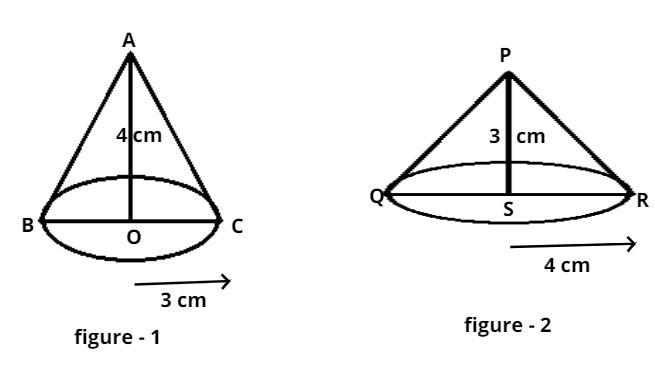
Consider the right angle triangles AOC and PSR respectively.
The base OC = 3 cm and SR = 4 cm.
And height AO = 4 cm and PS = 3cm.
So by Pythagoras theorem we have,
$ \Rightarrow {\left( {{\text{Hypotenuse}}} \right)^2} = {\left( {{\text{perpendicular}}} \right)^2} + {\left( {{\text{base}}} \right)^2}$
$ \Rightarrow {\left( {AC} \right)^2} = {\left( {AO} \right)^2} + {\left( {OC} \right)^2}$ and ${\left( {PR} \right)^2} = {\left( {PS} \right)^2} + {\left( {SR} \right)^2}$
$ \Rightarrow {\left( {AC} \right)^2} = {3^2} + {4^2} = 9 + 16 = 25 = {5^2}$ and ${\left( {PR} \right)^2} = {4^2} + {3^2} = 16 + 9 = 25 = {5^2}$
$ \Rightarrow AC = PR = 5$ cm.
So the hypotenuse = 5 cm.
Now when we revolve this right angle triangles about its hypotenuse it will form a cone as shown in figures. When base is 3 cm it will form a cone as shown in figure – 1 and when the base is 4 cm it will form a cone as shown in figure – 2.
Now as we know that the volume (V) of the cube is $\dfrac{1}{3}\pi {\left( r \right)^2}h$ cubic units.
Where (r) and (h) are the base radius and height of the cone respectively.
Now as we know that the surface area (S.A) of the cone is $\left( {\pi rl + \pi {r^2}} \right)$
Where (r) and (l) is base radius and slant height of the cone respectively.
So the slant height of the first and second cone is 5 cm.
So the volume (V1) and surface area (S.A)1 of the first cone is
$ \Rightarrow {V_1} = \dfrac{1}{3} \times \dfrac{{22}}{7} \times {\left( 3 \right)^2} \times 4 = 37.7{\text{ c}}{{\text{m}}^3}$ $\left[ {\because \pi = \dfrac{{22}}{7}} \right]$
And
$ \Rightarrow {\left( {S.A} \right)_1} = \left( {\pi rl + \pi {r^2}} \right) = \pi r\left( {l + r} \right) = \dfrac{{22}}{7} \times 3\left( {5 + 3} \right) = 75.42{\text{ c}}{{\text{m}}^2}$
Now the volume (V2) and surface (S.A)2 area of the second cone is
$ \Rightarrow {V_2} = \dfrac{1}{3} \times \dfrac{{22}}{7} \times {\left( 4 \right)^2} \times 3 = 50.28{\text{ c}}{{\text{m}}^3}$
And
$ \Rightarrow {\left( {S.A} \right)_2} = \left( {\pi rl + \pi {r^2}} \right) = \pi r\left( {l + r} \right) = \dfrac{{22}}{7} \times 4\left( {5 + 4} \right) = 113.14{\text{ c}}{{\text{m}}^2}$
So this is the required answer.
Note – When a triangle is revolved with a very high speed the observer observes its configuration as a cone that is why it is being asked to find the volume and surface area of the cone so formed. A cone is a three-dimensional shape in geometry that narrows smoothly from a flat base (usually circular base) to a point (which forms an axis to the center of the base) called the apex or the vertex.
Complete step-by-step answer:
Consider the right angle triangles AOC and PSR respectively.
The base OC = 3 cm and SR = 4 cm.
And height AO = 4 cm and PS = 3cm.
So by Pythagoras theorem we have,
$ \Rightarrow {\left( {{\text{Hypotenuse}}} \right)^2} = {\left( {{\text{perpendicular}}} \right)^2} + {\left( {{\text{base}}} \right)^2}$
$ \Rightarrow {\left( {AC} \right)^2} = {\left( {AO} \right)^2} + {\left( {OC} \right)^2}$ and ${\left( {PR} \right)^2} = {\left( {PS} \right)^2} + {\left( {SR} \right)^2}$
$ \Rightarrow {\left( {AC} \right)^2} = {3^2} + {4^2} = 9 + 16 = 25 = {5^2}$ and ${\left( {PR} \right)^2} = {4^2} + {3^2} = 16 + 9 = 25 = {5^2}$
$ \Rightarrow AC = PR = 5$ cm.
So the hypotenuse = 5 cm.
Now when we revolve this right angle triangles about its hypotenuse it will form a cone as shown in figures. When base is 3 cm it will form a cone as shown in figure – 1 and when the base is 4 cm it will form a cone as shown in figure – 2.
Now as we know that the volume (V) of the cube is $\dfrac{1}{3}\pi {\left( r \right)^2}h$ cubic units.
Where (r) and (h) are the base radius and height of the cone respectively.
Now as we know that the surface area (S.A) of the cone is $\left( {\pi rl + \pi {r^2}} \right)$
Where (r) and (l) is base radius and slant height of the cone respectively.
So the slant height of the first and second cone is 5 cm.
So the volume (V1) and surface area (S.A)1 of the first cone is
$ \Rightarrow {V_1} = \dfrac{1}{3} \times \dfrac{{22}}{7} \times {\left( 3 \right)^2} \times 4 = 37.7{\text{ c}}{{\text{m}}^3}$ $\left[ {\because \pi = \dfrac{{22}}{7}} \right]$
And
$ \Rightarrow {\left( {S.A} \right)_1} = \left( {\pi rl + \pi {r^2}} \right) = \pi r\left( {l + r} \right) = \dfrac{{22}}{7} \times 3\left( {5 + 3} \right) = 75.42{\text{ c}}{{\text{m}}^2}$
Now the volume (V2) and surface (S.A)2 area of the second cone is
$ \Rightarrow {V_2} = \dfrac{1}{3} \times \dfrac{{22}}{7} \times {\left( 4 \right)^2} \times 3 = 50.28{\text{ c}}{{\text{m}}^3}$
And
$ \Rightarrow {\left( {S.A} \right)_2} = \left( {\pi rl + \pi {r^2}} \right) = \pi r\left( {l + r} \right) = \dfrac{{22}}{7} \times 4\left( {5 + 4} \right) = 113.14{\text{ c}}{{\text{m}}^2}$
So this is the required answer.
Note – When a triangle is revolved with a very high speed the observer observes its configuration as a cone that is why it is being asked to find the volume and surface area of the cone so formed. A cone is a three-dimensional shape in geometry that narrows smoothly from a flat base (usually circular base) to a point (which forms an axis to the center of the base) called the apex or the vertex.
Recently Updated Pages
Master Class 12 Business Studies: Engaging Questions & Answers for Success

Master Class 12 Biology: Engaging Questions & Answers for Success
Master Class 12 Chemistry: Engaging Questions & Answers for Success
Class 12 Question and Answer - Your Ultimate Solutions Guide
Master Class 11 Social Science: Engaging Questions & Answers for Success
Master Class 11 English: Engaging Questions & Answers for Success
Trending doubts
What is the full form of NDA a National Democratic class 10 social science CBSE
Explain the Treaty of Vienna of 1815 class 10 social science CBSE
Who Won 36 Oscar Awards? Record Holder Revealed
Bharatiya Janata Party was founded in the year A 1979 class 10 social science CBSE
What is the median of the first 10 natural numbers class 10 maths CBSE
Why is it 530 pm in india when it is 1200 afternoon class 10 social science CBSE