




A resonance tube is old and has a jagged end. It is still used in the laboratory to determine velocity of sound in air. A tuning fork of frequency 512 Hz produces first resonance when the tube is filled with water to a mark 11 cm below a reference mark, near the open end of the tube. The experiment is repeated with another fork of frequency 256 Hz which produces first resonance when water reaches a mark 27 cm below the reference mark. The velocity of sound in air, obtained in the experiment, is close to:
A. $328m/s$
B. $322m/s$
C. $341m/s$
D. $335m/s$
Answer
 Verified
675.6k+ views
Hint:
1. Velocity of sound is constant in a given medium.
2. First resonance frequency occurs for air column length, $l = \dfrac{\lambda }{4}$ in ideal scenarios.
3. End correction must be added to the path length of first resonance frequency.
Formula Used:
1. Distance between two consecutive nodes $ = \dfrac{\lambda }{2}$ …… (a)
2. Distance between Antinode and next successive node $ = \dfrac{\lambda }{4}$ ……. (b)
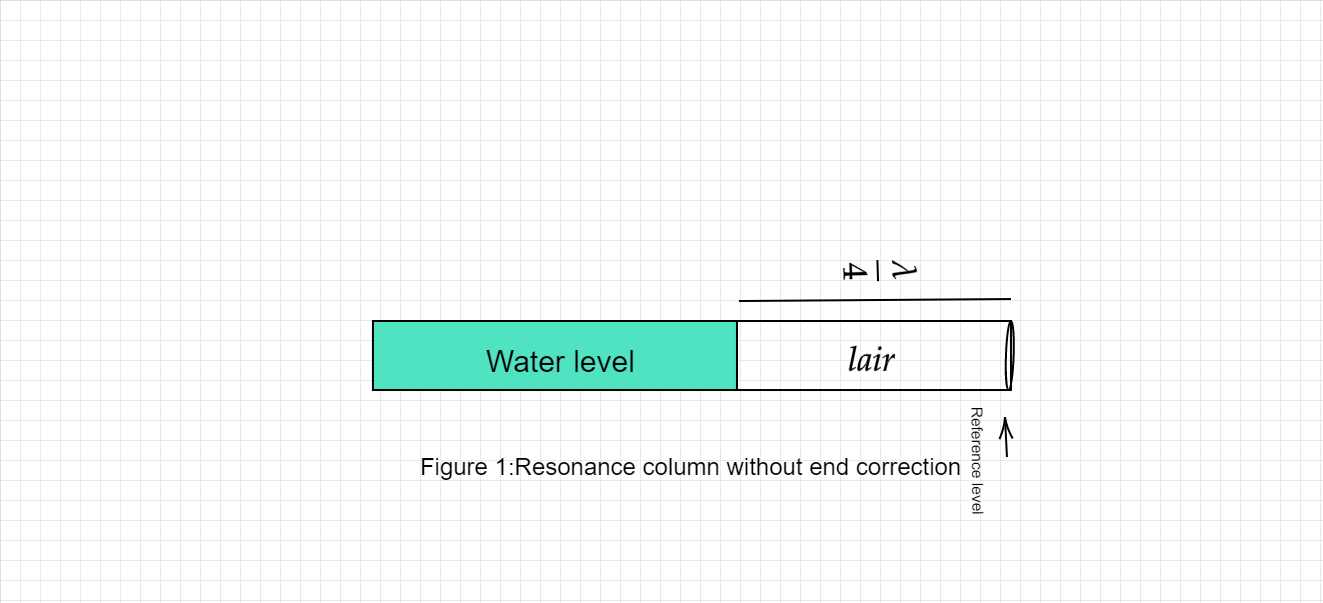
3.First resonance frequency with air column of length ${l_{air}} + e = \dfrac{\lambda }{4}$ ……. (c)
where $e$ is end correction
4. Constant speed of sound wave with $f$ be frequency of tuning fork and $\lambda $ be wavelength of sound wave $v = \lambda f$ $ \Rightarrow \lambda = \dfrac{v}{f}$ …… (d)
Figure 1 shows rough sketch for first resonance air column:
Complete step by step answer:
Given,
Two tuning forks of frequencies ${f_1}$ and ${f_2}$ be 512 Hz and 256 Hz respectively.
Corresponding to each frequency’s paths, the lengths of the first resonance air column are 11cm and 27 cm respectively.
Let, end correction be $e$
Step 1 of 4:
Using equation (c) and (b) for frequency ${f_1}$=512 Hz we get
$\dfrac{{{\lambda _1}}}{4} = {l_{1,air}} + e$ …… (1)
Given ${l_{air}} = 11cm$,
Putting substitutions from equation (1) and (d) we get,
$\dfrac{v}{{4 \times {f_1}}} = 11cm + e$ …… (2)
Step 2 of 4:
Similarly, using equation (c) and (b) for frequency ${f_2}$ =256 Hz we get
$\dfrac{{{\lambda _2}}}{4} = {l_{2,}}_{air} + e$ …… (3)
Putting substitutions from equation (1) and (d) we get,
$\dfrac{v}{{4 \times {f_2}}} = 27cm + e$ …… (4)
Step 3 of 4:
Subtracting equation (2) from equation (4) we get,
$\dfrac{v}{{4 \times {f_2}}} - \dfrac{v}{{4 \times {f_1}}} = 27cm + e - 11cm + e$
$ \Rightarrow \dfrac{v}{4}\left( {\dfrac{1}{{{f_2}}} - \dfrac{1}{{{f_1}}}} \right) = 16 \times {10^{ - 2}}m$ …… (5)
Step 4 of 4:
Putting values of ${f_1}$ and ${f_2}$ in equation (5) we get,
$v = 328m/s$
Correct Answer: A.$328m/s$
Additional Information: At the opening of a vessel there always lies an antinode. There lies a node at the interface between air and fluid since the fluid boundary acts as a closed vessel because at that point no displacement is possible.
Note: End correction should always be considered while solving sound wave problems in a vessel or tube.
1. Velocity of sound is constant in a given medium.
2. First resonance frequency occurs for air column length, $l = \dfrac{\lambda }{4}$ in ideal scenarios.
3. End correction must be added to the path length of first resonance frequency.
Formula Used:
1. Distance between two consecutive nodes $ = \dfrac{\lambda }{2}$ …… (a)
2. Distance between Antinode and next successive node $ = \dfrac{\lambda }{4}$ ……. (b)
3.First resonance frequency with air column of length ${l_{air}} + e = \dfrac{\lambda }{4}$ ……. (c)
where $e$ is end correction
4. Constant speed of sound wave with $f$ be frequency of tuning fork and $\lambda $ be wavelength of sound wave $v = \lambda f$ $ \Rightarrow \lambda = \dfrac{v}{f}$ …… (d)
Figure 1 shows rough sketch for first resonance air column:
Complete step by step answer:
Given,
Two tuning forks of frequencies ${f_1}$ and ${f_2}$ be 512 Hz and 256 Hz respectively.
Corresponding to each frequency’s paths, the lengths of the first resonance air column are 11cm and 27 cm respectively.
Let, end correction be $e$
Step 1 of 4:
Using equation (c) and (b) for frequency ${f_1}$=512 Hz we get
$\dfrac{{{\lambda _1}}}{4} = {l_{1,air}} + e$ …… (1)
Given ${l_{air}} = 11cm$,
Putting substitutions from equation (1) and (d) we get,
$\dfrac{v}{{4 \times {f_1}}} = 11cm + e$ …… (2)
Step 2 of 4:
Similarly, using equation (c) and (b) for frequency ${f_2}$ =256 Hz we get
$\dfrac{{{\lambda _2}}}{4} = {l_{2,}}_{air} + e$ …… (3)
Putting substitutions from equation (1) and (d) we get,
$\dfrac{v}{{4 \times {f_2}}} = 27cm + e$ …… (4)
Step 3 of 4:
Subtracting equation (2) from equation (4) we get,
$\dfrac{v}{{4 \times {f_2}}} - \dfrac{v}{{4 \times {f_1}}} = 27cm + e - 11cm + e$
$ \Rightarrow \dfrac{v}{4}\left( {\dfrac{1}{{{f_2}}} - \dfrac{1}{{{f_1}}}} \right) = 16 \times {10^{ - 2}}m$ …… (5)
Step 4 of 4:
Putting values of ${f_1}$ and ${f_2}$ in equation (5) we get,
$v = 328m/s$
Correct Answer: A.$328m/s$
Additional Information: At the opening of a vessel there always lies an antinode. There lies a node at the interface between air and fluid since the fluid boundary acts as a closed vessel because at that point no displacement is possible.
Note: End correction should always be considered while solving sound wave problems in a vessel or tube.
Recently Updated Pages
Which will be the least stable resonating structure class 11 chemistry CBSE

How many 5 digit telephone numbers can be construc-class-11-maths-CBSE
How do you find the angle of the resultant vector class 11 physics CBSE
Draw labelled diagram of the following i Gram seed class 11 biology CBSE
1 Quintal is equal to a 110 kg b 10 kg c 100kg d 1000 class 11 physics CBSE
What is the need and importance of classification class 11 biology CBSE
Trending doubts
Find the value of the expression given below sin 30circ class 11 maths CBSE
One Metric ton is equal to kg A 10000 B 1000 C 100 class 11 physics CBSE
10 examples of friction in our daily life
Draw a diagram of a plant cell and label at least eight class 11 biology CBSE
Difference between physical and chemical change class 11 chemistry CBSE
Proton was discovered by A Thomson B Rutherford C Chadwick class 11 chemistry CBSE