




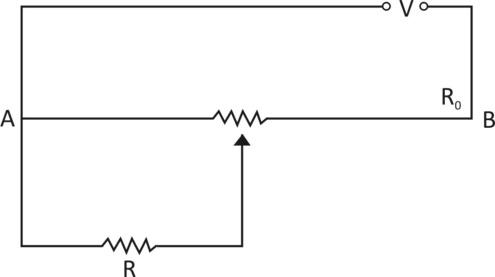
A resistance of $R\Omega $draws current from a potentiometer. The potentiometer wire, $AB$, has total resistance of ${R_0}\Omega .$. A voltage V is supplied to the potentiometer. Derive an expression for the voltage across $R$when the sliding contact is in the middle of the potentiometer wire.
Answer
 Verified
637.8k+ views
Hint: Concept of principle of potentiometer . As length increases, the potential drop across the length also increases and vice versa.
Complete step by step answer:
Potentiometer: It is a device that is used to measure unknown emf or potential differences.
Principle of potentiometer: It is based on the principle that when a constant current flows through a wire of uniform composition and cross-sectional area, then the potential drop across any length of wire will be directly proportional to that length as we know that, from ohm’s law
$V = IR$
And $R = \rho \dfrac{\ell }{A}$
So, $V = \dfrac{{I\rho }}{A}\ell $
When V is the potential difference $\rho $is the resistivity of wire A is the area of cross-section.
l is length of wire
R is the resistance
Now, for uniform cross section and area and constant current
\[\dfrac{{TP}}{A} = cons\tan t = K(let)\]
So, $V = k\ell $
$V\alpha \ell $
Which is the basic principle of potentiometer or we can also say potential gradient that is variation of potential with length his constant
$ \Rightarrow \dfrac{V}{\ell } = constant = K$
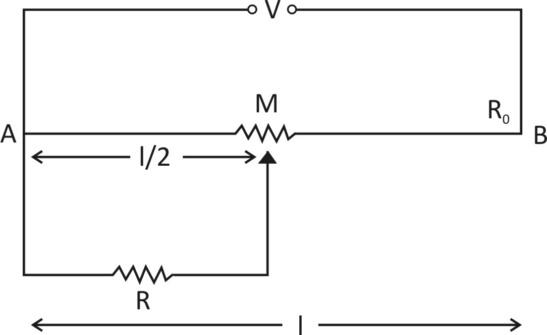
Now, in the question, let the length of wire be $\ell $.
And $M$be the mid point of wire.
Now, if $V$is the potential applied between A and B points then, according to principle of potentiometer
$V\,\alpha \,\ell $
$V = k\ell $ …..(i)
Where $k$is constant.
Let voltage across $R\,\,be\,\,V'$and is equal to AM where length is ${\mu _2}$so,
$V'\alpha \dfrac{\ell }{2}$
$ \Rightarrow V' = \dfrac{{K\ell }}{2}$ ……(ii)
From (i) and (ii) we get,
$V' = \dfrac{V}{2}$
Note:
As the potential difference depends on the end point so the potential drop across resistor R will be the same as V' which is in accordance with the principle of potentiometer.
Complete step by step answer:
Potentiometer: It is a device that is used to measure unknown emf or potential differences.
Principle of potentiometer: It is based on the principle that when a constant current flows through a wire of uniform composition and cross-sectional area, then the potential drop across any length of wire will be directly proportional to that length as we know that, from ohm’s law
$V = IR$
And $R = \rho \dfrac{\ell }{A}$
So, $V = \dfrac{{I\rho }}{A}\ell $
When V is the potential difference $\rho $is the resistivity of wire A is the area of cross-section.
l is length of wire
R is the resistance
Now, for uniform cross section and area and constant current
\[\dfrac{{TP}}{A} = cons\tan t = K(let)\]
So, $V = k\ell $
$V\alpha \ell $
Which is the basic principle of potentiometer or we can also say potential gradient that is variation of potential with length his constant
$ \Rightarrow \dfrac{V}{\ell } = constant = K$
Now, in the question, let the length of wire be $\ell $.
And $M$be the mid point of wire.
Now, if $V$is the potential applied between A and B points then, according to principle of potentiometer
$V\,\alpha \,\ell $
$V = k\ell $ …..(i)
Where $k$is constant.
Let voltage across $R\,\,be\,\,V'$and is equal to AM where length is ${\mu _2}$so,
$V'\alpha \dfrac{\ell }{2}$
$ \Rightarrow V' = \dfrac{{K\ell }}{2}$ ……(ii)
From (i) and (ii) we get,
$V' = \dfrac{V}{2}$
Note:
As the potential difference depends on the end point so the potential drop across resistor R will be the same as V' which is in accordance with the principle of potentiometer.
Recently Updated Pages
Basicity of sulphurous acid and sulphuric acid are

Master Class 12 Economics: Engaging Questions & Answers for Success
Master Class 12 Biology: Engaging Questions & Answers for Success
Master Class 11 English: Engaging Questions & Answers for Success
Master Class 11 Physics: Engaging Questions & Answers for Success
Master Class 11 Computer Science: Engaging Questions & Answers for Success
Trending doubts
Draw a labelled sketch of the human eye class 12 physics CBSE
The chemical formula of tear gas is A CO Cl 2 B C 10 class 12 chemistry CBSE
Draw ray diagrams each showing i myopic eye and ii class 12 physics CBSE
Which are the Top 10 Largest Countries of the World?
Differentiate between homogeneous and heterogeneous class 12 chemistry CBSE
Which is the correct genotypic ratio of mendel dihybrid class 12 biology CBSE