




A rectangular swimming pool has a length 30 meters, width of 10 meters and average depth is 2 meter. If a hose can fill the pool at a rate of 0.5 cubic meter per minute, how many hours will it take to fill the pool?
A. 12 hours
B. 24 hours
C. 20 hours
D. 15 hours
Answer
 Verified
655.8k+ views
Hint: First of all we have to imagine a diagram of a rectangular pool. Then to find the amount of water contained in the pool, we have to calculate the volume of a rectangular pool by this formulae \[v=l\times b\times h\text{ }{{\text{m}}^{3}}\]. After getting the volume we have to calculate the time as a hose can fill the pool at a rate of 0.5 cubic meters per minute. After getting the time in minutes we have calculated it in an hour so that we can conclude our question.
Complete step-by-step answer:
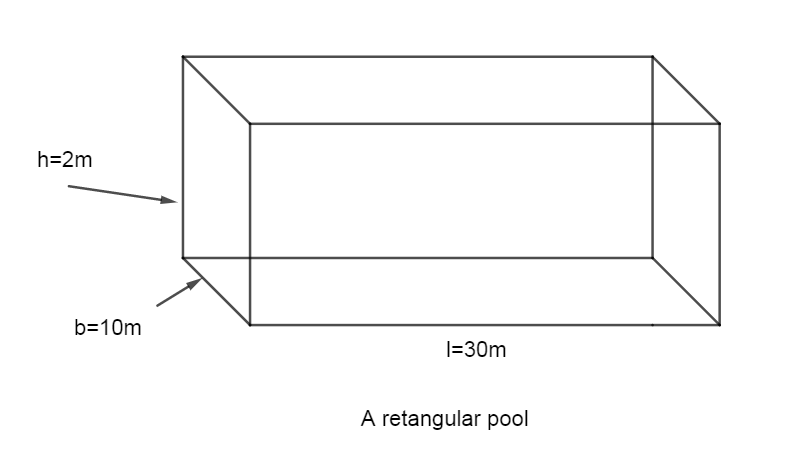
Here is a diagram of a rectangular swimming pool.
The swimming pool has a length \[l=30\] meters, width of \[b=10\] meters and average depth is \[h=2\] meter.
We know the volume of a rectangular pool is \[v=l\times b\times h\text{ }{{\text{m}}^{3}}\] where “l” is length, “b” is width, “h” is height and “v” is volume of the pool.
Now putting the value of \[l=30\] meters, \[b=10\] meters, \[h=2\] meter we get,
\[\begin{align}
& \Rightarrow v=30\times 10\times 2\text{ }{{\text{m}}^{3}} \\
& \Rightarrow v=600\text{ }{{\text{m}}^{3}} \\
\end{align}\]
The volume of the rectangular pool is \[600\text{ }{{\text{m}}^{3}}\].
Now according to the question a hose can fill the pool at a rate of 0.5 cubic meters per minute.
\[0.5\text{ }{{\text{m}}^{3}}\]pool will be filled in 1 minute
\[\text{1 }{{\text{m}}^{3}}\] pool will be filled in
\[\begin{align}
& \dfrac{1}{0.5}\text{ minute} \\
& \Rightarrow \text{2 minute} \\
\end{align}\]
Now, time will take to fill the \[600\text{ }{{\text{m}}^{3}}\] pool will be,
\[\begin{align}
& 600\times 2\text{ minute} \\
& \Rightarrow \text{1200 minute} \\
\end{align}\]
We know to convert minute to hour we have divided the minute value with 60.
Now converting the value from minute to hour we get,
\[\begin{align}
& \dfrac{\text{1200}}{60}\text{ hour} \\
& \Rightarrow 20\text{ hour} \\
\end{align}\]
To fill the rectangular pool the hose will take 20 hour (Option C).
Note: To find the amount of water in the pool students has to calculate the volume of the pool. So they have to remember the formula of volume of a volume of a rectangular pool is \[v=l\times b\times h\text{ }{{\text{m}}^{3}}\]. In this problem we can directly write the time taken using the concept of rate.
It is given that rate of filling the pool is \[0.5\text{ }{{\text{m}}^{3}}/\min \]
Now we have to find the time.
So we can divide the total volume \[600\text{ }{{\text{m}}^{3}}\] by \[0.5\text{ }{{\text{m}}^{3}}/\min \] so that the unit of the answer we get will be in minutes. Then we can convert it to hours.
\[\begin{align}
& \dfrac{600}{0.5} \\
& \Rightarrow \dfrac{6000}{5} \\
& \Rightarrow 1200 \\
\end{align}\]
The pool will fill in 1200 min. Which is,
\[\begin{align}
& \dfrac{1200}{60} \\
& \Rightarrow 20 \\
\end{align}\]
The hose will take 20 hours to fill the swimming pool.
Complete step-by-step answer:
Here is a diagram of a rectangular swimming pool.
The swimming pool has a length \[l=30\] meters, width of \[b=10\] meters and average depth is \[h=2\] meter.
We know the volume of a rectangular pool is \[v=l\times b\times h\text{ }{{\text{m}}^{3}}\] where “l” is length, “b” is width, “h” is height and “v” is volume of the pool.
Now putting the value of \[l=30\] meters, \[b=10\] meters, \[h=2\] meter we get,
\[\begin{align}
& \Rightarrow v=30\times 10\times 2\text{ }{{\text{m}}^{3}} \\
& \Rightarrow v=600\text{ }{{\text{m}}^{3}} \\
\end{align}\]
The volume of the rectangular pool is \[600\text{ }{{\text{m}}^{3}}\].
Now according to the question a hose can fill the pool at a rate of 0.5 cubic meters per minute.
\[0.5\text{ }{{\text{m}}^{3}}\]pool will be filled in 1 minute
\[\text{1 }{{\text{m}}^{3}}\] pool will be filled in
\[\begin{align}
& \dfrac{1}{0.5}\text{ minute} \\
& \Rightarrow \text{2 minute} \\
\end{align}\]
Now, time will take to fill the \[600\text{ }{{\text{m}}^{3}}\] pool will be,
\[\begin{align}
& 600\times 2\text{ minute} \\
& \Rightarrow \text{1200 minute} \\
\end{align}\]
We know to convert minute to hour we have divided the minute value with 60.
Now converting the value from minute to hour we get,
\[\begin{align}
& \dfrac{\text{1200}}{60}\text{ hour} \\
& \Rightarrow 20\text{ hour} \\
\end{align}\]
To fill the rectangular pool the hose will take 20 hour (Option C).
Note: To find the amount of water in the pool students has to calculate the volume of the pool. So they have to remember the formula of volume of a volume of a rectangular pool is \[v=l\times b\times h\text{ }{{\text{m}}^{3}}\]. In this problem we can directly write the time taken using the concept of rate.
It is given that rate of filling the pool is \[0.5\text{ }{{\text{m}}^{3}}/\min \]
Now we have to find the time.
So we can divide the total volume \[600\text{ }{{\text{m}}^{3}}\] by \[0.5\text{ }{{\text{m}}^{3}}/\min \] so that the unit of the answer we get will be in minutes. Then we can convert it to hours.
\[\begin{align}
& \dfrac{600}{0.5} \\
& \Rightarrow \dfrac{6000}{5} \\
& \Rightarrow 1200 \\
\end{align}\]
The pool will fill in 1200 min. Which is,
\[\begin{align}
& \dfrac{1200}{60} \\
& \Rightarrow 20 \\
\end{align}\]
The hose will take 20 hours to fill the swimming pool.
Recently Updated Pages
Class 10 Question and Answer - Your Ultimate Solutions Guide

Master Class 10 Computer Science: Engaging Questions & Answers for Success
Master Class 10 General Knowledge: Engaging Questions & Answers for Success
Master Class 12 Economics: Engaging Questions & Answers for Success
Master Class 12 Social Science: Engaging Questions & Answers for Success
Master Class 12 English: Engaging Questions & Answers for Success
Trending doubts
Explain the Treaty of Vienna of 1815 class 10 social science CBSE
The slogan Jai Hind was given by A Lal Bahadur Shastri class 10 social science CBSE
10 examples of evaporation in daily life with explanations
What is the full form of POSCO class 10 social science CBSE
Five things I will do to build a great India class 10 english CBSE
Identify the feminine form of noun nephew a shenephew class 10 english CBSE