




A rectangular pool 20 meters wide and 60 meters long is surrounded by a walkway of uniform width. If the total area of the walkway is 516 square meters, how wide, in meters, is the walkway?
Answer
 Verified
598.2k+ views
Hint: First find the area of the pool. Then assume the width of the walkway as ‘x’. Find the area of the rectangle consisting of the pool and the walkway in terms of ‘x’. Then solve for ‘x’ to find the width of the walkway.
Complete step-by-step answer:
We know the area of a rectangle$=$ length$\times $width or breath
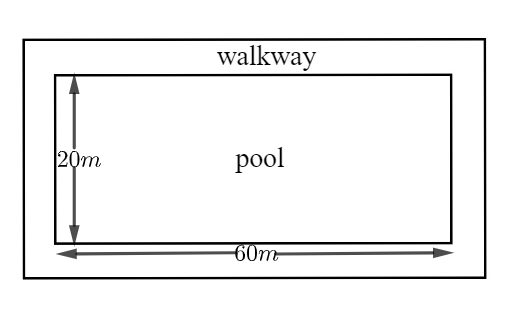
Given, the width of the pool$=20m$
The length of the pool$=60m$
So, the area of the pool$=20\times 60=1200{{m}^{2}}$
Now for the area of the rectangle
Let the width of the walkway be ‘x’ meters.
So the length of the rectangle consisting the pool and the walkway$=60+x+x=60+2x$
And the width of the rectangle consisting the pool and the walkway$=20+x+x=20+2x$
Hence, the area of the rectangle consisting the pool and the walkway$=\left( 60+2x \right)\left( 20+2x \right)$
But as we know the area of the rectangle consisting the pool and the walkway$=$ the area of the pool$+$the area of the walkway
And since the area of the walkway is given as $516{{m}^{2}}$, hence it can be written as
$\begin{align}
& \left( 60+2x \right)\left( 20+2x \right)=1200+516 \\
& \Rightarrow 1200+120x+40x+4{{x}^{2}}=1716 \\
& \Rightarrow 4{{x}^{2}}+160x+1200-1716=0 \\
& \Rightarrow 4{{x}^{2}}+160x-516=0 \\
& \Rightarrow 4\left( {{x}^{2}}+40x-129 \right)=0 \\
& \Rightarrow {{x}^{2}}+40x-129=0 \\
& \Rightarrow x=\dfrac{-40\pm \sqrt{{{40}^{2}}-4\cdot 1\cdot \left( -129 \right)}}{2\cdot 1} \\
& \Rightarrow x=\dfrac{-40\pm \sqrt{1600+516}}{2} \\
& \Rightarrow x=\dfrac{-40\pm \sqrt{2116}}{2} \\
& \Rightarrow x=\dfrac{-40\pm 46}{2} \\
\end{align}$
Either
$\begin{align}
& x=\dfrac{-40+46}{2} \\
& \Rightarrow x=\dfrac{6}{2} \\
& \Rightarrow x=3 \\
\end{align}$
Or
$\begin{align}
& x=\dfrac{-40-46}{2} \\
& \Rightarrow x=\dfrac{-86}{2} \\
\end{align}$
$\Rightarrow x=-43$ (Not possible as ‘x’ is a width)
So, we can conclude that the walkway is 3 meters wide.
This is the required solution.
Note: The equation ${{x}^{2}}+40x-129=0$ we obtained has solved using the formula $x=\dfrac{-b\pm \sqrt{{{b}^{2}}-4ac}}{2a}$. It can also be solved by factorization. We just have to find two numbers whose sum is $40$ and the product is $-129$. The numbers are $43$ and $-3$. So the equation can be solved as
\[\begin{align}
& {{x}^{2}}+40x-129=0 \\
& \Rightarrow {{x}^{2}}+43x-3x-129=0 \\
& \Rightarrow x\left( x+43 \right)-3\left( x+43 \right)=0 \\
& \Rightarrow \left( x+43 \right)\left( x-3 \right)=0 \\
\end{align}\]
Either
$x+43=0$
$\Rightarrow x=-43$ (Not possible)
Or
$\begin{align}
& x-3=0 \\
& \Rightarrow x=3 \\
\end{align}$
This is the alternative method.
Complete step-by-step answer:
We know the area of a rectangle$=$ length$\times $width or breath
Given, the width of the pool$=20m$
The length of the pool$=60m$
So, the area of the pool$=20\times 60=1200{{m}^{2}}$
Now for the area of the rectangle
Let the width of the walkway be ‘x’ meters.
So the length of the rectangle consisting the pool and the walkway$=60+x+x=60+2x$
And the width of the rectangle consisting the pool and the walkway$=20+x+x=20+2x$
Hence, the area of the rectangle consisting the pool and the walkway$=\left( 60+2x \right)\left( 20+2x \right)$
But as we know the area of the rectangle consisting the pool and the walkway$=$ the area of the pool$+$the area of the walkway
And since the area of the walkway is given as $516{{m}^{2}}$, hence it can be written as
$\begin{align}
& \left( 60+2x \right)\left( 20+2x \right)=1200+516 \\
& \Rightarrow 1200+120x+40x+4{{x}^{2}}=1716 \\
& \Rightarrow 4{{x}^{2}}+160x+1200-1716=0 \\
& \Rightarrow 4{{x}^{2}}+160x-516=0 \\
& \Rightarrow 4\left( {{x}^{2}}+40x-129 \right)=0 \\
& \Rightarrow {{x}^{2}}+40x-129=0 \\
& \Rightarrow x=\dfrac{-40\pm \sqrt{{{40}^{2}}-4\cdot 1\cdot \left( -129 \right)}}{2\cdot 1} \\
& \Rightarrow x=\dfrac{-40\pm \sqrt{1600+516}}{2} \\
& \Rightarrow x=\dfrac{-40\pm \sqrt{2116}}{2} \\
& \Rightarrow x=\dfrac{-40\pm 46}{2} \\
\end{align}$
Either
$\begin{align}
& x=\dfrac{-40+46}{2} \\
& \Rightarrow x=\dfrac{6}{2} \\
& \Rightarrow x=3 \\
\end{align}$
Or
$\begin{align}
& x=\dfrac{-40-46}{2} \\
& \Rightarrow x=\dfrac{-86}{2} \\
\end{align}$
$\Rightarrow x=-43$ (Not possible as ‘x’ is a width)
So, we can conclude that the walkway is 3 meters wide.
This is the required solution.
Note: The equation ${{x}^{2}}+40x-129=0$ we obtained has solved using the formula $x=\dfrac{-b\pm \sqrt{{{b}^{2}}-4ac}}{2a}$. It can also be solved by factorization. We just have to find two numbers whose sum is $40$ and the product is $-129$. The numbers are $43$ and $-3$. So the equation can be solved as
\[\begin{align}
& {{x}^{2}}+40x-129=0 \\
& \Rightarrow {{x}^{2}}+43x-3x-129=0 \\
& \Rightarrow x\left( x+43 \right)-3\left( x+43 \right)=0 \\
& \Rightarrow \left( x+43 \right)\left( x-3 \right)=0 \\
\end{align}\]
Either
$x+43=0$
$\Rightarrow x=-43$ (Not possible)
Or
$\begin{align}
& x-3=0 \\
& \Rightarrow x=3 \\
\end{align}$
This is the alternative method.
Recently Updated Pages
Master Class 11 English: Engaging Questions & Answers for Success

Master Class 11 Social Science: Engaging Questions & Answers for Success
Master Class 11 Maths: Engaging Questions & Answers for Success
Master Class 11 Biology: Engaging Questions & Answers for Success
Master Class 11 Physics: Engaging Questions & Answers for Success
Master Class 11 Chemistry: Engaging Questions & Answers for Success
Trending doubts