




A rectangular frame of wire abed has dimensions $ 32cm\times 8.0cm $ and a total resistance of $ 2.0\Omega $ it is pulled out of magnetic field $ B=0.020T $ by applying a force of $ 3.2\times {{10}^{-5}}N $ (figure). It is found that the frame moves with constant speed.
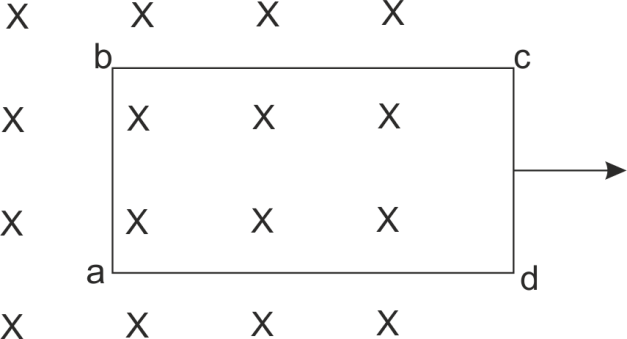
(a) The constant speed of the terms is-
(A) $ \text{25m/s} $
(B) $ 20\text{ m/s} $
(C) $ 16\text{ m/s} $
(D) $ 7.5\text{ m/s} $
(b) The emf induced in the loop is –
(A) $ 8.0\times {{10}^{-2}}V $
(B) $ 5.0\times {{10}^{-2}}V $
(C) $ 2.0\times {{10}^{-2}}V $
(D) $ 4.0\times {{10}^{-2}}V $
(c) The potential differences between the points $ a $ and $ b $ is equal to:
(A) $ 4.8\times {{10}^{-2}}V $
(B) $ 3.6\times {{10}^{-2}}V $
(C) $ 2.4\times {{10}^{-2}}V $
(D) $ 1.6\times {{10}^{-2}}V $
Answer
 Verified
572.4k+ views
Hint :(a) Use formula of magnetic force and put current formula for magnetic force in terms of velocity and calculate velocity after putting values.
(b) Use induced emf formula and put values and calculate induced emf in loop.
(c) find the resistance per unit length and calculate ratio of resistance then calculate potential difference between point $ a $ and $ b $ .
$ F=ilB $
$ e=VBl $
$ i=\dfrac{BlV}{R} $
Complete Step By Step Answer:
As per data given in the question we have,
$ R=2\Omega $
$ B=0.020T $
$ l=32cm=0.32m $
(a) Let's consider speed frame is $ V $ as we know, magnetic force is given by,
$ F-ilB=3.2\times {{10}^{-5}}N...(i) $
Here, current in coil is given by,
$ i=\dfrac{BlV}{R}...(ii) $
Substituting, equation $ (ii) $ in equation $ (i) $
$ {{B}^{2}}{{l}^{2}}\dfrac{V}{R}=3.2\times {{10}^{-5}}N $
Substituting other values in above equation,
$ {{0.02}^{2}}\times {{0.32}^{2}}\times \dfrac{V}{2}=3.2\times {{10}^{-5}}N $
$ 0.004\times 0.1024\times \dfrac{V}{2}=3.2\times {{10}^{-5}}N $
$ V=\dfrac{2\times 3.2\times {{10}^{-5}}}{0.0004\times 0.1024} $
$ V=25\text{ m/s} $
Constant speed of the frame is $ 25\text{ m/s} $
Hence option (A) is the correct answer.
(b) EMF induced is
$ \in =VBl $
Substituting values in above equation,
$ \in =25\times 0.02\times 0.08 $
$ \in =0.04V $
$ \in 4.0\times {{10}^{-2}}V $
The EMF induced in the loop is $ 4.0\times {{10}^{-2}}V $
Hence option (D) is the correct answer.
(c) Resistance per unit length is
$ r=\dfrac{0.2}{0.8} $ (since $ 0.32+0.32+0.08+0.08=0.8) $
Ratio of resistance is
$ \dfrac{ab}{cd}=\dfrac{2\times 0.72}{0.8} $
$ \dfrac{ab}{cd}=1.8\Omega $
Potential difference across points $ a $ and $ b $ is
$ {{V}_{ab}}=iR $
Here $ i=\dfrac{BlV}{R} $
$ \therefore {{V}_{ab}}=\dfrac{B;V}{2}\times 1.8 $
Substituting values in above equation
$ {{V}_{ab}}=\dfrac{0.02\times 0.08\times 25\times 1.8}{2} $
$ {{V}_{ab}}=0.036V $
$ {{V}_{ab}}=3.6\times {{10}^{-2}}V $
The potential difference across points $ a $ and $ b $ is $ 8.6\times {{10}^{-2}}V $
Hence, option (B) is correct answer.
Note :
(a) velocity is a ratio of displacement to change in time. Distance and displacement are the main key points of velocity. There will be no velocity if there is no displacement in the object or if the object does not have any distance.
There are two kinds of velocity.
(i) initial velocity: velocity of body at beginning of the given is called initial velocity.
(ii) Final velocity: velocity of body at the end of time given is called final velocity.
(b) induced electromotive force, electromagnetic induction and electromotive force induction are different names of induced EMF.
(C) Potential difference is the same as voltage.
Potential difference is the amount of current multiplied by resistance.
$ V=IR $
Calculation looks lengthy because of multiple questions. So solve step by step subparts one after the other.
(b) Use induced emf formula and put values and calculate induced emf in loop.
(c) find the resistance per unit length and calculate ratio of resistance then calculate potential difference between point $ a $ and $ b $ .
$ F=ilB $
$ e=VBl $
$ i=\dfrac{BlV}{R} $
Complete Step By Step Answer:
As per data given in the question we have,
$ R=2\Omega $
$ B=0.020T $
$ l=32cm=0.32m $
(a) Let's consider speed frame is $ V $ as we know, magnetic force is given by,
$ F-ilB=3.2\times {{10}^{-5}}N...(i) $
Here, current in coil is given by,
$ i=\dfrac{BlV}{R}...(ii) $
Substituting, equation $ (ii) $ in equation $ (i) $
$ {{B}^{2}}{{l}^{2}}\dfrac{V}{R}=3.2\times {{10}^{-5}}N $
Substituting other values in above equation,
$ {{0.02}^{2}}\times {{0.32}^{2}}\times \dfrac{V}{2}=3.2\times {{10}^{-5}}N $
$ 0.004\times 0.1024\times \dfrac{V}{2}=3.2\times {{10}^{-5}}N $
$ V=\dfrac{2\times 3.2\times {{10}^{-5}}}{0.0004\times 0.1024} $
$ V=25\text{ m/s} $
Constant speed of the frame is $ 25\text{ m/s} $
Hence option (A) is the correct answer.
(b) EMF induced is
$ \in =VBl $
Substituting values in above equation,
$ \in =25\times 0.02\times 0.08 $
$ \in =0.04V $
$ \in 4.0\times {{10}^{-2}}V $
The EMF induced in the loop is $ 4.0\times {{10}^{-2}}V $
Hence option (D) is the correct answer.
(c) Resistance per unit length is
$ r=\dfrac{0.2}{0.8} $ (since $ 0.32+0.32+0.08+0.08=0.8) $
Ratio of resistance is
$ \dfrac{ab}{cd}=\dfrac{2\times 0.72}{0.8} $
$ \dfrac{ab}{cd}=1.8\Omega $
Potential difference across points $ a $ and $ b $ is
$ {{V}_{ab}}=iR $
Here $ i=\dfrac{BlV}{R} $
$ \therefore {{V}_{ab}}=\dfrac{B;V}{2}\times 1.8 $
Substituting values in above equation
$ {{V}_{ab}}=\dfrac{0.02\times 0.08\times 25\times 1.8}{2} $
$ {{V}_{ab}}=0.036V $
$ {{V}_{ab}}=3.6\times {{10}^{-2}}V $
The potential difference across points $ a $ and $ b $ is $ 8.6\times {{10}^{-2}}V $
Hence, option (B) is correct answer.
Note :
(a) velocity is a ratio of displacement to change in time. Distance and displacement are the main key points of velocity. There will be no velocity if there is no displacement in the object or if the object does not have any distance.
There are two kinds of velocity.
(i) initial velocity: velocity of body at beginning of the given is called initial velocity.
(ii) Final velocity: velocity of body at the end of time given is called final velocity.
(b) induced electromotive force, electromagnetic induction and electromotive force induction are different names of induced EMF.
(C) Potential difference is the same as voltage.
Potential difference is the amount of current multiplied by resistance.
$ V=IR $
Calculation looks lengthy because of multiple questions. So solve step by step subparts one after the other.
Recently Updated Pages
Master Class 11 Social Science: Engaging Questions & Answers for Success

Master Class 11 English: Engaging Questions & Answers for Success
Master Class 11 Maths: Engaging Questions & Answers for Success
Master Class 11 Chemistry: Engaging Questions & Answers for Success
Master Class 11 Biology: Engaging Questions & Answers for Success
Master Class 11 Physics: Engaging Questions & Answers for Success
Trending doubts
One Metric ton is equal to kg A 10000 B 1000 C 100 class 11 physics CBSE
Difference Between Prokaryotic Cells and Eukaryotic Cells
How many of the following diseases can be studied with class 11 biology CBSE
Which of the following enzymes is used for carboxylation class 11 biology CBSE
Two of the body parts which do not appear in MRI are class 11 biology CBSE
Draw a diagram of a plant cell and label at least eight class 11 biology CBSE