




A rectangular container with dimensions 4 inches by 9 inches by 10 inches is fully filled with water. Now, if we empty the rectangular container’s content in a cylindrical vessel of diameter 6 inches without any spillage, then the height of the water attained in the cylindrical vessel will be
\[\left( \text{a} \right)\text{ }\dfrac{40}{\pi }\]
\[\left( \text{b} \right)\text{ }\dfrac{60}{\pi }\]
(c) 24
(d) 30
Answer
 Verified
638.4k+ views
Hint: To solve the given question, we will first find out the volume of the water in the rectangular container which will be equal to the volume of this rectangular container. The volume of the rectangular container with length ‘l’, breadth ‘b’, and height ‘h’ is \[l\times b\times h.\] Now, after finding the volume of the water, we will make use of the fact that this volume of the water will remain the same in the cylindrical vessel. The volume of the cylindrical vessel is \[\pi {{r}^{2}}h\] where r is the radius and h is the height. From here, we will calculate the value of the unknown height.
Complete step-by-step answer:
Before we start solving the question, let us first consider the diagrammatic representation of the question, which is as shown below.
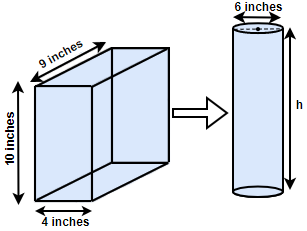
The first thing we are going to do while solving the question is to find the volume of water in the rectangular container. The volume of the water will be equal to the volume of the rectangular container. The rectangular container is cuboid in shape. The volume of the cuboid with length ‘l’, breadth ‘b’ and height ‘h’ is given by the formula,
\[\text{Volume}=l\times b\times h\]
In our case, l = 4 inches, b = 9 inches and h = 10 inches. Thus, we have,
\[\text{Volume of water}=\text{Volume of the container}=\left( 4\times 9\times 10 \right){{\left( \text{inches} \right)}^{3}}\]
Volume of water = 360 cubic inches
Now, the water is emptied in the cylindrical vessel without spilling. So, we can say that the volume of water in a cylindrical vessel will be equal to the volume of water in the rectangular container. Thus, we get,
Volume of water in the cylindrical vessel = 360 cubic inches
Now, the volume of the water will be equal to the volume of the cylinder whose diameter is 6 inches and the height is h inches. Now, the radius will be half the diameter that is \[\dfrac{1}{2}\times 6=3\text{ inches}.\] Now, we will get,
Volume of water = 360 cubic inches
The volume of the cylinder is given by the formula,
\[\text{Volume}=\pi {{r}^{2}}h\]
where r is the radius and h is the height. In our case, r = 3 inches. Thus, we will get,
\[\Rightarrow \pi \times {{\left( 3\text{ inches} \right)}^{2}}\times h=360\text{ cubic inches}\]
\[\Rightarrow \pi \times 9\text{ sq}\text{. inch }\times h\text{ inch}=360\text{ cubic inches}\]
\[\Rightarrow 9\pi h=360\text{ inch}\]
\[\Rightarrow h=\dfrac{360}{9\pi }\text{ inch}\]
\[\Rightarrow h=\dfrac{40}{\pi }\text{ inch}\]
Hence, option (a) is the right answer
Note: While solving the question, we have assumed that the rectangular container and the cylindrical vessel are hollow and they have negligible thickness. Due to this assumption, the volume of the water is equal to the volume of the rectangular container and the volume of the cylindrical vessel respectively.
Complete step-by-step answer:
Before we start solving the question, let us first consider the diagrammatic representation of the question, which is as shown below.
The first thing we are going to do while solving the question is to find the volume of water in the rectangular container. The volume of the water will be equal to the volume of the rectangular container. The rectangular container is cuboid in shape. The volume of the cuboid with length ‘l’, breadth ‘b’ and height ‘h’ is given by the formula,
\[\text{Volume}=l\times b\times h\]
In our case, l = 4 inches, b = 9 inches and h = 10 inches. Thus, we have,
\[\text{Volume of water}=\text{Volume of the container}=\left( 4\times 9\times 10 \right){{\left( \text{inches} \right)}^{3}}\]
Volume of water = 360 cubic inches
Now, the water is emptied in the cylindrical vessel without spilling. So, we can say that the volume of water in a cylindrical vessel will be equal to the volume of water in the rectangular container. Thus, we get,
Volume of water in the cylindrical vessel = 360 cubic inches
Now, the volume of the water will be equal to the volume of the cylinder whose diameter is 6 inches and the height is h inches. Now, the radius will be half the diameter that is \[\dfrac{1}{2}\times 6=3\text{ inches}.\] Now, we will get,
Volume of water = 360 cubic inches
The volume of the cylinder is given by the formula,
\[\text{Volume}=\pi {{r}^{2}}h\]
where r is the radius and h is the height. In our case, r = 3 inches. Thus, we will get,
\[\Rightarrow \pi \times {{\left( 3\text{ inches} \right)}^{2}}\times h=360\text{ cubic inches}\]
\[\Rightarrow \pi \times 9\text{ sq}\text{. inch }\times h\text{ inch}=360\text{ cubic inches}\]
\[\Rightarrow 9\pi h=360\text{ inch}\]
\[\Rightarrow h=\dfrac{360}{9\pi }\text{ inch}\]
\[\Rightarrow h=\dfrac{40}{\pi }\text{ inch}\]
Hence, option (a) is the right answer
Note: While solving the question, we have assumed that the rectangular container and the cylindrical vessel are hollow and they have negligible thickness. Due to this assumption, the volume of the water is equal to the volume of the rectangular container and the volume of the cylindrical vessel respectively.
Recently Updated Pages
Master Class 11 English: Engaging Questions & Answers for Success

Master Class 11 Social Science: Engaging Questions & Answers for Success
Master Class 11 Maths: Engaging Questions & Answers for Success
Master Class 11 Biology: Engaging Questions & Answers for Success
Master Class 11 Physics: Engaging Questions & Answers for Success
Master Class 11 Chemistry: Engaging Questions & Answers for Success