




A rectangular coil of copper wires is rotated in a magnetic field. The direction of the induced current changes once in each:
A. Two revolution
B. One revolution
C. Half revolution
D. One fourth revolution
Answer
 Verified
564.6k+ views
Hint: This question utilizes the concept of induced currents. We know that current can be induced in a conducting loop when it is exposed to a changing magnetic field. Here, the flux through the rectangular loop is constantly changing, hence current is induced in the rectangular coil.
Rules used:
Fleming's Right hand rule: It states that when the thumb, the index finger and the middle finger of the Right hand is kept mutually perpendicular to each other, the thumb gives the direction of motion, the index finger gives the direction of magnetic field and the middle finger gives the direction of the induced current.
Complete step by step answer:
According to the given question, a rectangular coil of copper wires is rotating in a constant magnetic field. Let there be a magnetic field $B$ given off by a magnet. Let there be a rectangular coil $DEFG$ which is placed in the magnetic field $B$. Let there be a axis passing through the middle of coil $DEFG$ about which it is rotated as shown below
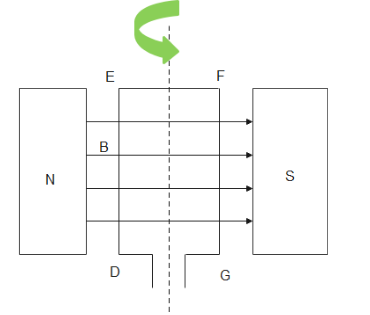
Applying Fleming's Right hand rule and putting the directions for part $DE$ , we find that the current is induced in direction $DEFGD$ .
After half rotation, from the below figure
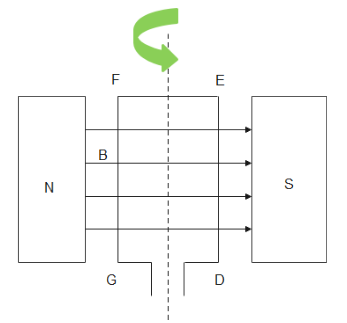
Again, applying Fleming's Right Hand Rule for $GF$ , we find the direction of induced current to be $GFEDG$. Therefore, we can infer that current reverses its direction after every half rotation.
Thus, the correct answer is option C.
Note: Fleming's Right hand rule is only used for finding the induced current when a conductor is placed in a magnetic field(mostly in coils) whereas Fleming's Left hand rule is used to find the direction of force when a current carrying wire is placed in a magnetic field. They should not be confused with each other.
Rules used:
Fleming's Right hand rule: It states that when the thumb, the index finger and the middle finger of the Right hand is kept mutually perpendicular to each other, the thumb gives the direction of motion, the index finger gives the direction of magnetic field and the middle finger gives the direction of the induced current.
Complete step by step answer:
According to the given question, a rectangular coil of copper wires is rotating in a constant magnetic field. Let there be a magnetic field $B$ given off by a magnet. Let there be a rectangular coil $DEFG$ which is placed in the magnetic field $B$. Let there be a axis passing through the middle of coil $DEFG$ about which it is rotated as shown below
Applying Fleming's Right hand rule and putting the directions for part $DE$ , we find that the current is induced in direction $DEFGD$ .
After half rotation, from the below figure
Again, applying Fleming's Right Hand Rule for $GF$ , we find the direction of induced current to be $GFEDG$. Therefore, we can infer that current reverses its direction after every half rotation.
Thus, the correct answer is option C.
Note: Fleming's Right hand rule is only used for finding the induced current when a conductor is placed in a magnetic field(mostly in coils) whereas Fleming's Left hand rule is used to find the direction of force when a current carrying wire is placed in a magnetic field. They should not be confused with each other.
Recently Updated Pages
Which of the following graphs shows the variation of class 12 physics CBSE

Draw a labelled diagram of the human male reproductive class 12 biology CBSE
Describe the experiment to compare the emf of two cells class 12 physics CBSE
What is standard hydrogen electrode
What is conventional current and electric current class 12 physics CBSE
2Bromopentane is treated with an alcoholic KOH solution class 12 chemistry CBSE
Trending doubts
Draw a labelled sketch of the human eye class 12 physics CBSE
Which are the Top 10 Largest Countries of the World?
Differentiate between homogeneous and heterogeneous class 12 chemistry CBSE
Draw ray diagrams each showing i myopic eye and ii class 12 physics CBSE
Which is the correct genotypic ratio of mendel dihybrid class 12 biology CBSE
What is the Full Form of PVC, PET, HDPE, LDPE, PP and PS ?