




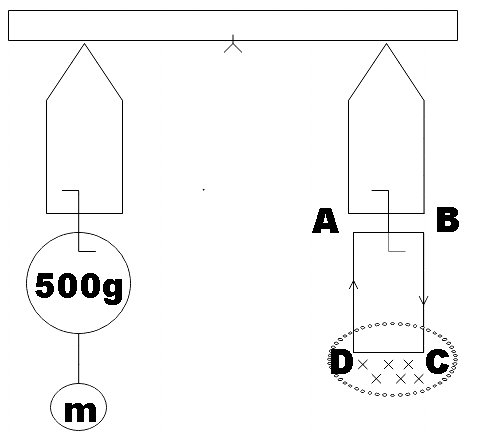
A rectangular coil ABCD is hung from one side of a balance as shown in the figure. A 500g mass is added to the other arm to balance the weight of the coil. A current of 9.8A is passed through the coil and a constant magnetic field of 0.4T acting inward (in XZ plane) is switched on such that only an arm CD of length 1.5cm lies in the field. The additional mass m must be added to regain the balance is
A. 4g
B. 5g
C. 6g
D.7g
Answer
 Verified
554.4k+ views
Hint: As a first step, you could consider the case when neither current nor the magnetic field is present and then balance the forces. Then, you could go for the next case when both are present. On balancing the forces that are acting on both arms and then rearranging and then substituting accordingly will give the required mass.
Formula used:
Magnetic force,
$F=BIL\sin \theta $
Complete answer:
In the question, we are given a rectangular coil ABCD hung from the arm that is balanced by a 500g mass on the arm. Therefore, we could say that,
${{W}_{ABCD}}=Mg=500\times g=500\times 9.8$
Where, M is the mass of the coil.
Now, we are told that 9.8A current is then passed through the coil and the arm CD of the coil lies in a 0.4T magnetic field. Then, quite obviously this arm CD will experience a magnetic force and in order to balance this force a mass m is added to the other arm. We are supposed to find m.
Magnetic force is given by,
$F=BIL\sin \theta $
Where, $\theta $ is the angle between L and B which here is $90{}^\circ $
Substituting the values we get,
$F=0.4\times 9.8\times 1.5$
This force will be equal to the weight of the new body introduced on the other arm of the balance. So,
$mg=0.4\times 9.8\times 1.5$
$\Rightarrow m=\dfrac{0.4\times 9.8\times 1.5}{9.8}$
$\therefore m=6g$
Therefore, we found the mass to be equal to 6g.
Hence, option C is found to be the correct answer.
Note:
We are basically balancing the forces acting on the two arms. For the final part we haven’t considered the weight of the coil and weight of the 500g body. This is because we already know that they are equal in magnitude and they balance each other. So, we have directly considered the weight of the m massed body balancing the magnetic force.
Formula used:
Magnetic force,
$F=BIL\sin \theta $
Complete answer:
In the question, we are given a rectangular coil ABCD hung from the arm that is balanced by a 500g mass on the arm. Therefore, we could say that,
${{W}_{ABCD}}=Mg=500\times g=500\times 9.8$
Where, M is the mass of the coil.
Now, we are told that 9.8A current is then passed through the coil and the arm CD of the coil lies in a 0.4T magnetic field. Then, quite obviously this arm CD will experience a magnetic force and in order to balance this force a mass m is added to the other arm. We are supposed to find m.
Magnetic force is given by,
$F=BIL\sin \theta $
Where, $\theta $ is the angle between L and B which here is $90{}^\circ $
Substituting the values we get,
$F=0.4\times 9.8\times 1.5$
This force will be equal to the weight of the new body introduced on the other arm of the balance. So,
$mg=0.4\times 9.8\times 1.5$
$\Rightarrow m=\dfrac{0.4\times 9.8\times 1.5}{9.8}$
$\therefore m=6g$
Therefore, we found the mass to be equal to 6g.
Hence, option C is found to be the correct answer.
Note:
We are basically balancing the forces acting on the two arms. For the final part we haven’t considered the weight of the coil and weight of the 500g body. This is because we already know that they are equal in magnitude and they balance each other. So, we have directly considered the weight of the m massed body balancing the magnetic force.
Recently Updated Pages
Master Class 11 Computer Science: Engaging Questions & Answers for Success

Master Class 11 Business Studies: Engaging Questions & Answers for Success
Master Class 11 Economics: Engaging Questions & Answers for Success
Master Class 11 English: Engaging Questions & Answers for Success
Master Class 11 Maths: Engaging Questions & Answers for Success
Master Class 11 Biology: Engaging Questions & Answers for Success
Trending doubts
One Metric ton is equal to kg A 10000 B 1000 C 100 class 11 physics CBSE
There are 720 permutations of the digits 1 2 3 4 5 class 11 maths CBSE
Discuss the various forms of bacteria class 11 biology CBSE
Draw a diagram of a plant cell and label at least eight class 11 biology CBSE
State the laws of reflection of light
Explain zero factorial class 11 maths CBSE