




A rectangular block of wood has dimensions 24 cm by 8 cm by 7 cm. It is cut up into children’s bricks. Each brick is a cube of side 3 cm. Find the volume of the wood that is left.
Answer
 Verified
667.5k+ views
Hint: We are given the dimensions of a cuboid wooden box. So, we use L = 24, B = 7 and H = 8 to find the volume of the total wood using the formula of volume of a cuboid, \[V=L\times B\times H.\] Then, we have the dimension of the cube as 3cm. So, we will find the volume of the cube using the formula of volume of a cube, \[V=S\times S\times S\] where S is the side. Then we will assume that the total cubes that can be cut down from cuboid as n, then we get the volume of the wood as n x Volume of 1 cube. So, we will simplify to get the remaining wood.
Complete step by step answer: We are given that the rectangular block of the wood has dimensions 24 cm by 8 cm by 7 cm.
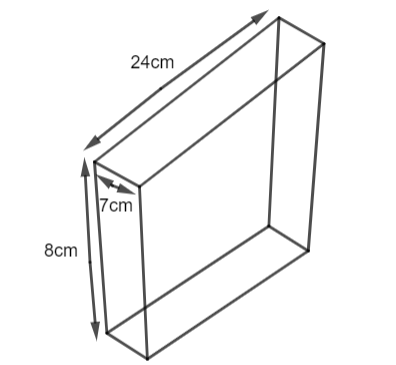
First, we will find the volume of the rectangular block. We know that the volume of the cuboid is given as \[\text{Volume}=L\times B\times H.\]
We have, L = 24, B = 7 and H = 8. So, we get,
\[\Rightarrow \text{Volume}=24\times 8\times 7\]
\[\Rightarrow \text{Volume}=1344c{{m}^{3}}.....\left( i \right)\]
So, we get the total volume of the wooden block as \[1344c{{m}^{3}}.\]
Now, we know that out of this, the small cubes are cut down. The dimension of the cube is \[3\times 3\times 3.\]
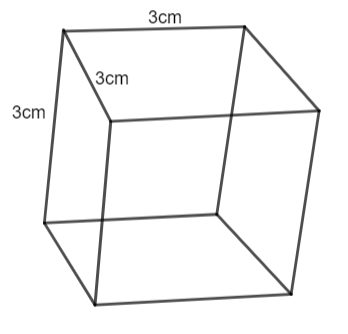
Now, we will find the volume of one cube and the volume is given as \[V=S\times S\times S\] where S is the side. So, we get,
\[\text{Volume of the cube}=3\times 3\times 3\]
\[\Rightarrow \text{Volume of the cube}=27c{{m}^{3}}.......\left( ii \right)\]
Let us assume that the number of cubes that can be cut from the cuboid is n. So, we get,
\[\text{Volume of cuboid}=n\times \left( \text{Volume of 1 cube} \right)\]
Now using (i) and (ii), we get,
\[\Rightarrow 1344=n\times 27\]
Now, divide both the sides by 27, we get,
\[\Rightarrow \dfrac{27n}{27}=\dfrac{1344}{27}\]
\[\Rightarrow n=\dfrac{1344}{27}\]
Now, after the division, we see that 1344 is not completely divisible by 27.
\[27\overset{49}{\overline{\left){\begin{align}
& 1344 \\
& \underline{108\text{ }} \\
& 264 \\
& \underline{243\text{ }} \\
& 21 \\
\end{align}}\right.}}\]
When 1344 is divided by 27, it will give the remainder as 21 and quotient as 49. So, we get 49 cubes cut down and \[21c{{m}^{3}}\] the volume is left.
Hence, the volume of the wood left is \[21c{{m}^{3}}.\]
Note: Another method to find the remaining is to just look at the remainder and another way is to subtract the total volume of the cube from the cuboid. As the quotient is 49 means 49 cubes are cut. So, the Total Volume of wood – Volume of the cube gives us the remaining wood. So,
\[1344-49\times 27=\text{Remaining Wood}\]
So, we get,
Remaining Wood = 1344 – 1323 = \[21c{{m}^{3}}\]
Complete step by step answer: We are given that the rectangular block of the wood has dimensions 24 cm by 8 cm by 7 cm.
First, we will find the volume of the rectangular block. We know that the volume of the cuboid is given as \[\text{Volume}=L\times B\times H.\]
We have, L = 24, B = 7 and H = 8. So, we get,
\[\Rightarrow \text{Volume}=24\times 8\times 7\]
\[\Rightarrow \text{Volume}=1344c{{m}^{3}}.....\left( i \right)\]
So, we get the total volume of the wooden block as \[1344c{{m}^{3}}.\]
Now, we know that out of this, the small cubes are cut down. The dimension of the cube is \[3\times 3\times 3.\]
Now, we will find the volume of one cube and the volume is given as \[V=S\times S\times S\] where S is the side. So, we get,
\[\text{Volume of the cube}=3\times 3\times 3\]
\[\Rightarrow \text{Volume of the cube}=27c{{m}^{3}}.......\left( ii \right)\]
Let us assume that the number of cubes that can be cut from the cuboid is n. So, we get,
\[\text{Volume of cuboid}=n\times \left( \text{Volume of 1 cube} \right)\]
Now using (i) and (ii), we get,
\[\Rightarrow 1344=n\times 27\]
Now, divide both the sides by 27, we get,
\[\Rightarrow \dfrac{27n}{27}=\dfrac{1344}{27}\]
\[\Rightarrow n=\dfrac{1344}{27}\]
Now, after the division, we see that 1344 is not completely divisible by 27.
\[27\overset{49}{\overline{\left){\begin{align}
& 1344 \\
& \underline{108\text{ }} \\
& 264 \\
& \underline{243\text{ }} \\
& 21 \\
\end{align}}\right.}}\]
When 1344 is divided by 27, it will give the remainder as 21 and quotient as 49. So, we get 49 cubes cut down and \[21c{{m}^{3}}\] the volume is left.
Hence, the volume of the wood left is \[21c{{m}^{3}}.\]
Note: Another method to find the remaining is to just look at the remainder and another way is to subtract the total volume of the cube from the cuboid. As the quotient is 49 means 49 cubes are cut. So, the Total Volume of wood – Volume of the cube gives us the remaining wood. So,
\[1344-49\times 27=\text{Remaining Wood}\]
So, we get,
Remaining Wood = 1344 – 1323 = \[21c{{m}^{3}}\]
Recently Updated Pages
Master Class 10 Computer Science: Engaging Questions & Answers for Success

Differentiate between voluntary action and reflex class 10 biology CBSE
The uses of bleaching powder are A It is used bleaching class 10 chemistry CBSE
Fill in the blanks with abstract nouns of the words class 10 english CBSE
How many threedigit numbers are there class 10 maths CBSE
What is a reflex arc class 10 biology CBSE
Trending doubts
Explain the Treaty of Vienna of 1815 class 10 social science CBSE
Which country is known as "The land of Fire and Ice"?
Make a sketch of the human nerve cell What function class 10 biology CBSE
The capital of British India was transferred from Calcutta class 10 social science CBSE
Identify the feminine form of noun nephew a shenephew class 10 english CBSE
What is meant by the term constituency A Place where class 10 social science CBSE