




A ray of light travelling in air enters obliquely into water. Does the light ray bend towards the normal or away from the normal?
Answer
 Verified
523.2k+ views
Hint: Refraction is the property of light which allows the bending of light when it travels from a medium to another medium of different refractive index. Both the medium must be transparent in their characteristics. Refraction also occurs for sound waves also.
Complete step by step answer:
The phenomenon by which waves change their wave direction is known as refraction.
Refraction of a light wave is defined as the bending of light rays when it travels from a optically denser medium to an optically rarer medium or vice versa. Both the media must be transparent or translucent.
When a light ray travels from denser medium to rarer medium then it bends away from the normal while it travels from rarer medium to denser medium it travels towards the normal.
We have to find the logic why it happens.
From Snell’s Law we know,
${\mu _1}\sin i = {\mu _2}\sin r$ where $i$ is the angle of incidence and $r$ is the angle of refraction. ${\mu _1}$ be the refractive index of the rarer medium and ${\mu _2}$ be the refractive index of the denser medium.
Case:1
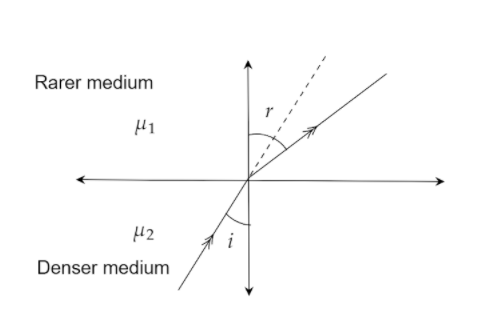
When light ray travels from denser medium to rarer medium then, the incident angle is in denser medium while refracted angle in rarer medium.
We know, ${\mu _2} > {\mu _1}$
According to Snell’s Law, for ${\mu _1}\sin r = {\mu _2}\sin i$, the value of $r$ must be greater than $i$.
So, it bends away from the normal when it travels from denser medium to rarer medium.
Case: 2
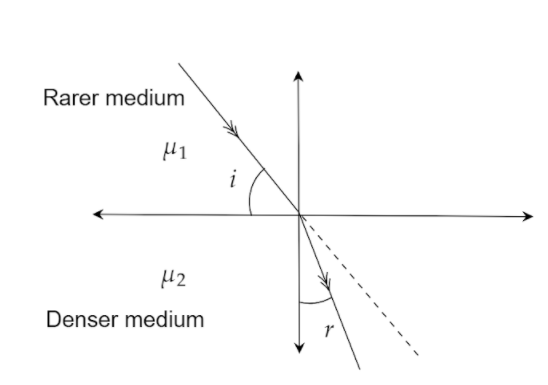
When light ray travels from rarer medium to denser medium then, the incident angle is in the rarer medium while the refracted angle in the denser medium.
We know, ${\mu _2} > {\mu _1}$
According to Snell’s Law, for ${\mu _1}\sin i = {\mu _2}\sin r$, the value of $i$ must be greater than $r$.
So, it bends towards the normal when it travels from rarer medium to denser medium.
So, we get to know that a ray of light travelling in air enters obliquely into water and they bend towards the normal.
Note: It must be noted that $\sin $ is an increasing function, so the value of it increases as the function with it increases and decreases when the function decreases. Opaque bodies do not cooperate with refraction as they do not allow light to pass through them. The perpendicular Y-axis is known as normal.
Complete step by step answer:
The phenomenon by which waves change their wave direction is known as refraction.
Refraction of a light wave is defined as the bending of light rays when it travels from a optically denser medium to an optically rarer medium or vice versa. Both the media must be transparent or translucent.
When a light ray travels from denser medium to rarer medium then it bends away from the normal while it travels from rarer medium to denser medium it travels towards the normal.
We have to find the logic why it happens.
From Snell’s Law we know,
${\mu _1}\sin i = {\mu _2}\sin r$ where $i$ is the angle of incidence and $r$ is the angle of refraction. ${\mu _1}$ be the refractive index of the rarer medium and ${\mu _2}$ be the refractive index of the denser medium.
Case:1
When light ray travels from denser medium to rarer medium then, the incident angle is in denser medium while refracted angle in rarer medium.
We know, ${\mu _2} > {\mu _1}$
According to Snell’s Law, for ${\mu _1}\sin r = {\mu _2}\sin i$, the value of $r$ must be greater than $i$.
So, it bends away from the normal when it travels from denser medium to rarer medium.
Case: 2
When light ray travels from rarer medium to denser medium then, the incident angle is in the rarer medium while the refracted angle in the denser medium.
We know, ${\mu _2} > {\mu _1}$
According to Snell’s Law, for ${\mu _1}\sin i = {\mu _2}\sin r$, the value of $i$ must be greater than $r$.
So, it bends towards the normal when it travels from rarer medium to denser medium.
So, we get to know that a ray of light travelling in air enters obliquely into water and they bend towards the normal.
Note: It must be noted that $\sin $ is an increasing function, so the value of it increases as the function with it increases and decreases when the function decreases. Opaque bodies do not cooperate with refraction as they do not allow light to pass through them. The perpendicular Y-axis is known as normal.
Recently Updated Pages
Master Class 12 Social Science: Engaging Questions & Answers for Success

Master Class 12 Physics: Engaging Questions & Answers for Success
Master Class 12 Maths: Engaging Questions & Answers for Success
Master Class 12 Economics: Engaging Questions & Answers for Success
Master Class 12 Chemistry: Engaging Questions & Answers for Success
Master Class 12 Business Studies: Engaging Questions & Answers for Success
Trending doubts
Which are the Top 10 Largest Countries of the World?
Draw a labelled sketch of the human eye class 12 physics CBSE
Explain the structure of megasporangium class 12 biology CBSE
What are the major means of transport Explain each class 12 social science CBSE
How many chromosomes are found in human ovum a 46 b class 12 biology CBSE
The diagram of the section of a maize grain is given class 12 biology CBSE