




A ray of light strikes a glass plate at an angle of 60°. If the reflected and refracted rays are perpendicular to each other, the refractive index of glass is
A. $\dfrac{\sqrt{3}}{2}$
B. $\dfrac{3}{2}$
C. $\dfrac{1}{2}$
D. $\sqrt{3}$
Answer
 Verified
638.1k+ views
Hint: From the angle of incidence given in the question, we get angle of reflection equal to the same by laws of reflection. By basic geometry, we know that the refracted angle should be 30° for the reflected and refracted ray to be perpendicular to each other. Now, we could substitute these values into Snell’s law of refraction (assuming the other medium is air) to get the refractive index of glass.
Formula used:
Law of reflection,
Angle of incidence = angle of reflection
Snell’s Law,
$\dfrac{\sin (i)}{\sin (r)}={{n}_{21}}=\dfrac{{{n}_{2}}}{{{n}_{1}}}$
Complete step by step answer:
We are given a ray of light that strikes a glass plate at an angle of 60°. That is,
Angle of incidence (i) =60° …………….. (1)
Where, angle of incidence is the angle made by the incident ray with the normal to the surface.
By law of reflection we have that,
Angle of incidence (i) = angle of reflection (e)
So, angle of reflection (e) =60° ………………. (2)
Where, angle of reflection is the angle made by the reflected ray with the normal.
When a light ray is incident on a glass surface, there is a change in medium. So, the incident ray is getting refracted at the glass surface.
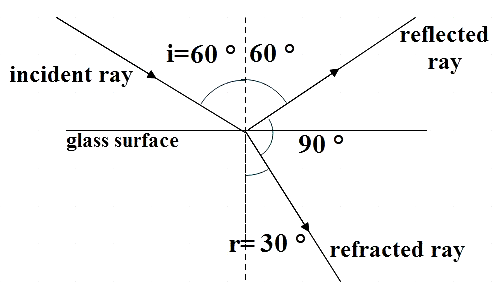
We are given the question that the reflected ray and the refracted ray lies perpendicular to each other. Hence, from the above given figure with our prior knowledge in geometry, we realize that the refracted angle (r) is 30°.
Refracted angle is the angle made by the refracted ray with the normal.
Refracted angle (r) = 30° …………….. (3)
Now, let us recall Snell’s law which states that, ratio of the sine of the angle of incidence to that of refraction is a constant for a given pair of media. This constant is what we call the refractive index of that medium with respect to the refractive index of the medium in which light was incident. That is,
$\dfrac{\sin (i)}{\sin (r)}={{n}_{21}}=\dfrac{{{n}_{2}}}{{{n}_{1}}}$ …………………… (4)
Let us assume that the first medium given in the question is air. Also, we know that the refractive index of air is 1.
So, ${{n}_{1}}$ in this question is 1, hence, the equation (4) now becomes,
$\dfrac{\sin (i)}{\sin (r)}=\dfrac{{{n}_{2}}}{1}=n$
Where, n is the refractive index of glass with respect to air. Now, substituting (1), (2) and (3) in (4) we get,
$\dfrac{\sin 60{}^\circ }{\sin 30{}^\circ }=n$
$n=\dfrac{\dfrac{\sqrt{3}}{2}}{\dfrac{1}{2}}$
Therefore, refractive index of glass is,
$n=\sqrt{3}$
The solution to the given question is option D.
Note:
While dealing with optics related problems, make sure that you draw a neat ray diagram prior to answering the question. By doing so you might be able to understand the problem more clearly and hence find the answer easily. Also, check whether the angle at which the ray strikes is given with respect to the glass surface or the normal. For example, if the angle given in this question was with the glass surface, angle of incidence (i) should be taken as,
$i={{\left( 90-60 \right)}^{{}^\circ }}=30{}^\circ $ .
Formula used:
Law of reflection,
Angle of incidence = angle of reflection
Snell’s Law,
$\dfrac{\sin (i)}{\sin (r)}={{n}_{21}}=\dfrac{{{n}_{2}}}{{{n}_{1}}}$
Complete step by step answer:
We are given a ray of light that strikes a glass plate at an angle of 60°. That is,
Angle of incidence (i) =60° …………….. (1)
Where, angle of incidence is the angle made by the incident ray with the normal to the surface.
By law of reflection we have that,
Angle of incidence (i) = angle of reflection (e)
So, angle of reflection (e) =60° ………………. (2)
Where, angle of reflection is the angle made by the reflected ray with the normal.
When a light ray is incident on a glass surface, there is a change in medium. So, the incident ray is getting refracted at the glass surface.
We are given the question that the reflected ray and the refracted ray lies perpendicular to each other. Hence, from the above given figure with our prior knowledge in geometry, we realize that the refracted angle (r) is 30°.
Refracted angle is the angle made by the refracted ray with the normal.
Refracted angle (r) = 30° …………….. (3)
Now, let us recall Snell’s law which states that, ratio of the sine of the angle of incidence to that of refraction is a constant for a given pair of media. This constant is what we call the refractive index of that medium with respect to the refractive index of the medium in which light was incident. That is,
$\dfrac{\sin (i)}{\sin (r)}={{n}_{21}}=\dfrac{{{n}_{2}}}{{{n}_{1}}}$ …………………… (4)
Let us assume that the first medium given in the question is air. Also, we know that the refractive index of air is 1.
So, ${{n}_{1}}$ in this question is 1, hence, the equation (4) now becomes,
$\dfrac{\sin (i)}{\sin (r)}=\dfrac{{{n}_{2}}}{1}=n$
Where, n is the refractive index of glass with respect to air. Now, substituting (1), (2) and (3) in (4) we get,
$\dfrac{\sin 60{}^\circ }{\sin 30{}^\circ }=n$
$n=\dfrac{\dfrac{\sqrt{3}}{2}}{\dfrac{1}{2}}$
Therefore, refractive index of glass is,
$n=\sqrt{3}$
The solution to the given question is option D.
Note:
While dealing with optics related problems, make sure that you draw a neat ray diagram prior to answering the question. By doing so you might be able to understand the problem more clearly and hence find the answer easily. Also, check whether the angle at which the ray strikes is given with respect to the glass surface or the normal. For example, if the angle given in this question was with the glass surface, angle of incidence (i) should be taken as,
$i={{\left( 90-60 \right)}^{{}^\circ }}=30{}^\circ $ .
Recently Updated Pages
Basicity of sulphurous acid and sulphuric acid are

Master Class 12 Economics: Engaging Questions & Answers for Success
Master Class 12 Biology: Engaging Questions & Answers for Success
Master Class 11 English: Engaging Questions & Answers for Success
Master Class 11 Physics: Engaging Questions & Answers for Success
Master Class 11 Computer Science: Engaging Questions & Answers for Success
Trending doubts
Draw a labelled sketch of the human eye class 12 physics CBSE
The chemical formula of tear gas is A CO Cl 2 B C 10 class 12 chemistry CBSE
Draw ray diagrams each showing i myopic eye and ii class 12 physics CBSE
Which are the Top 10 Largest Countries of the World?
Differentiate between homogeneous and heterogeneous class 12 chemistry CBSE
Which is the correct genotypic ratio of mendel dihybrid class 12 biology CBSE