




When a ray of light passes from a rarer to denser medium it bends towards the normal
a) True
b) False
Answer
 Verified
646.2k+ views
Hint: Speed of light in any medium is always less than that of speed of light in vacuum. Hence, from the definition of refractive index we can easily come to a conclusion whether the ray of light will bend or move away from the normal.
Complete solution:
Let us first define the refractive index of a substance.
Refractive index of a medium for a light of given wavelength can be defined as the ratio of speed of light in vacuum to that of the speed in the medium
Mathematically expressed as $\eta =\dfrac{c}{v}$ where c is the speed of light in vacuum and v is the speed of light in medium.
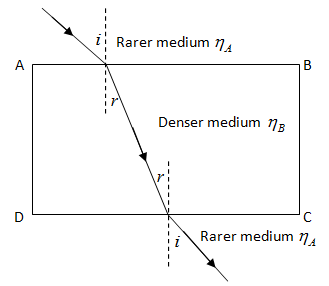
So, in the above diagram a ray of light is incident on the surface AB at an angle i of the denser medium gets refracted at an angle r, hits the surface DC at an angle r and then comes out of the medium at an angle i.
Using Snell’s law of refraction, refractive index of denser medium with respect to rarer medium is given by,
${{\eta }_{BA}}=\dfrac{\operatorname{Sin}i}{\operatorname{Sin}r}=\dfrac{{{\eta }_{B}}}{{{\eta }_{A}}}$
Speed of light in the rarer medium is always greater than the denser medium ,
Using the general definition of refractive index Snell law can be written as,
$\dfrac{\operatorname{Sin}i}{\operatorname{Sin}r}=\dfrac{{{\eta }_{B}}}{{{\eta }_{A}}}=\dfrac{\dfrac{\text{speed of light in vacuum}}{\text{speed of light in B}}}{\dfrac{\text{speed of light in vacuum}}{\text{speed of light in A}}}$
After cancelling similar terms,
$\dfrac{\operatorname{Sin}i}{\operatorname{Sin}r}=\dfrac{\text{speed of light in A}}{\text{speed of light in B}}$
If we consider the above equation we know that speed of light in medium A is greater than in medium B. Hence,
$\operatorname{Sin}i>\operatorname{Sin}r$ implies that $i>r$
Hence the light bends as it moves from rarer to denser medium. Therefore the statement is true.
Additional information:
There is a better analogy to understand the above situation. If the light had to continue the same path in the denser medium it would have taken more time to come out of the medium. Since it bends it comparatively takes less time, as light wants to travel the fastest.
Note: When a ray of light enters from a rarer to denser medium light bends. But if the ray light moves from denser to rarer medium light moves away from the normal. Since the speed of light changes as it enters from a rarer to denser medium the frequency of light does not change but its wavelength changes.
Complete solution:
Let us first define the refractive index of a substance.
Refractive index of a medium for a light of given wavelength can be defined as the ratio of speed of light in vacuum to that of the speed in the medium
Mathematically expressed as $\eta =\dfrac{c}{v}$ where c is the speed of light in vacuum and v is the speed of light in medium.
So, in the above diagram a ray of light is incident on the surface AB at an angle i of the denser medium gets refracted at an angle r, hits the surface DC at an angle r and then comes out of the medium at an angle i.
Using Snell’s law of refraction, refractive index of denser medium with respect to rarer medium is given by,
${{\eta }_{BA}}=\dfrac{\operatorname{Sin}i}{\operatorname{Sin}r}=\dfrac{{{\eta }_{B}}}{{{\eta }_{A}}}$
Speed of light in the rarer medium is always greater than the denser medium ,
Using the general definition of refractive index Snell law can be written as,
$\dfrac{\operatorname{Sin}i}{\operatorname{Sin}r}=\dfrac{{{\eta }_{B}}}{{{\eta }_{A}}}=\dfrac{\dfrac{\text{speed of light in vacuum}}{\text{speed of light in B}}}{\dfrac{\text{speed of light in vacuum}}{\text{speed of light in A}}}$
After cancelling similar terms,
$\dfrac{\operatorname{Sin}i}{\operatorname{Sin}r}=\dfrac{\text{speed of light in A}}{\text{speed of light in B}}$
If we consider the above equation we know that speed of light in medium A is greater than in medium B. Hence,
$\operatorname{Sin}i>\operatorname{Sin}r$ implies that $i>r$
Hence the light bends as it moves from rarer to denser medium. Therefore the statement is true.
Additional information:
There is a better analogy to understand the above situation. If the light had to continue the same path in the denser medium it would have taken more time to come out of the medium. Since it bends it comparatively takes less time, as light wants to travel the fastest.
Note: When a ray of light enters from a rarer to denser medium light bends. But if the ray light moves from denser to rarer medium light moves away from the normal. Since the speed of light changes as it enters from a rarer to denser medium the frequency of light does not change but its wavelength changes.
Recently Updated Pages
Basicity of sulphurous acid and sulphuric acid are

Master Class 12 Economics: Engaging Questions & Answers for Success
Master Class 12 Biology: Engaging Questions & Answers for Success
Master Class 11 English: Engaging Questions & Answers for Success
Master Class 11 Physics: Engaging Questions & Answers for Success
Master Class 11 Computer Science: Engaging Questions & Answers for Success
Trending doubts
Draw a labelled sketch of the human eye class 12 physics CBSE
The chemical formula of tear gas is A CO Cl 2 B C 10 class 12 chemistry CBSE
Draw ray diagrams each showing i myopic eye and ii class 12 physics CBSE
Which are the Top 10 Largest Countries of the World?
Differentiate between homogeneous and heterogeneous class 12 chemistry CBSE
Which is the correct genotypic ratio of mendel dihybrid class 12 biology CBSE