




A ray of light is incident on a glass sphere of refractive index $\dfrac{3}{2}$ . What should be the angle of incidence so that the ray which enters the sphere does not come out of the sphere?
a. ${\sin ^{ - 1}}\left( {\dfrac{2}{3}} \right)$
b. ${60^ \circ }$
c. ${90^ \circ }$
d. ${30^ \circ }$
Answer
 Verified
557.4k+ views
Hint: We want to determine the angle of incidence of a ray of light on a sphere of glass with refractive index $\dfrac{3}{2}$ so as to ensure that the ray of light does not come out of the sphere and by using Snell’s Law we will get the answer.
Formula used:
$\mu = \dfrac{{\sin i}}{{\sin r}}$
Complete step-by-step solution:
For the light to not come out of the sphere, $e$ must be greater than or equal to \[{90^ \circ }\].
Consider a ray of light $AB$ incident on the glass sphere at point $B$ at an angle $i$ . The angle of refraction is $r$ .
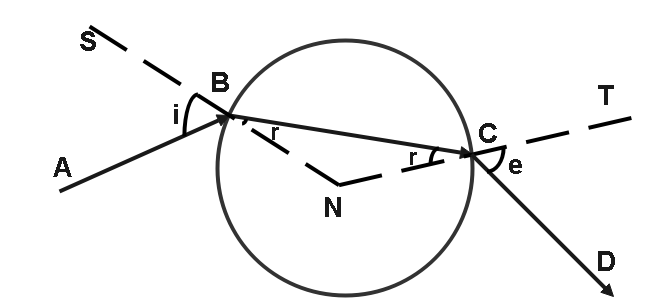
The refracted ray $BC$ comes out of the sphere at point at point $C$ and emerges from the sphere as ray $CD$ , with an angle of emergence $e$ .
Here we can see that $NS$ and $NT$ are the normal at the point of incidence and the point of emergence respectively and that $NB$ and $NC$ are radii of the sphere.
$ \Rightarrow \angle NBC = r = \angle NCB$
Also,
$\mu = \dfrac{{\sin i}}{{\sin r}}$
Where,
$\mu $ is known as the refractive index,
\[i\] is known as the angle of incidence and
$r$ is known as the angle of refraction.
And
$\mu = \dfrac{{\sin e}}{{\sin r}}$
$ \Rightarrow \sin i = \sin e \\
\Rightarrow i = e $
This means that, when a ray of light is incident on a sphere, the angle of incidence and the angle of emergence are always equal. If the ray of light should not come out of the sphere it means that the angle of emergence has to be at least ${90^ \circ }$ .
$\therefore $ The angle of incidence is ${90^ \circ }$ .
Hence, option (c) is the correct option.
Note: However, the angle of incidence cannot be more than ${90^ \circ }$ and if the angle of incidence is ${90^ \circ }$ , the ray of light will just brush past the sphere and will not enter the sphere. Refractive index is basically the speed of light in a medium with respect to air. Since we have speeds in both numerator and denominator, their units cancel out and thus the refractive index is unit less.
Additional information: The phenomenon happening here is known as refraction of light, this happens due to different speeds of light in different mediums. The medium in which the speed of light is more is known as rarer and in which it is less is known as denser medium.
Formula used:
$\mu = \dfrac{{\sin i}}{{\sin r}}$
Complete step-by-step solution:
For the light to not come out of the sphere, $e$ must be greater than or equal to \[{90^ \circ }\].
Consider a ray of light $AB$ incident on the glass sphere at point $B$ at an angle $i$ . The angle of refraction is $r$ .
The refracted ray $BC$ comes out of the sphere at point at point $C$ and emerges from the sphere as ray $CD$ , with an angle of emergence $e$ .
Here we can see that $NS$ and $NT$ are the normal at the point of incidence and the point of emergence respectively and that $NB$ and $NC$ are radii of the sphere.
$ \Rightarrow \angle NBC = r = \angle NCB$
Also,
$\mu = \dfrac{{\sin i}}{{\sin r}}$
Where,
$\mu $ is known as the refractive index,
\[i\] is known as the angle of incidence and
$r$ is known as the angle of refraction.
And
$\mu = \dfrac{{\sin e}}{{\sin r}}$
$ \Rightarrow \sin i = \sin e \\
\Rightarrow i = e $
This means that, when a ray of light is incident on a sphere, the angle of incidence and the angle of emergence are always equal. If the ray of light should not come out of the sphere it means that the angle of emergence has to be at least ${90^ \circ }$ .
$\therefore $ The angle of incidence is ${90^ \circ }$ .
Hence, option (c) is the correct option.
Note: However, the angle of incidence cannot be more than ${90^ \circ }$ and if the angle of incidence is ${90^ \circ }$ , the ray of light will just brush past the sphere and will not enter the sphere. Refractive index is basically the speed of light in a medium with respect to air. Since we have speeds in both numerator and denominator, their units cancel out and thus the refractive index is unit less.
Additional information: The phenomenon happening here is known as refraction of light, this happens due to different speeds of light in different mediums. The medium in which the speed of light is more is known as rarer and in which it is less is known as denser medium.
Recently Updated Pages
Differentiate between voluntary action and reflex class 10 biology CBSE

The uses of bleaching powder are A It is used bleaching class 10 chemistry CBSE
Fill in the blanks with abstract nouns of the words class 10 english CBSE
How many threedigit numbers are there class 10 maths CBSE
What is a reflex arc class 10 biology CBSE
Construct a square whose diagonal is 6cm Measure the class 10 maths CBSE
Trending doubts
Explain the Treaty of Vienna of 1815 class 10 social science CBSE
The slogan Jai Hind was given by A Lal Bahadur Shastri class 10 social science CBSE
10 examples of evaporation in daily life with explanations
What is the full form of POSCO class 10 social science CBSE
Identify the feminine form of noun nephew a shenephew class 10 english CBSE
Make a sketch of the human nerve cell What function class 10 biology CBSE