




A ray of light is incident at an angle of incidence i, on one face of a prism of angle A (assumed to be small) and emerges normally from the opposite face. If the refractive index of the prism is \[\mu \]¸ the angle of incidence $i$ is nearly equal to
A) \[\dfrac{A}{\mu }\]
B) \[\dfrac{A}{{2\mu }}\]
C) \[\mu A\]
D) \[\dfrac{{\mu A}}{2}\]
Answer
 Verified
586.5k+ views
Hint: As we know snell’s law is all about the relationship between the angle of incidence and angle refraction so Here, we will be using the formula of Snell’s law and will do some approximation wherever needed.
Formula used:
We will use Snell’s law here which is
\[\mu_1\sin i = \mu_2\sin r\]
Where $i$ is the angle of incidence and r is the angle of refraction. And \[\mu_1\& \mu_2\] are the refractive indexes of the first and second medium through which the light passes.
Complete step by step solution:
Given, the Angle of incidence of the light is $i$ on the prism. The angle of the prism is A which is to be assumed small. The ray of light emerges normally from the opposite face of the prism. And the refractive index of the prism is given which is \[\mu \].
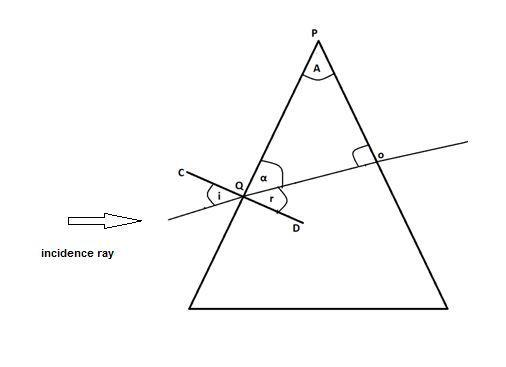
In the figure, consider triangle PQO
As we know, the sum of all angles of a triangle is equal to \[{180^ \circ }\]. So,
\[\angle {\text{PQO + }}\angle {\text{QPO + }}\angle {\text{POQ = 18}}{0^ \circ }\]
Putting \[\angle {\text{PQO = A,}}\angle {\text{QPO = }}\alpha ,\angle {\text{POQ = 9}}{{\text{0}}^ \circ }\]
So \[ \Rightarrow A + \alpha + {90^ \circ } = {180^ \circ }\]
Therefore after calculation we will get
\[ \Rightarrow \alpha = {90^ \circ } - A\]
\[ \Rightarrow A = {90^ \circ } - \alpha \] (1)
Since, CD is perpendicular on the face of the prism, So
\[\alpha + r = {90^ \circ }\]
From equation (1)
$
\Rightarrow r = {90^ \circ } - \alpha \\
\Rightarrow r = A \\
$
Therefore angle prism is equal to angle of refraction
Now, From Snell’s law,
For small angle,
i = \[\mu A\]. since sin x = x, for small angles.
Thus, we can see the angle of incidence is nearly equal to \[\mu A\].
Hence, option C is correct.
Note:
The approximation of sin function done in this solution is applicable in case of small angles only. The precisely made diagrams will give you a better understanding of the given condition.
Formula used:
We will use Snell’s law here which is
\[\mu_1\sin i = \mu_2\sin r\]
Where $i$ is the angle of incidence and r is the angle of refraction. And \[\mu_1\& \mu_2\] are the refractive indexes of the first and second medium through which the light passes.
Complete step by step solution:
Given, the Angle of incidence of the light is $i$ on the prism. The angle of the prism is A which is to be assumed small. The ray of light emerges normally from the opposite face of the prism. And the refractive index of the prism is given which is \[\mu \].
In the figure, consider triangle PQO
As we know, the sum of all angles of a triangle is equal to \[{180^ \circ }\]. So,
\[\angle {\text{PQO + }}\angle {\text{QPO + }}\angle {\text{POQ = 18}}{0^ \circ }\]
Putting \[\angle {\text{PQO = A,}}\angle {\text{QPO = }}\alpha ,\angle {\text{POQ = 9}}{{\text{0}}^ \circ }\]
So \[ \Rightarrow A + \alpha + {90^ \circ } = {180^ \circ }\]
Therefore after calculation we will get
\[ \Rightarrow \alpha = {90^ \circ } - A\]
\[ \Rightarrow A = {90^ \circ } - \alpha \] (1)
Since, CD is perpendicular on the face of the prism, So
\[\alpha + r = {90^ \circ }\]
From equation (1)
$
\Rightarrow r = {90^ \circ } - \alpha \\
\Rightarrow r = A \\
$
Therefore angle prism is equal to angle of refraction
Now, From Snell’s law,
For small angle,
i = \[\mu A\]. since sin x = x, for small angles.
Thus, we can see the angle of incidence is nearly equal to \[\mu A\].
Hence, option C is correct.
Note:
The approximation of sin function done in this solution is applicable in case of small angles only. The precisely made diagrams will give you a better understanding of the given condition.
Recently Updated Pages
Master Class 10 Computer Science: Engaging Questions & Answers for Success

Master Class 10 General Knowledge: Engaging Questions & Answers for Success
Master Class 10 English: Engaging Questions & Answers for Success
Master Class 10 Social Science: Engaging Questions & Answers for Success
Master Class 10 Maths: Engaging Questions & Answers for Success
Master Class 10 Science: Engaging Questions & Answers for Success
Trending doubts
What is the median of the first 10 natural numbers class 10 maths CBSE
Which women's tennis player has 24 Grand Slam singles titles?
Who is the Brand Ambassador of Incredible India?
Why is there a time difference of about 5 hours between class 10 social science CBSE
Write a letter to the principal requesting him to grant class 10 english CBSE
A moving boat is observed from the top of a 150 m high class 10 maths CBSE