




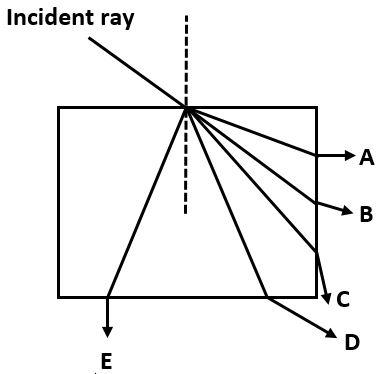
A ray of light incident on a piece of glass as shown above. The light passed through the glass and emerged into the air. $A,B,C,D$ and $E$ are possible paths of light. Choose the best possible path of light.
A. $A$
B. $B$
C. $C$
D. $D$
E. $E$
Answer
 Verified
622.2k+ views
Hint: We consider two types of mediums when we talk about refraction. Rarer medium and denser medium. Rarer medium is where the distance between molecules is more in comparison with the distance between the molecules of a denser medium. When light travels from denser to rarer medium, it bends away from the normal.
Complete step by step answer:
Observe the diagram
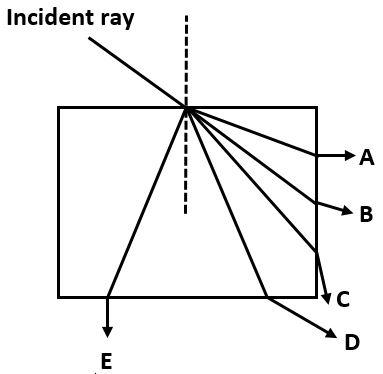
We consider two types of mediums when we talk about refraction. Rarer medium and denser medium. Rarer medium is where the distance between molecules is more in comparison with the distance between the molecules of a denser medium. For example, in this question, air will be the rarer medium and glass will be the denser medium.
When light travels from denser to rarer medium, it bends away from the normal. And when light travels from rarer to denser medium, it bends towards the normal.
So, if we consider the incident ray to fall on a glass slab from air, then the light ray must bend towards the normal as air is a rarer medium and the glass slab be denser medium.
Again, when the light reaches to the end of the glass slab and refracts out to the air medium, then the light must bend away from the normal.
D is the only ray that is satisfying this condition.
Therefore, form the above explanation the correct option is (D) $D$.
Note:When the light rays either bend or change their direction will be passing from one medium to another is a called refraction of light. The refraction of light takes place when light travels from air into glass, form glass into air, from air water or form water into air. The speed of light reduces when it passes from rarer to denser medium. And the speed of light increases when it passes from denser to rarer medium.
Complete step by step answer:
Observe the diagram
We consider two types of mediums when we talk about refraction. Rarer medium and denser medium. Rarer medium is where the distance between molecules is more in comparison with the distance between the molecules of a denser medium. For example, in this question, air will be the rarer medium and glass will be the denser medium.
When light travels from denser to rarer medium, it bends away from the normal. And when light travels from rarer to denser medium, it bends towards the normal.
So, if we consider the incident ray to fall on a glass slab from air, then the light ray must bend towards the normal as air is a rarer medium and the glass slab be denser medium.
Again, when the light reaches to the end of the glass slab and refracts out to the air medium, then the light must bend away from the normal.
D is the only ray that is satisfying this condition.
Therefore, form the above explanation the correct option is (D) $D$.
Note:When the light rays either bend or change their direction will be passing from one medium to another is a called refraction of light. The refraction of light takes place when light travels from air into glass, form glass into air, from air water or form water into air. The speed of light reduces when it passes from rarer to denser medium. And the speed of light increases when it passes from denser to rarer medium.
Recently Updated Pages
Basicity of sulphurous acid and sulphuric acid are

Master Class 12 Economics: Engaging Questions & Answers for Success
Master Class 12 Biology: Engaging Questions & Answers for Success
Master Class 11 English: Engaging Questions & Answers for Success
Master Class 11 Physics: Engaging Questions & Answers for Success
Master Class 11 Computer Science: Engaging Questions & Answers for Success
Trending doubts
Draw a labelled sketch of the human eye class 12 physics CBSE
The chemical formula of tear gas is A CO Cl 2 B C 10 class 12 chemistry CBSE
Draw ray diagrams each showing i myopic eye and ii class 12 physics CBSE
Which are the Top 10 Largest Countries of the World?
Differentiate between homogeneous and heterogeneous class 12 chemistry CBSE
Which is the correct genotypic ratio of mendel dihybrid class 12 biology CBSE