




A ramp is constructed in a parabolic shape such that the height y of any point on its surface is given in terms of the point's horizontal distance x from the bottom of the ramp be $y = \dfrac{{{x^2}}}{{2L}}$. A block of granite is to be set on the ramp; the coefficient of static friction is 0.80. What is the maximum x coordinate at which the block can be placed on the ramp so that it will remain at rest, if L=10m?
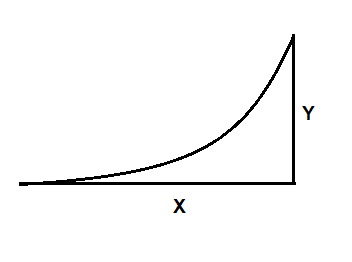
A. 8 m
B. 8.4 m
C. 9 m
D. 9.4 m
Answer
 Verified
606.9k+ views
Hint: The coefficient of static friction is the ratio of friction force over normal force. Frictional force is the vertical force and normal force is the horizontal force. After substituting the force values we will be getting the coefficient friction as the slope. Slope is the ratio of change in y-coordinates over the change in x-coordinates. Use this info to solve the rest of the problem.
Complete step by step answer:
We are given that a ramp is constructed in a parabolic shape such that the height y of any point on its surface is given in terms of the point's horizontal distance x from the bottom of the ramp be $y = \dfrac{{{x^2}}}{{2L}}$. A block of granite is to be set on the ramp; the coefficient of static friction is 0.80.
We have to find the maximum distance at which the block must be placed so that it will remain at rest.
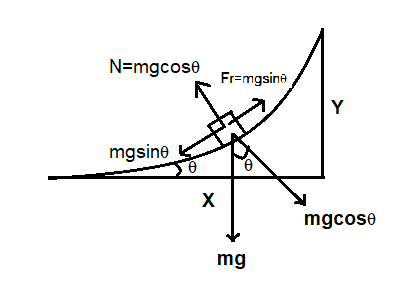
Coefficient of friction is the ratio of frictional force to the normal force.
Frictional force is the vertical force which is $mg\sin \theta $
Normal force is the horizontal force which is $mg\cos \theta $
Therefore,
$COF = \dfrac{{{F_{friction}}}}{{{F_{normal}}}} = \dfrac{{mg\sin \theta }}{{mg\cos \theta }} = \tan \theta $
We know that $\tan \theta $ is the slope, and slope is the ratio of change in y and change in x.
$\tan \theta = \dfrac{{dy}}{{dx}}$ and $y = \dfrac{{{x^2}}}{{2L}}$
Therefore,
$
\dfrac{{dy}}{{dx}} = \dfrac{d}{{dx}}\left( {\dfrac{{{x^2}}}{{2L}}} \right) \\
\Rightarrow \dfrac{{dy}}{{dx}} = \dfrac{{2x}}{{2L}} = \dfrac{x}{L} \\
$
On equating the value of slope to coefficient of friction, we get
$
COF = \tan \theta = \dfrac{{dy}}{{dx}} = \dfrac{x}{L} \\
\Rightarrow COF = \dfrac{x}{L} \\
$
But we know that the value of coefficient of static friction is 0.8 and the value of L is 10m.
$
\Rightarrow COF = \dfrac{x}{L} = 0.8 \\
\Rightarrow \dfrac{x}{L} = 0.8 \\
\Rightarrow \dfrac{x}{{10}} = 0.8 \\
\Rightarrow x = 0.8 \times 10 = 8m \\
$
Therefore, the maximum x-coordinate distance to put the block in rest is 8 m.
The correct option is Option A.
Note:Single force, when it is directed at an angle to the horizontal, is separated into two forces which have different directions and their equivalent results in the main force. This is called resolution of force. Do not confuse horizontal force with vertical force. As the angle with the horizontal increases, the horizontal force decreases, and when the angle with the horizontal decreases, the vertical force increases.
Complete step by step answer:
We are given that a ramp is constructed in a parabolic shape such that the height y of any point on its surface is given in terms of the point's horizontal distance x from the bottom of the ramp be $y = \dfrac{{{x^2}}}{{2L}}$. A block of granite is to be set on the ramp; the coefficient of static friction is 0.80.
We have to find the maximum distance at which the block must be placed so that it will remain at rest.
Coefficient of friction is the ratio of frictional force to the normal force.
Frictional force is the vertical force which is $mg\sin \theta $
Normal force is the horizontal force which is $mg\cos \theta $
Therefore,
$COF = \dfrac{{{F_{friction}}}}{{{F_{normal}}}} = \dfrac{{mg\sin \theta }}{{mg\cos \theta }} = \tan \theta $
We know that $\tan \theta $ is the slope, and slope is the ratio of change in y and change in x.
$\tan \theta = \dfrac{{dy}}{{dx}}$ and $y = \dfrac{{{x^2}}}{{2L}}$
Therefore,
$
\dfrac{{dy}}{{dx}} = \dfrac{d}{{dx}}\left( {\dfrac{{{x^2}}}{{2L}}} \right) \\
\Rightarrow \dfrac{{dy}}{{dx}} = \dfrac{{2x}}{{2L}} = \dfrac{x}{L} \\
$
On equating the value of slope to coefficient of friction, we get
$
COF = \tan \theta = \dfrac{{dy}}{{dx}} = \dfrac{x}{L} \\
\Rightarrow COF = \dfrac{x}{L} \\
$
But we know that the value of coefficient of static friction is 0.8 and the value of L is 10m.
$
\Rightarrow COF = \dfrac{x}{L} = 0.8 \\
\Rightarrow \dfrac{x}{L} = 0.8 \\
\Rightarrow \dfrac{x}{{10}} = 0.8 \\
\Rightarrow x = 0.8 \times 10 = 8m \\
$
Therefore, the maximum x-coordinate distance to put the block in rest is 8 m.
The correct option is Option A.
Note:Single force, when it is directed at an angle to the horizontal, is separated into two forces which have different directions and their equivalent results in the main force. This is called resolution of force. Do not confuse horizontal force with vertical force. As the angle with the horizontal increases, the horizontal force decreases, and when the angle with the horizontal decreases, the vertical force increases.
Recently Updated Pages
Master Class 11 Social Science: Engaging Questions & Answers for Success

Master Class 11 Chemistry: Engaging Questions & Answers for Success
Master Class 12 Business Studies: Engaging Questions & Answers for Success
Master Class 12 Chemistry: Engaging Questions & Answers for Success
Master Class 12 Biology: Engaging Questions & Answers for Success
Class 12 Question and Answer - Your Ultimate Solutions Guide
Trending doubts
One Metric ton is equal to kg A 10000 B 1000 C 100 class 11 physics CBSE
Difference Between Prokaryotic Cells and Eukaryotic Cells
How many of the following diseases can be studied with class 11 biology CBSE
Two of the body parts which do not appear in MRI are class 11 biology CBSE
Which of the following enzymes is used for carboxylation class 11 biology CBSE
Explain zero factorial class 11 maths CBSE