




A railway of mass 50 tons is pulling a wagon of mass 40 tons with a force of 4500 N. The resistance force acting is 1 N per ton. The tension in the coupling between the engine and the wagon is:
A. 1600 N
B. 2000 N
C. 3000 N
D. 1500 N
Answer
 Verified
612.3k+ views
Hint: Sum of all the forces is equals to ,
$Force = mass \times acceleration$ ,
${F_{net}} = m \times a$ ,
Complete step by step solution:
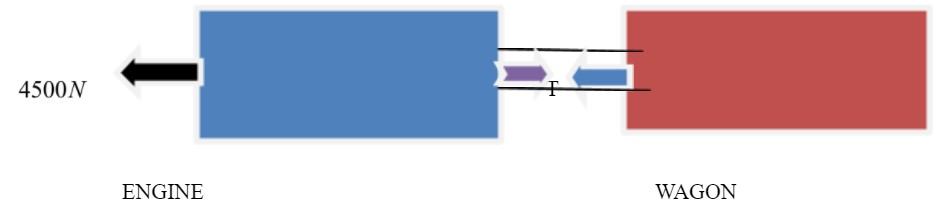
As we can see in our free body diagram that the net force is $4500N$ through which the whole train is being pulled.
Coupling force is the force which acts upon an object in equal magnitude but in the opposite direction.
Just think of it, that through the influence of which force actually the wagon is moving, Yes, exactly it’s Tension force.
Here, Tension force is our coupling force because for an Engine, it is acting in the opposite direction, but for Wagon, it becomes a pulling force.
The approach that we are going to pick up is to first find the acceleration of the train and then use this acceleration to find the tension force.
Let the mass of the Engine be m1,
Let the mass of the Wagon be m2,
Let a be the acceleration of the whole train.
So,
$F = m \times a$ ,
$F = \left( {m_1 + m_2} \right) \times a$ , because $m_1 + m_2$ is the total mass.
$m1 = 50tonne\left( {given} \right)$ ,
So convert it in the S.I unit, that is Kg.
$1$ $ton = 1000kg$,
Therefore, $m_1 = 50 \times 1000kg$
$m_1 = 5000kg$
$m_2 = 40 tonne$
Therefore,$m_2 = 40000kg$ ,
Now,
$F = \left( {m_1 + m_2} \right) \times a$ ,
$4500 = (50000 + 40000) \times a$ ,
$a = \dfrac{{4500}}{{90000}}$ ,
$a = 0.05m/s$ .
We have to find the Coupling force means Tension force.
Tension force for wagon = mass of wagon $ \times $ acceleration,
$T = {m_2} \times a$ ,
$T = 40000 \times 0.05$ ,
$T = 2000N$
$\therefore $ Option(B) is correct.
Note: Tension is the coupling force, which means it will act in opposite directions with equal magnitude. Net force is the sum of the vector forces, because force is vector quantity, so the opposite force will automatically get cancelled. Net force equals to non-Zero means the object is accelerating.
$Force = mass \times acceleration$ ,
${F_{net}} = m \times a$ ,
Complete step by step solution:
As we can see in our free body diagram that the net force is $4500N$ through which the whole train is being pulled.
Coupling force is the force which acts upon an object in equal magnitude but in the opposite direction.
Just think of it, that through the influence of which force actually the wagon is moving, Yes, exactly it’s Tension force.
Here, Tension force is our coupling force because for an Engine, it is acting in the opposite direction, but for Wagon, it becomes a pulling force.
The approach that we are going to pick up is to first find the acceleration of the train and then use this acceleration to find the tension force.
Let the mass of the Engine be m1,
Let the mass of the Wagon be m2,
Let a be the acceleration of the whole train.
So,
$F = m \times a$ ,
$F = \left( {m_1 + m_2} \right) \times a$ , because $m_1 + m_2$ is the total mass.
$m1 = 50tonne\left( {given} \right)$ ,
So convert it in the S.I unit, that is Kg.
$1$ $ton = 1000kg$,
Therefore, $m_1 = 50 \times 1000kg$
$m_1 = 5000kg$
$m_2 = 40 tonne$
Therefore,$m_2 = 40000kg$ ,
Now,
$F = \left( {m_1 + m_2} \right) \times a$ ,
$4500 = (50000 + 40000) \times a$ ,
$a = \dfrac{{4500}}{{90000}}$ ,
$a = 0.05m/s$ .
We have to find the Coupling force means Tension force.
Tension force for wagon = mass of wagon $ \times $ acceleration,
$T = {m_2} \times a$ ,
$T = 40000 \times 0.05$ ,
$T = 2000N$
$\therefore $ Option(B) is correct.
Note: Tension is the coupling force, which means it will act in opposite directions with equal magnitude. Net force is the sum of the vector forces, because force is vector quantity, so the opposite force will automatically get cancelled. Net force equals to non-Zero means the object is accelerating.
Recently Updated Pages
Master Class 11 Social Science: Engaging Questions & Answers for Success

Master Class 11 English: Engaging Questions & Answers for Success
Master Class 11 Maths: Engaging Questions & Answers for Success
Master Class 11 Chemistry: Engaging Questions & Answers for Success
Master Class 11 Biology: Engaging Questions & Answers for Success
Master Class 11 Physics: Engaging Questions & Answers for Success
Trending doubts
Differentiate between an exothermic and an endothermic class 11 chemistry CBSE
One Metric ton is equal to kg A 10000 B 1000 C 100 class 11 physics CBSE
Difference Between Prokaryotic Cells and Eukaryotic Cells
There are 720 permutations of the digits 1 2 3 4 5 class 11 maths CBSE
Draw a diagram of a plant cell and label at least eight class 11 biology CBSE
Which chemical is known as king of chemicals A H 2 class 11 chemistry CBSE