




A railroad curve is to be laid out on a circle. What radius should be used if the track is to change direction \[{{25}^{\circ }}\] in the direction of 40 meters?
Answer
 Verified
639.9k+ views
Hint: For the above question first of all we will change the angle into radians from degrees by using the conversion \[{{1}^{\circ }}=\dfrac{\pi }{180}radians\].
Then we will use the formula as given below:
\[r=\dfrac{l}{\theta }\], where ‘r’ is the radius of the circle, ‘l’ is the length of arc and \['\theta '\] is the angle subtended by the arc of length at center. Also, \['\theta '\] must be in radian.
Complete step-by-step answer:
We have been given that a train is to change direction by \[{{25}^{\circ }}\] in a direction of 40 meters on a circular path. Now we know that \[{{1}^{\circ }}=\dfrac{\pi }{180}radians\].
\[\Rightarrow {{25}^{\circ }}=\dfrac{\pi }{180}\times 25=\dfrac{5\pi }{36}radians\]
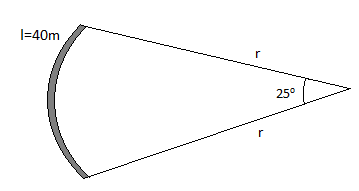
We know that on a circular path, if the length of arc is ‘l’, the radius of the circle is ‘r’ and the angle subtended by the arc at center is \['\theta '\], then \[r=\dfrac{l}{\theta }\], where \['\theta '\] must be in radians.
Now we have l = 40 meters and \[\theta =\dfrac{5\pi }{36}radians\], then:
\[\begin{align}
& \Rightarrow r=\dfrac{l}{\theta } \\
& \Rightarrow \dfrac{40}{{}^{5\pi }/{}_{36}}=\dfrac{40\times 36}{5\pi }=\dfrac{288}{\pi } \\
\end{align}\]
Since \[\pi =\dfrac{22}{7}\], \[\Rightarrow r=\dfrac{288\times 7}{22}=91.63m(approx)\]
Therefore, the radius is equal to 91.63 meters (approximately).
Note: Be careful while changing the radians into degree and don’t get confused in the conversion 1 radian = \[\dfrac{180}{\pi }\] degrees because in a hurry, we might end up taking 1 radian = \[\dfrac{\pi }{180}\] degrees which is absolutely wrong. Also remember that in \[r=\dfrac{l}{\theta }\], \[\theta \] must be in radians. We cannot substitute the value in degree or other units of angle.
Then we will use the formula as given below:
\[r=\dfrac{l}{\theta }\], where ‘r’ is the radius of the circle, ‘l’ is the length of arc and \['\theta '\] is the angle subtended by the arc of length at center. Also, \['\theta '\] must be in radian.
Complete step-by-step answer:
We have been given that a train is to change direction by \[{{25}^{\circ }}\] in a direction of 40 meters on a circular path. Now we know that \[{{1}^{\circ }}=\dfrac{\pi }{180}radians\].
\[\Rightarrow {{25}^{\circ }}=\dfrac{\pi }{180}\times 25=\dfrac{5\pi }{36}radians\]
We know that on a circular path, if the length of arc is ‘l’, the radius of the circle is ‘r’ and the angle subtended by the arc at center is \['\theta '\], then \[r=\dfrac{l}{\theta }\], where \['\theta '\] must be in radians.
Now we have l = 40 meters and \[\theta =\dfrac{5\pi }{36}radians\], then:
\[\begin{align}
& \Rightarrow r=\dfrac{l}{\theta } \\
& \Rightarrow \dfrac{40}{{}^{5\pi }/{}_{36}}=\dfrac{40\times 36}{5\pi }=\dfrac{288}{\pi } \\
\end{align}\]
Since \[\pi =\dfrac{22}{7}\], \[\Rightarrow r=\dfrac{288\times 7}{22}=91.63m(approx)\]
Therefore, the radius is equal to 91.63 meters (approximately).
Note: Be careful while changing the radians into degree and don’t get confused in the conversion 1 radian = \[\dfrac{180}{\pi }\] degrees because in a hurry, we might end up taking 1 radian = \[\dfrac{\pi }{180}\] degrees which is absolutely wrong. Also remember that in \[r=\dfrac{l}{\theta }\], \[\theta \] must be in radians. We cannot substitute the value in degree or other units of angle.
Recently Updated Pages
Master Class 12 Economics: Engaging Questions & Answers for Success

Master Class 12 English: Engaging Questions & Answers for Success
Master Class 12 Social Science: Engaging Questions & Answers for Success
Master Class 12 Maths: Engaging Questions & Answers for Success
Master Class 12 Physics: Engaging Questions & Answers for Success
Master Class 9 General Knowledge: Engaging Questions & Answers for Success
Trending doubts
The speaker of the Lok Sabha is elected by the APresident class 10 social science CBSE
Complete the sentence with the most appropriate word class 10 english CBSE
a Draw a labelled diagram of a sectional view of the class 10 biology CBSE
What were the majoritarian measures taken in Sri Lanka class 10 social science CBSE
Fill the blanks with proper collective nouns 1 A of class 10 english CBSE
Identify the feminine form of the noun Bachelor a Bachelorette class 10 english CBSE